Order of Operations (BIDMAS) — Is 8÷2(2+2) 1 or 16? | KS3 Maths
Is 8 divided by 2(2+2) equal to 16 or 1? How the order of operations settles the famous argument, and why brackets remove all doubt.
By the modern order of operations the answer is 16: divide and multiply share a rung and run left to right. The expression is written ambiguously on purpose.
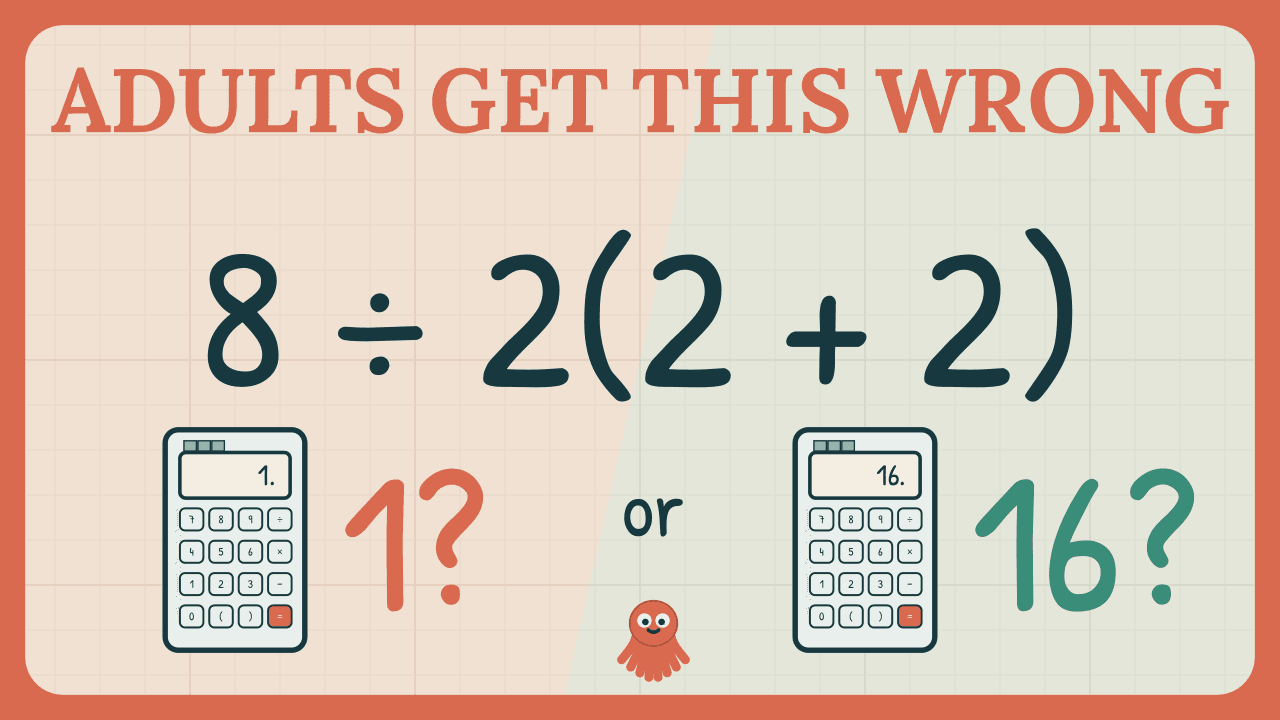
is the calculation the internet cannot agree on. By the order of operations taught today the answer is 16 — division and multiplication share a rung of the ladder and run left to right. The genuinely interesting part is why so many people reach a different answer, and what that says about writing maths clearly.
The question everyone argues about
Worked example
Settle it: 8 ÷ 2(2 + 2)
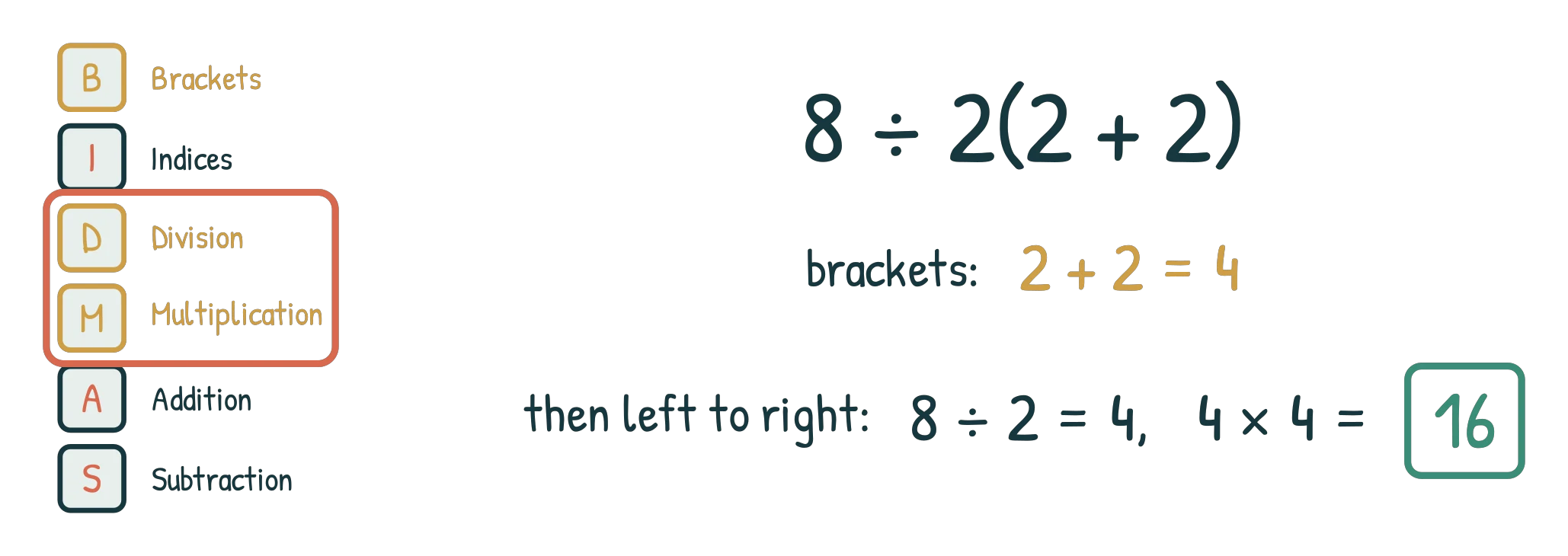
Brackets first: , so the expression becomes — because just means .
Now we have a division and a multiplication. They're equal priority, so work left to right, like reading a sentence:
In UK schools — and in every exam you'll ever sit — the answer is 16.
So why do some people say 1?
They read as one glued-together object — as if the 2 belongs to the brackets — and work it out first: . That gluing has a proper name, multiplication by juxtaposition, and the people who use it aren't making it up: around a hundred years ago many textbooks really did teach "do all the multiplications first, then divide", and some calculators (and even physics journals) still bind tighter than today. That's why two different calculators can give two different answers to the same buttons.
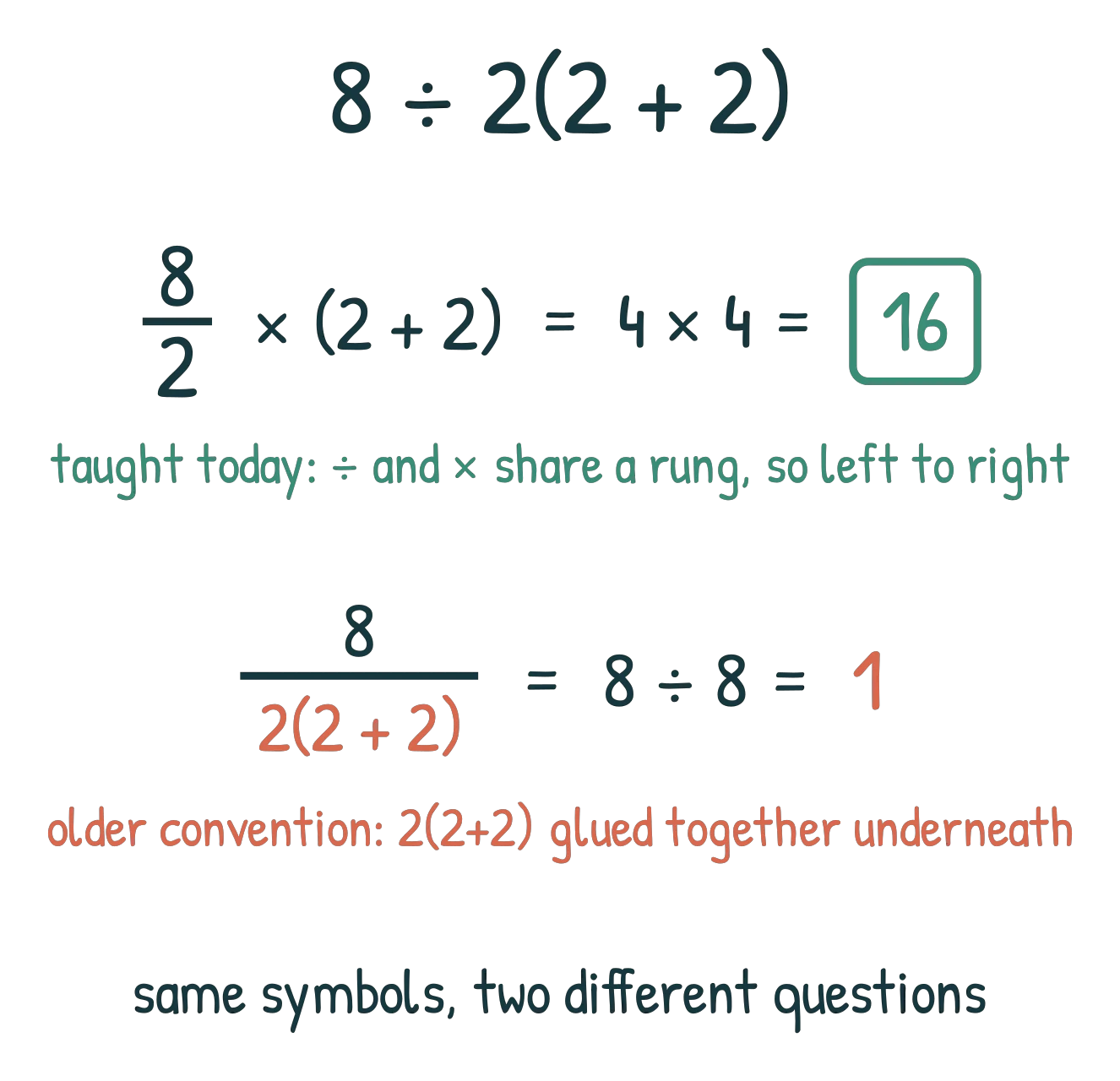
But the modern convention used in UK schools and exams is settled: equal priority, left to right — 16.
More trick questions
Worked example
Same trap: 6 ÷ 2(1 + 2)
Brackets first: . Then left to right:
If you got 1, you glued the 2 to the brackets — that's the old convention, not the exam one.
Worked example
The PhD who said 5! — work out 230 − 220 ÷ 2
This one comes with a famous caption: "I say 120 — my maths PhD friend says 5!"
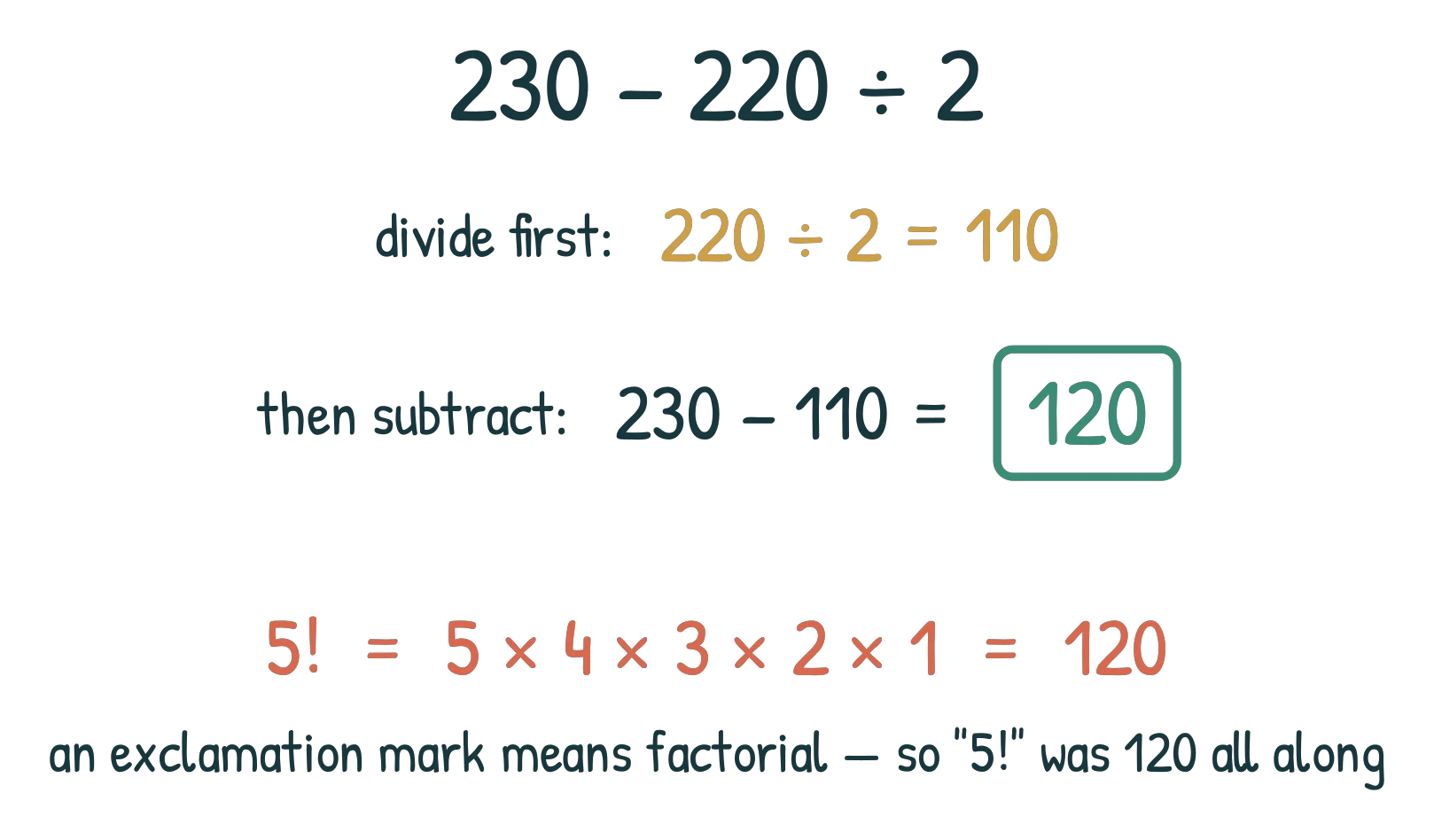
No brackets, no indices, so division before subtraction: , then .
So was the PhD wrong? Look closely: they said "5**!**" — and in maths an exclamation mark means factorial. . The PhD was right all along. Sneaky.
Practice questions
Try these yourself, then click to check each answer. Remember: brackets, indices, then divide/multiply left to right, then add/subtract left to right.
1.Work out 12 ÷ 3(2)Show answerHide answer
Left to right: , then . (If you got 2, you glued the 3 to the bracket.)
2.Work out 10 − 4 + 2Show answerHide answer
Left to right: , then — not 4! Addition and subtraction are equal priority too.
3.Work out 18 ÷ 3 + 3 × 2Show answerHide answer
Divide and multiply first: .
4.Work out 5 + 3 × 4, then (5 + 3) × 4Show answerHide answer
Multiply first: . With the brackets: — brackets change everything, which is exactly why we use them.
5.Work out 2 + 3²Show answerHide answer
Indices before adding: .
6.Work out 230 − 220 ÷ 2Show answerHide answer
Division first: . (And too, if a PhD tries to trick you.)
7.A student types 8 ÷ 2(2+2) into two calculators and gets two different answers. How should they type it to get 16 on every calculator?Show answerHide answer
Add the brackets that say what you mean: . Ambiguity is the calculator's problem only if you let it be.
Practise this skill
A free printable worksheet with 16 questions and a full worked answer key. No sign-up needed.
Get the Number Properties Test Paper with Mark Scheme free
Ready to test the whole topic? Your first paper is on us — exam-style questions with a full plain-English mark scheme. See what’s in it.
More number properties lessons
- How to Find Factors and Multiples | KS3 Maths
- What Is a Prime Number? | KS3 Maths
- Square and Cube Roots | KS3 Maths
- Multiplying and Dividing Negative Numbers | KS3 Maths
- Square and Cube Numbers | KS3 Maths
- Adding and Subtracting Negative Numbers | KS3 Maths
- How to Use BIDMAS — Order of Operations | KS3 Maths