Simplifying Ratios (No Calculator) — KS3 Maths
Simplify ratios by dividing every part by the highest common factor, including ratios with different units. Free KS3 lesson and worksheet.
Divide every part of the ratio by the highest common factor, and keep going until nothing divides them all. 6 : 9 becomes 2 : 3.
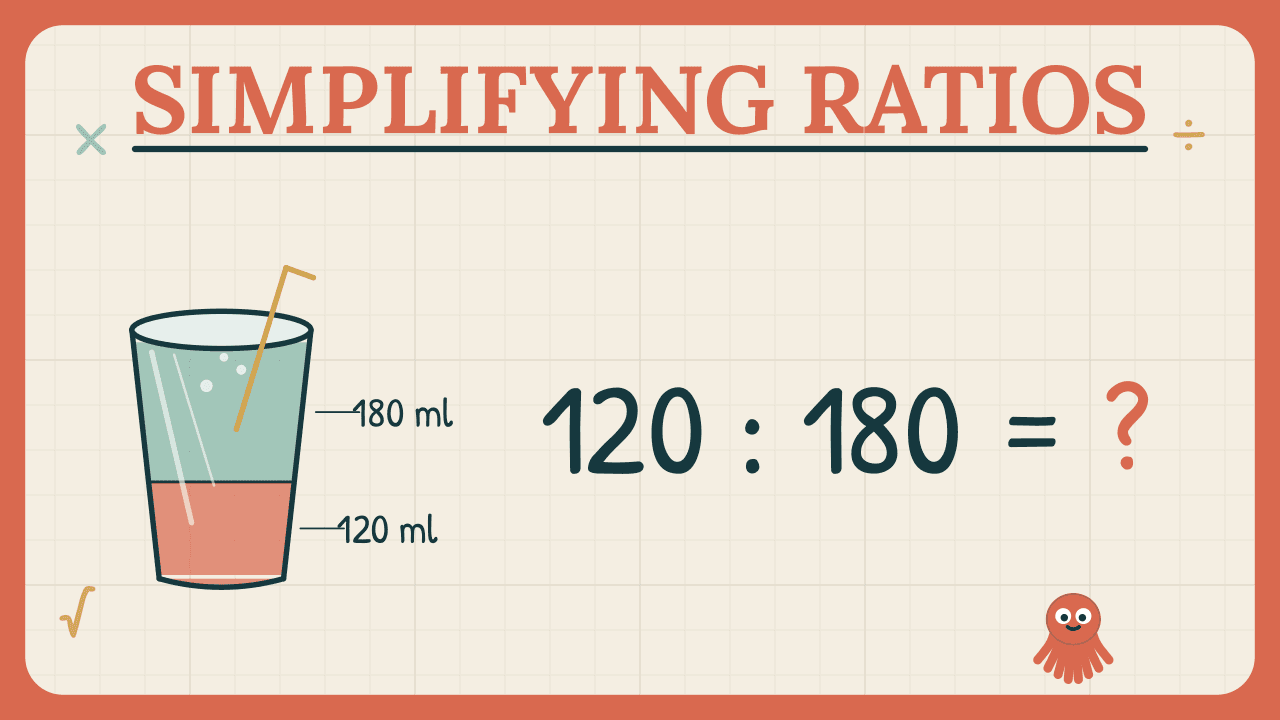
A ratio compares two amounts, and simplifying it means dividing every part by the same number until nothing divides them all. It's the same highest-common-factor move as simplifying fractions, applied to both sides at once — and the value of the comparison never changes, only the numbers get smaller.
What actually is a ratio?
A ratio tells you how many of one thing there are compared to another thing. If a pond has 6 frogs and 9 lizards, the ratio of frogs to lizards is 6 : 9.
Order matters. "Frogs to lizards" means the frog number comes first — write the ratio in words first (frogs : lizards), then swap in the numbers in the same order.
Worked example
Simplify 6 : 9 (frogs to lizards)
A pond has 6 frogs and 9 lizards, so the ratio of frogs to lizards is .
That's correct, but we can say it more simply. We need a number that divides into both 6 and 9 — the highest common factor of 6 and 9 is 3.
Divide both parts by 3: and .
So in its simplest form, the ratio of frogs to lizards is .
You can see it in the pond: circle groups of three, and the frogs make 2 groups while the lizards make 3. For every 2 frogs there are 3 lizards — the same proportion, just smaller numbers.

Worked example
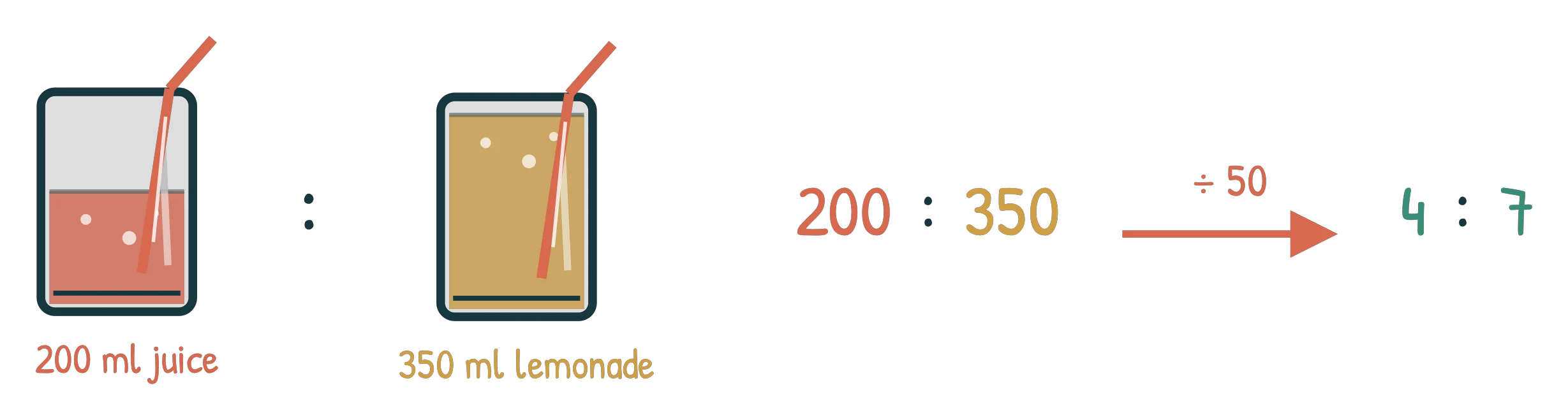
Simplify 200 : 350 (a fruit punch recipe)
A fruit punch mixes 200 ml of juice with 350 ml of lemonade, so the ratio of juice to lemonade is .
The highest common factor of 200 and 350 is 50.
Divide each part by 50: and .
So juice to lemonade in its simplest form is .
What if the units are different?
A ratio only makes sense when both parts are measured in the same unit — you can't compare centimetres with metres directly. So convert to the same unit first (usually the smaller one), then simplify as normal. The final ratio has no units at all.
Worked example
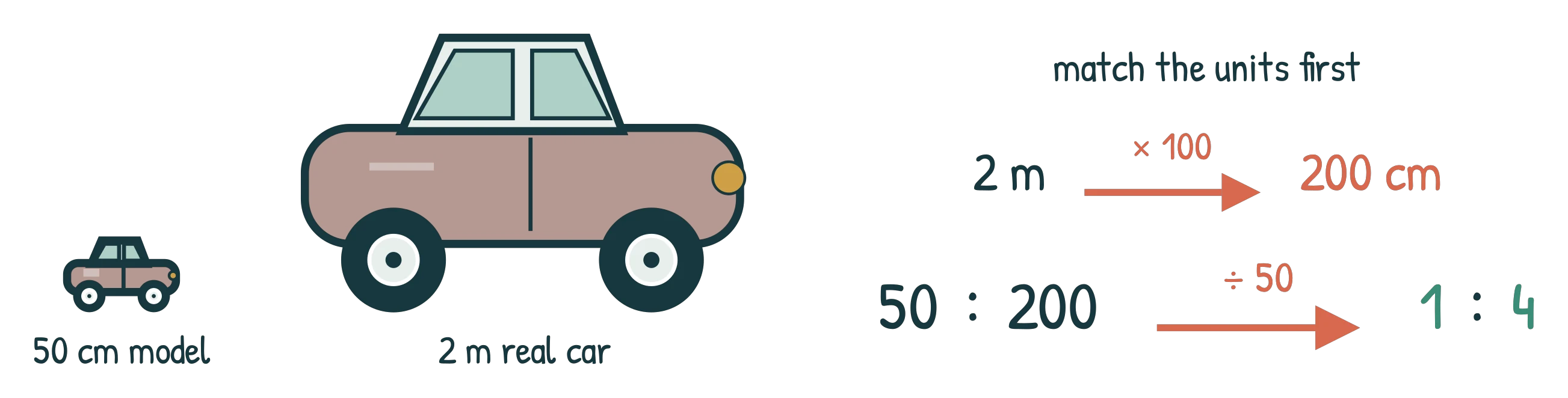
Different units: a 50 cm model of a 2 m car
A model car is 50 cm long and the real car is 2 m long. What is the ratio of the model to the real car?
Step 1 — make the units the same: m cm, so the ratio is .
Step 2 — divide by the highest common factor, which is 50: and .
So the ratio of model to real car is — the real car is exactly 4 times the length of the model.
Where you'll use this next
-
Sharing in a ratio is far easier when the ratio is simplified first.
-
Scale drawings and maps are ratios in simplest form, like 1 : 25000.
-
Simplifying fractions uses the identical highest-common-factor step.
-
Direct proportion takes dividing-both-sides to its conclusion — divide all the way down to one, and you can scale to any amount, which is how best-buy questions are answered.
Practice questions
Try these yourself, then click to check each answer. Remember: same units first, then divide every part by the highest common factor.
1.Simplify 8 : 12.Show answerHide answer
The highest common factor of 8 and 12 is 4.
and , so .
2.Simplify 15 : 35.Show answerHide answer
The highest common factor of 15 and 35 is 5.
and , so .
3.Simplify 27 : 36.Show answerHide answer
The highest common factor of 27 and 36 is 9.
and , so .
(If you divided by 3 first and got , that's fine — just keep going: 3 divides again, giving .)
4.A car park has 14 red cars and 21 silver cars. Write the ratio red : silver in its simplest form.Show answerHide answer
Red first, because it's named first: .
The highest common factor of 14 and 21 is 7, so and .
Red : silver .
5.Simplify 6 : 9 : 12.Show answerHide answer
The same rule works for three parts — find the highest common factor of all of them, which is 3.
, , , so .
6.Simplify 20 minutes : 1 hour.Show answerHide answer
Make the units the same first: 1 hour minutes, so the ratio is .
The highest common factor is 20: and .
So 20 minutes : 1 hour — no units in the final answer.
7.Spot the mistake: a student simplifies 16 : 24 by dividing by 2 and writes 8 : 12 as their final answer. What went wrong, and what is the correct answer?Show answerHide answer
Dividing by 2 is a correct step, but isn't fully simplified — 4 still divides into both parts. The student stopped too soon.
The highest common factor of 16 and 24 is 8: and .
So in its simplest form.
Practise this skill
A free printable worksheet with 16 questions and a full worked answer key. No sign-up needed.
Get the Ratio & Proportion Test Paper with Mark Scheme free
Ready to test the whole topic? Your first paper is on us — exam-style questions with a full plain-English mark scheme. See what’s in it.