Sharing in a Ratio (No Calculator) — KS3 Maths
Share an amount in a ratio: add the parts, divide the total, multiply up each share, plus the classic mistake to avoid. Free KS3 lesson.
Add the parts of the ratio, divide the total by that to get one part, then multiply up each share. £20 in 2 : 3 gives £8 and £12.
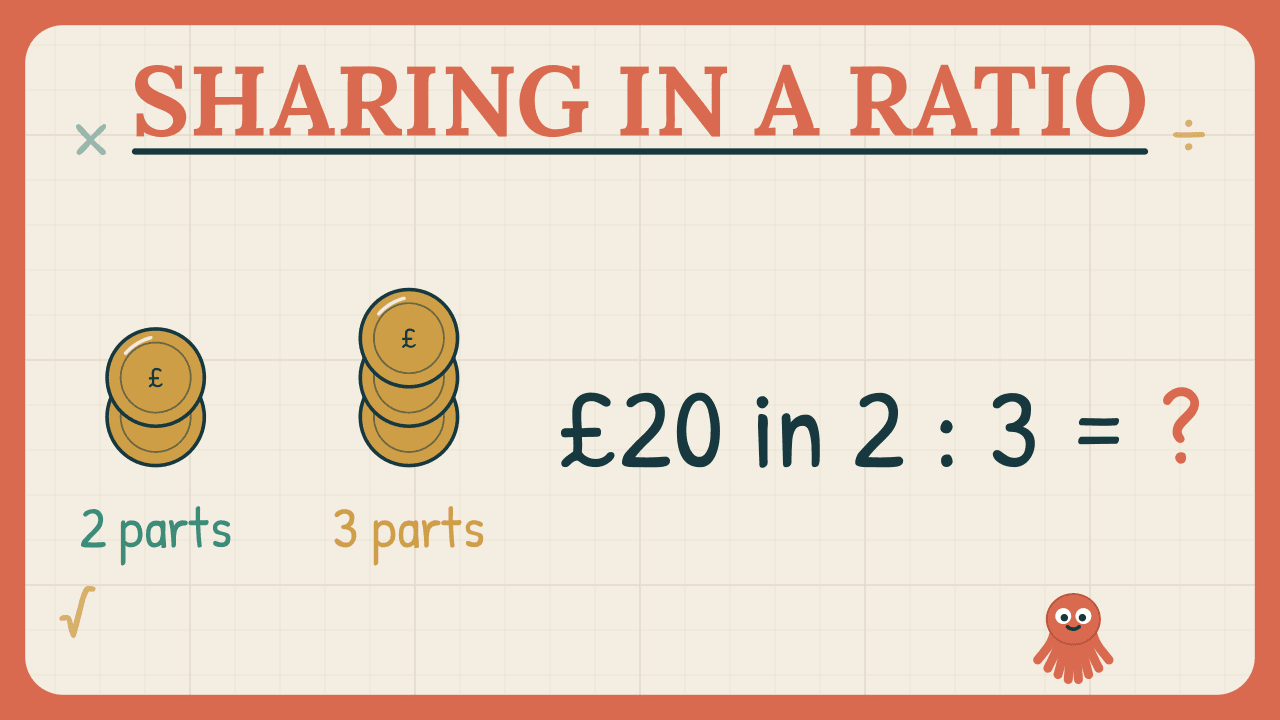
Sharing in a ratio is three steps, always the same three. Add the parts to find how many shares there are altogether, divide the total by that to find what one part is worth, then multiply up to get each person's share. It works for two-way splits, three-way splits and any total you're given.
What does a ratio like 2 : 3 actually mean?
If Mia and Ben share money in the ratio 2 : 3, the money is split into parts — 2 parts for Mia and 3 parts for Ben, so 5 equal parts altogether. The ratio numbers are not the amounts themselves; they just tell you how many parts each person gets.
Order matters too. If the question says "Mia and Ben in the ratio 2 : 3", Mia is named first, so the first number belongs to her.
Worked example
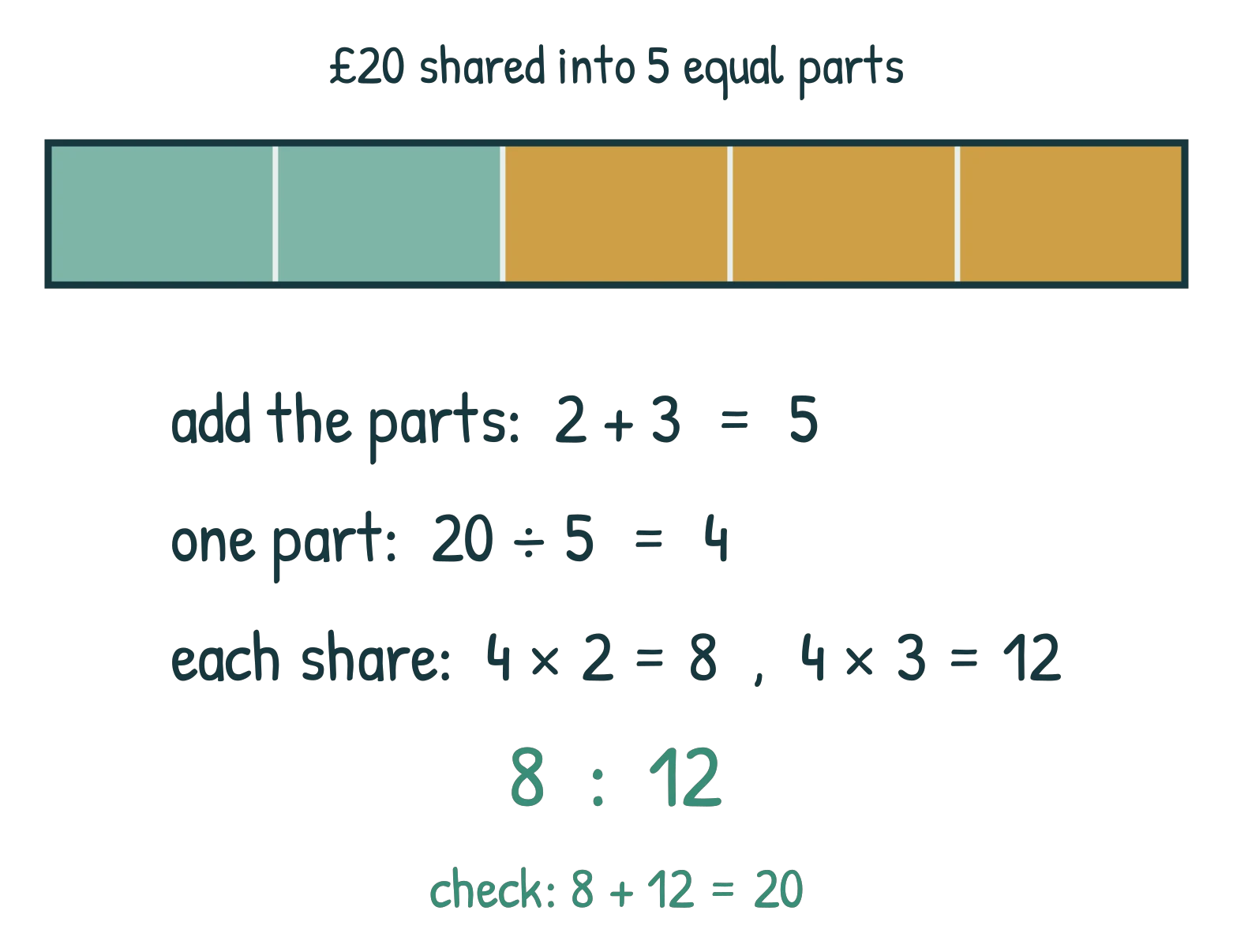
Share £20 in the ratio 2 : 3
Mia and Ben wash cars together. Mia worked two hours and Ben worked three, so they share their £20 earnings in the ratio 2 : 3.
Step 1 — add the parts: parts altogether.
Step 2 — divide the total: , so each part is worth £4.
Step 3 — multiply up each share:
- Mia has 2 parts:
- Ben has 3 parts:
Check: ✓ — exactly what they started with.
Worked example
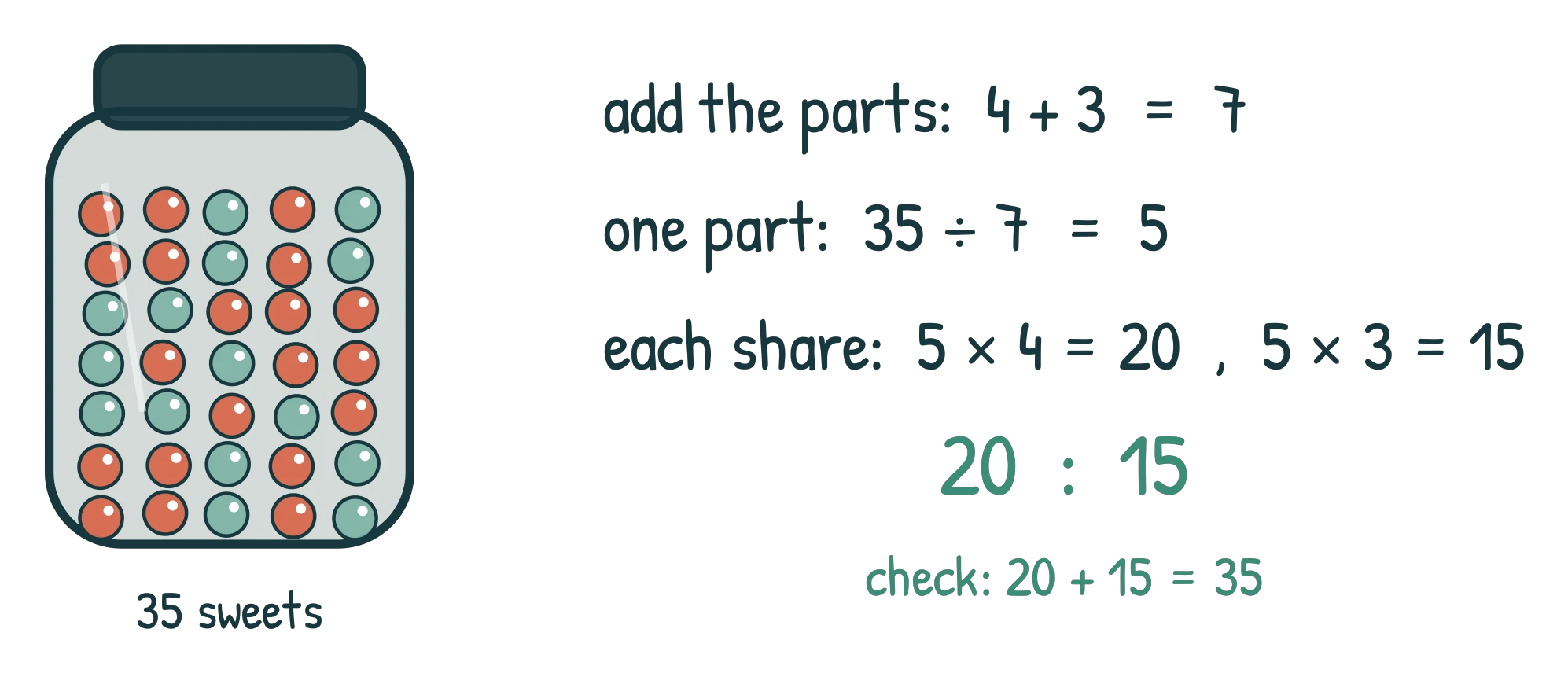
Share 35 sweets in the ratio 4 : 3
Asha and Tom share a jar of 35 sweets in the ratio 4 : 3. It's the same three steps — ratios aren't just for money.
Step 1 — add the parts: parts.
Step 2 — divide the total: sweets per part.
Step 3 — multiply up:
- Asha: sweets
- Tom: sweets
Check: ✓ — all the sweets are shared.
Sharing between three people
The golden rule doesn't change when a third person joins — you just add all the parts in step 1. It works for any number of people.
Worked example
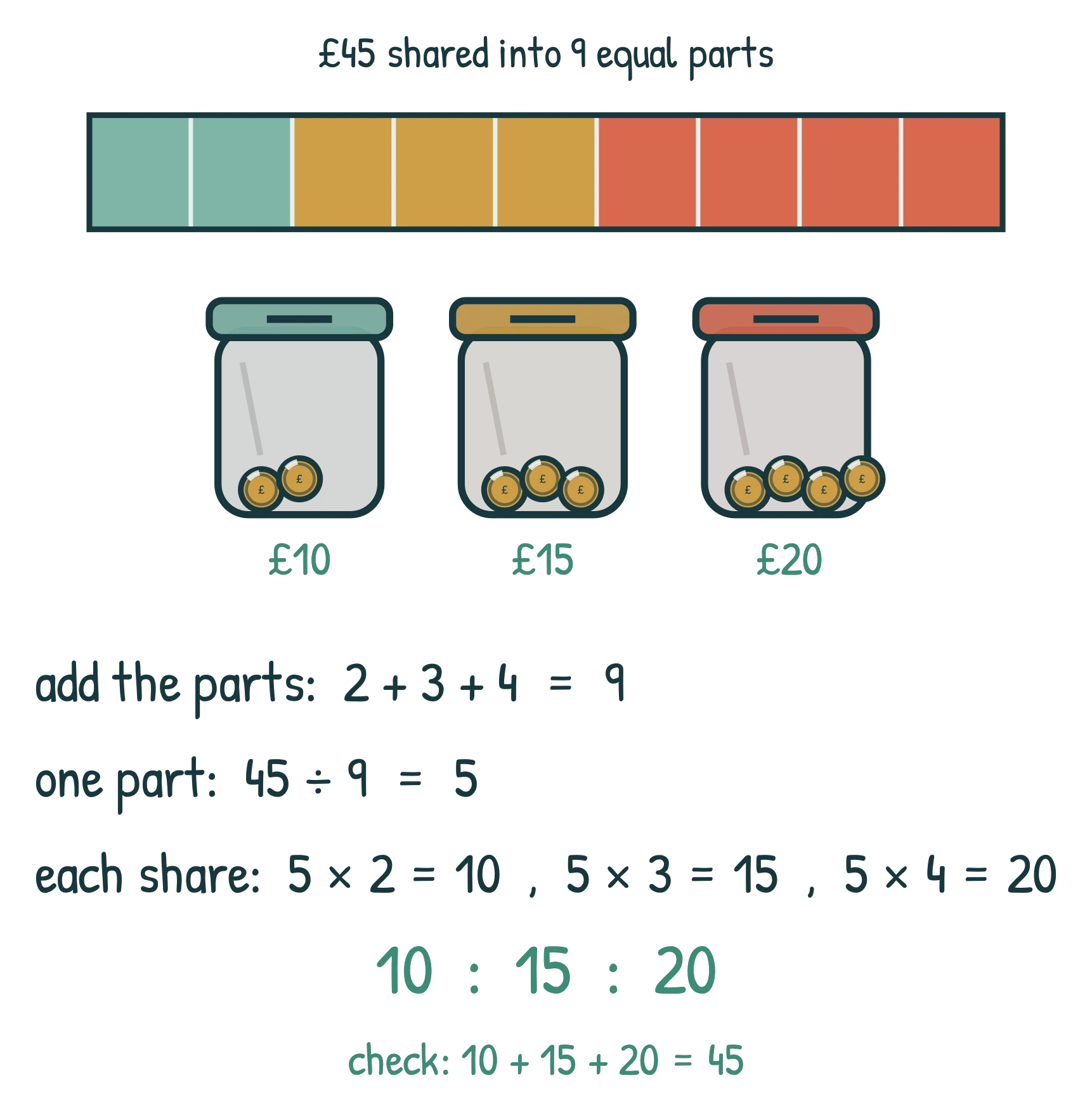
Three-way share: £45 in the ratio 2 : 3 : 4
Jo, Raj and Zara share £45 in the ratio 2 : 3 : 4.
Step 1 — add all the parts: parts.
Step 2 — divide the total: per part.
Step 3 — multiply up each share:
- Jo:
- Raj:
- Zara:
Check: ✓
Where you'll use this next
-
Simplifying ratios often comes first, to make the parts easier to add.
-
Recipes and scaling share ingredients in a fixed ratio.
-
Fractions of an amount is the same divide-then-multiply move — each share is a fraction of the total.
-
Direct proportion runs the same move through a single unit: divide to find what ONE costs, then multiply up to any amount.
Practice questions
Try these yourself, then click to check each answer. Every solution uses the same three steps: add the parts, divide the total, multiply up.
1.Share £18 between Amy and Sam in the ratio 1 : 2.Show answerHide answer
Add the parts: . Divide the total: per part.
Amy gets and Sam gets .
Check: ✓
2.Share £35 in the ratio 2 : 5.Show answerHide answer
Add the parts: . Divide the total: per part.
The shares are and .
Check: ✓
3.Share 48 sweets between Leo and Nina in the ratio 3 : 5.Show answerHide answer
Add the parts: . Divide the total: sweets per part.
Leo gets sweets and Nina gets sweets.
Check: ✓
4.Share £27 in the ratio 4 : 5.Show answerHide answer
Add the parts: . Divide the total: per part.
The shares are and .
Check: ✓
5.Share £48 between three friends in the ratio 1 : 2 : 3.Show answerHide answer
Add all the parts: . Divide the total: per part.
The shares are , and .
Check: ✓
6.Share £70 in the ratio 2 : 3 : 2.Show answerHide answer
Add all the parts: . Divide the total: per part.
The shares are , and .
Check: ✓ — two people can get the same share; that's fine.
7.Spot the mistake: a student shares £30 in the ratio 2 : 3 and gets £15 and £10. What went wrong, and what are the correct shares?Show answerHide answer
The student divided £30 by each ratio number ( and ) — the classic mistake. A quick check exposes it: , not £30.
Correctly: add the parts (), divide the total ( per part), multiply up: and .
Check: ✓
Practise this skill
A free printable worksheet with 16 questions and a full worked answer key. No sign-up needed.
Get the Ratio & Proportion Test Paper with Mark Scheme free
Ready to test the whole topic? Your first paper is on us — exam-style questions with a full plain-English mark scheme. See what’s in it.