How to Add & Subtract Fractions — KS3 Maths
Add and subtract fractions with different denominators: make the pieces the same size, then just count them. Free KS3 lesson and worksheet.
Make the bottoms match, then add or subtract the tops only. For 1/2 + 1/3, rewrite both over 6: 3/6 + 2/6 = 5/6.
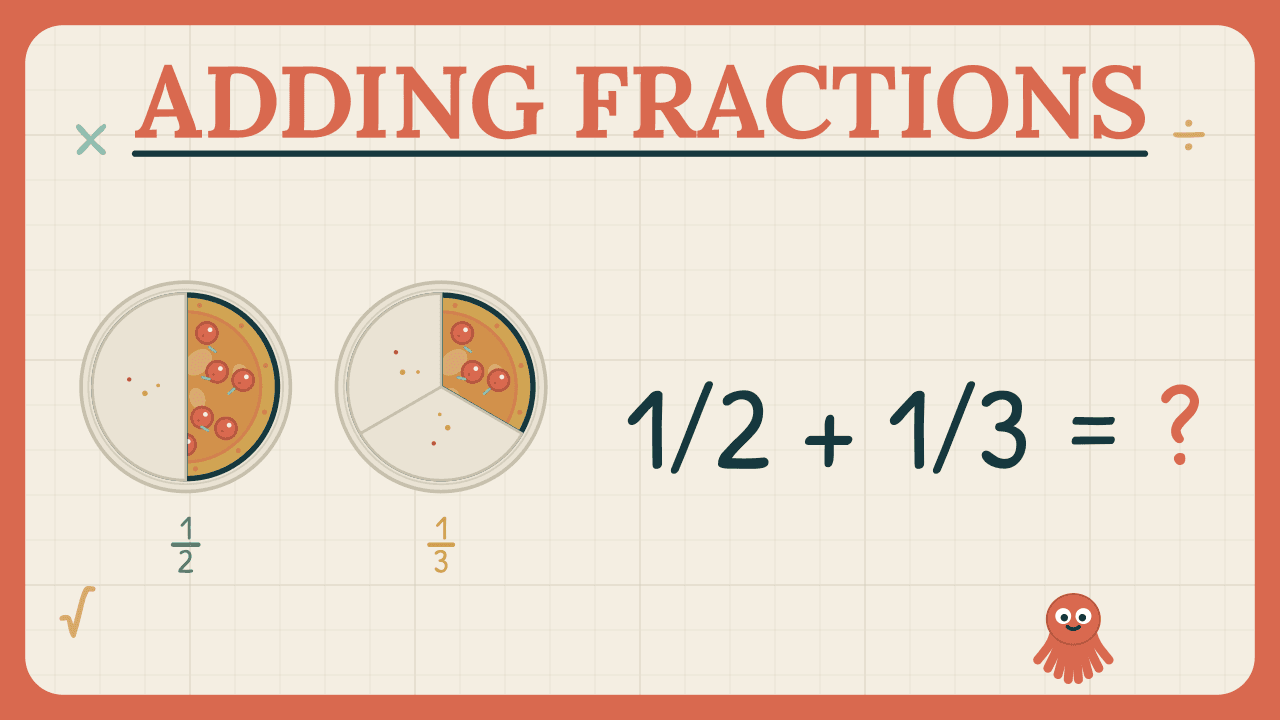
You can only add things that are the same size. Halves and thirds are different-sized pieces, so before you can combine them you rewrite both as the same kind of piece — sixths. Once the bottoms match, the tops just count up, because you're adding pieces of one size. Making the bottoms match is the whole job.
Why do the bottoms need to match?
Worked example
Leftover pizza: what is 1/2 + 1/3?
Friday night's pizza box has half a pizza left. Saturday's box has a third of a pizza left. How much pizza is that altogether?
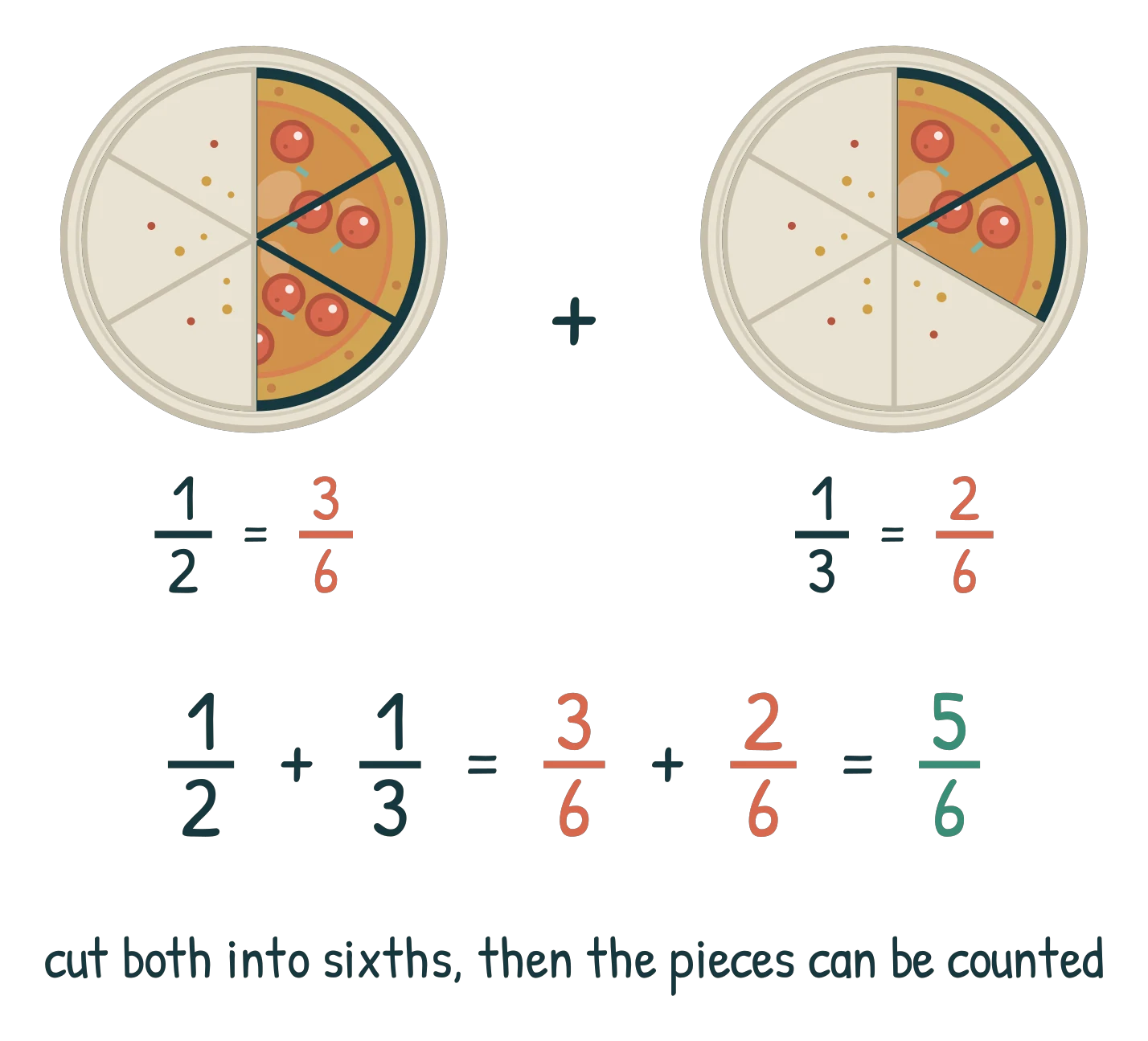
Can we just count the slices? One big slice and one smaller slice — two slices? Two what? The pieces are different sizes, so counting tells us nothing. So here's the move: cut both pizzas into sixths — sixths work because 2 and 3 both go into 6.
The half becomes , and the third becomes . Now every piece is the same size, so just count them:
Slide all five slices into one box and they fill five sixths of a pizza — one slice short of a whole. That's the whole secret: same-size pieces (a common denominator), then count the tops.
Worked example
Gran's veg patch: 2/3 + 1/4 with the multiples method
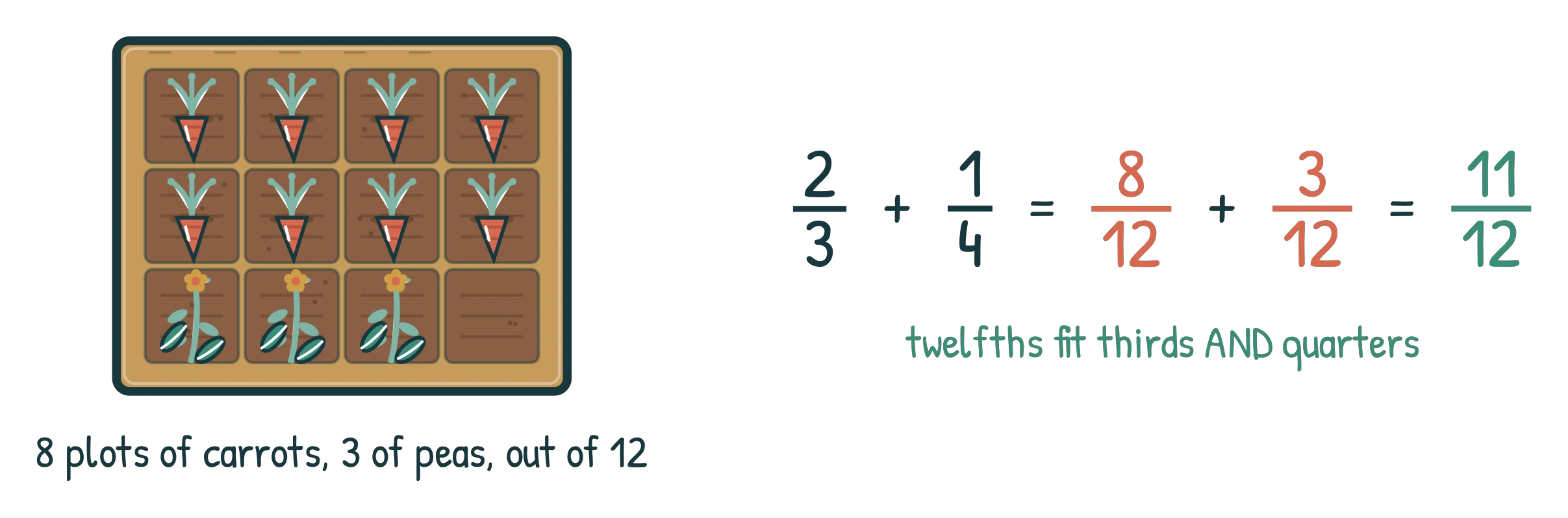
Gran's vegetable patch has 12 equal plots. She plants two thirds of the patch with carrots and a quarter of it with peas. How much of the patch is planted?
Thirds and quarters — neither bottom divides the other, so list the multiples:
- multiples of 3: 3, 6, 9, 12
- multiples of 4: 4, 8, 12
12 is in both lists — that's the common denominator. Rewrite both fractions (whatever you do to the bottom, do to the top):
The bottoms match, so add the tops: .
On the patch that's 8 plots of carrots plus 3 of peas — 11 of the 12 plots planted, and just one plot of bare soil left.
Worked example
Subtracting: 5/6 − 1/3 (and simplifying to finish)
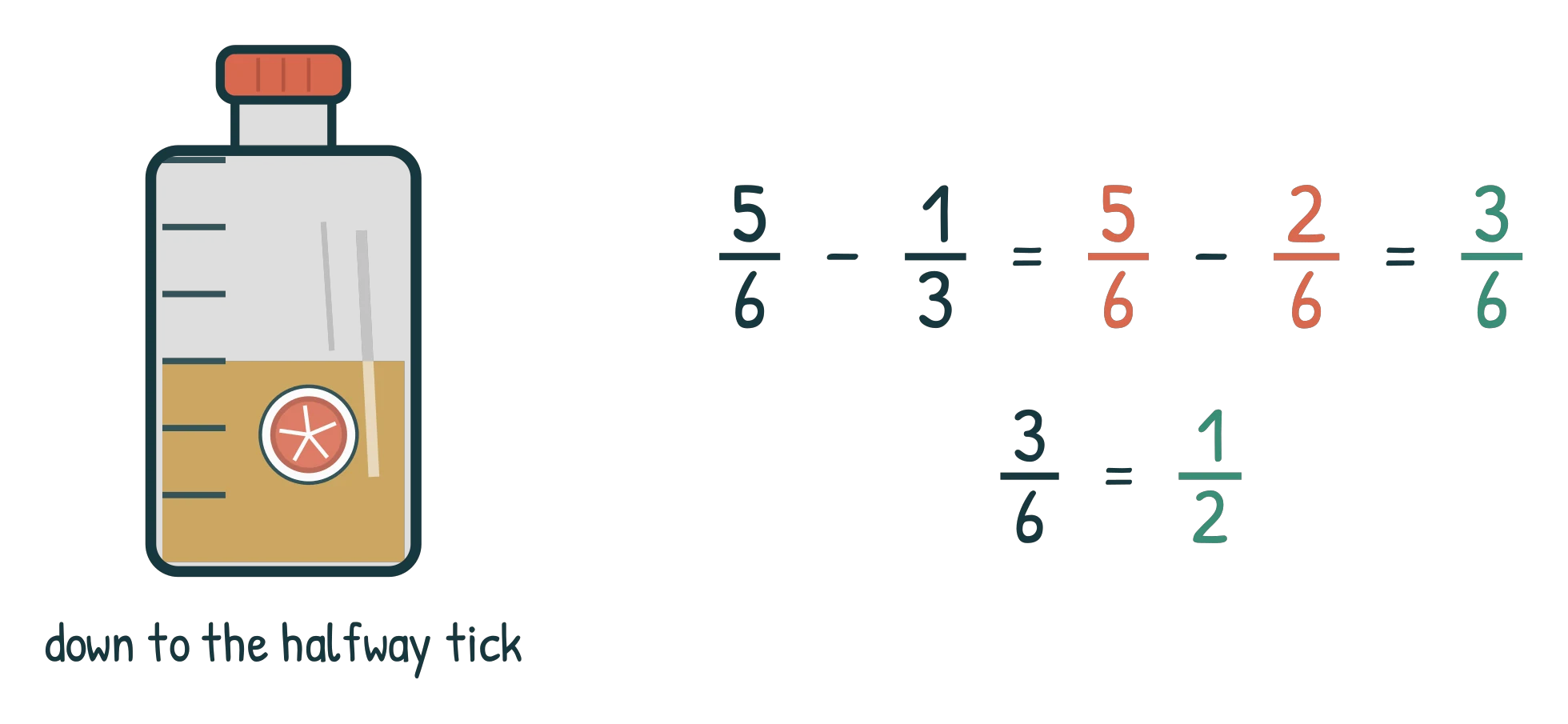
A bottle of juice is full. Amir drinks of the bottle. How much juice is left?
Here 3 goes into 6, so only one fraction needs rewriting: . Now subtract the tops:
Not finished! 3 and 6 share a factor of 3, so simplify: . Exactly half the bottle is left — and on the bottle's scale, the juice sits exactly on the halfway mark.
Where you'll use this next
- Converting improper fractions and mixed numbers — adding often gives a top-heavy answer that needs rewriting.
- Simplifying fractions is the final step on nearly every answer here.
- Algebraic fractions later on use exactly this common-denominator method with letters instead of numbers.
Practice questions
Try these yourself, then click to check each answer. Every solution makes the bottoms match first, then adds or subtracts the tops — and simplifies at the end.
1.Work out 1/3 + 1/6Show answerHide answer
6 is the common denominator: , so .
2.Work out 1/4 + 3/8Show answerHide answer
8 works: , so .
3.Work out 2/3 − 1/2Show answerHide answer
Multiples of 3: 3, 6. Multiples of 2: 2, 4, 6. So and : .
4.Work out 4/5 − 1/2Show answerHide answer
10 is the common denominator: and : .
5.Work out 1/6 + 3/4Show answerHide answer
Multiples of 6: 6, 12. Multiples of 4: 4, 8, 12. So and : .
6.Spot the mistake: a student writes 1/4 + 2/5 = 3/9. What went wrong, and what's the real answer?Show answerHide answer
They added straight across — tops AND bottoms. ( is only a third, which is less than the they started with!)
Correctly, 20 is the common denominator: and , so the answer is .
7.Sam pours 1/4 of a litre of squash, then tops it up with another 2/5 of a litre of water. How much drink is that altogether?Show answerHide answer
20 is the common denominator: of a litre.
Practise this skill
A free printable worksheet with 16 questions and a full worked answer key. No sign-up needed.
Get the Fractions Test Paper with Mark Scheme free
Ready to test the whole topic? Your first paper is on us — exam-style questions with a full plain-English mark scheme. See what’s in it.