Percentage Increase & Decrease (No Calculator) — KS3 Maths
Percentage increase and decrease: find the percentage, then add it on or take it off. Sale-price examples, no calculator. Free KS3 lesson.
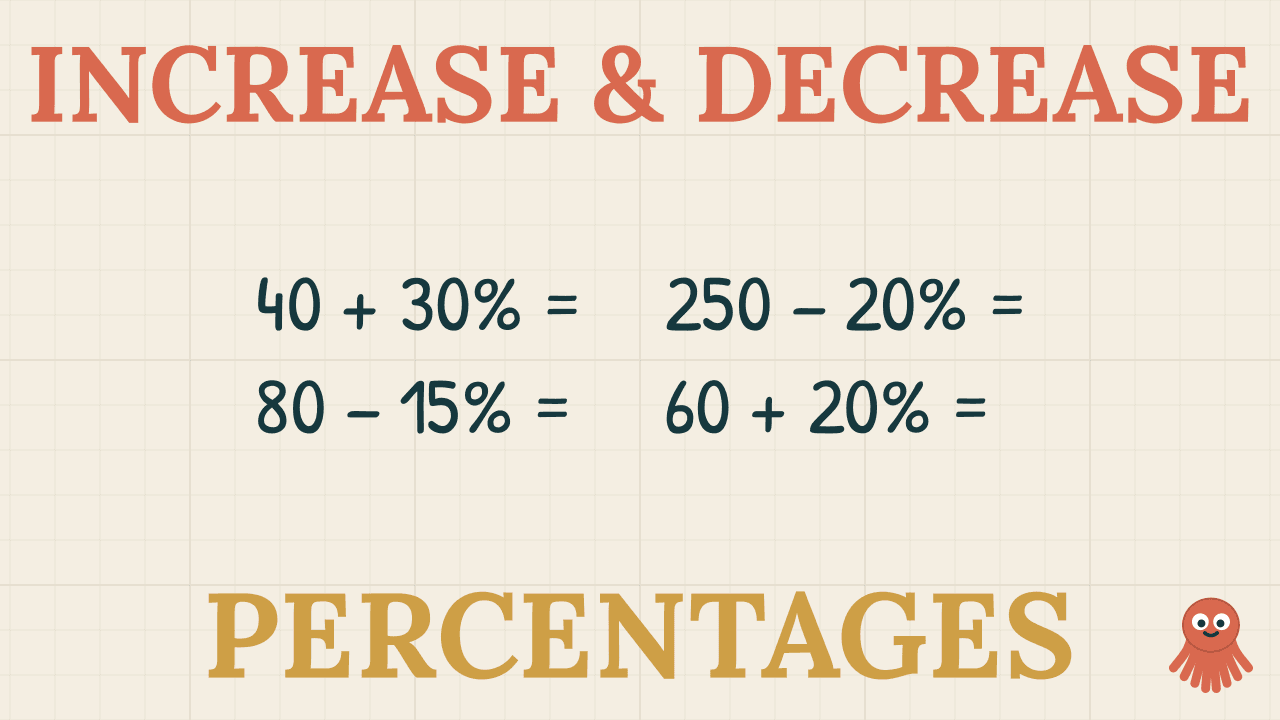
Find the percentage of the amount, then add it on to increase or take it off to decrease. 20% off £250 is £250 − £50 = £200.
A phone with off; a salary that goes up . Both are two steps: find the percentage, then add it on or take it off. The finding is exactly the 10%-block method from the previous lesson, so the only new thing here is the second step — and remembering that the answer is the new amount, not the change.
How do you increase or decrease by a percentage?
Worked example
Increase 40 by 30%
First find of : 10% is , so 30% is . Now add it on:
A 30% increase leaves you with of the original — which is exactly .
Worked example
20% off £250 (the sale price)
Find of : 10% is , so 20% is . For a decrease, take it off:
You pay £200 (that's of the original) and you save £50.
Worked example
Increase 60 by 15%
Find of : 10% is , 5% is , so 15% is . Add it on:
Going further
There's a one-step shortcut called a multiplier. A 30% increase leaves you with 130% of the original, so you can multiply by in one go. A 20% decrease leaves 80%, so multiply by . It's faster with a calculator and it's how the same problems get solved later on — but the two-step method is the one that works in your head, so learn it first.
Increases and decreases don't cancel. Put a price up 10% and then take 10% off, and you don't get back to where you started: £100 becomes £110, and 10% off that is £99. Each percentage is taken from a different amount.
Where you'll use this next
- Reverse percentages take the answer to one of these and work backwards to the original.
- Sales, tips, VAT and pay rises are the everyday version of this exact calculation.
- Simple interest repeats a percentage increase year after year.
Practice questions
Find the percentage first, then add it on or take it off. Then click to check.
1.Increase 80 by 10%Show answerHide answer
10% of 80 is 8: .
2.Decrease 200 by 30%Show answerHide answer
30% of 200 is 60: .
3.A £40 game has 25% off. What do you pay?Show answerHide answer
25% of 40 is £10: .
4.Increase 150 by 20%Show answerHide answer
20% of 150 is 30: .
5.A £30 ticket price rises by 15%. What's the new price?Show answerHide answer
15% of 30 is : .
6.A coat is £90 with 40% off. How much do you pay, and how much do you save?Show answerHide answer
40% of 90 is £36. You pay and save £36.
Practise this skill
A free printable worksheet with 16 questions and a full worked answer key. No sign-up needed.
Get the Percentages Test Paper with Mark Scheme free
Ready to test the whole topic? Your first paper is on us — exam-style questions with a full plain-English mark scheme. See what’s in it.