What Is a Prime Number? | KS3 Maths
A prime number has exactly two factors, 1 and itself. How to tell whether a number is prime, and how far you actually have to test.
A prime number has exactly two factors: 1 and itself. 7 is prime because nothing divides into it except 1 and 7. 12 is not, because 2, 3, 4 and 6 all do.
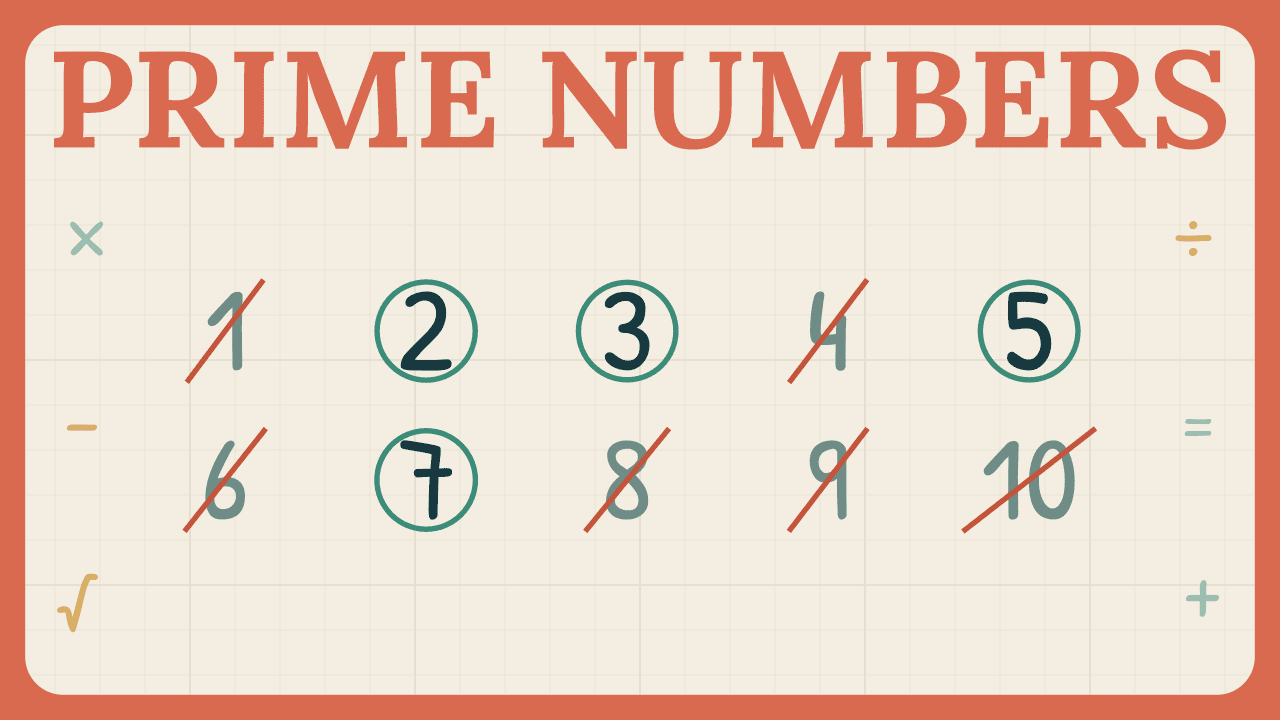
A prime number has exactly two factors: 1 and itself. The picture that makes it stick comes from factors and multiples: build rectangles out of tiles, and a prime is the number that can only manage one — a single row. Everything else can be folded into a block.
What is a prime number?
A prime number is a whole number greater than 1 whose only factors are 1 and itself.
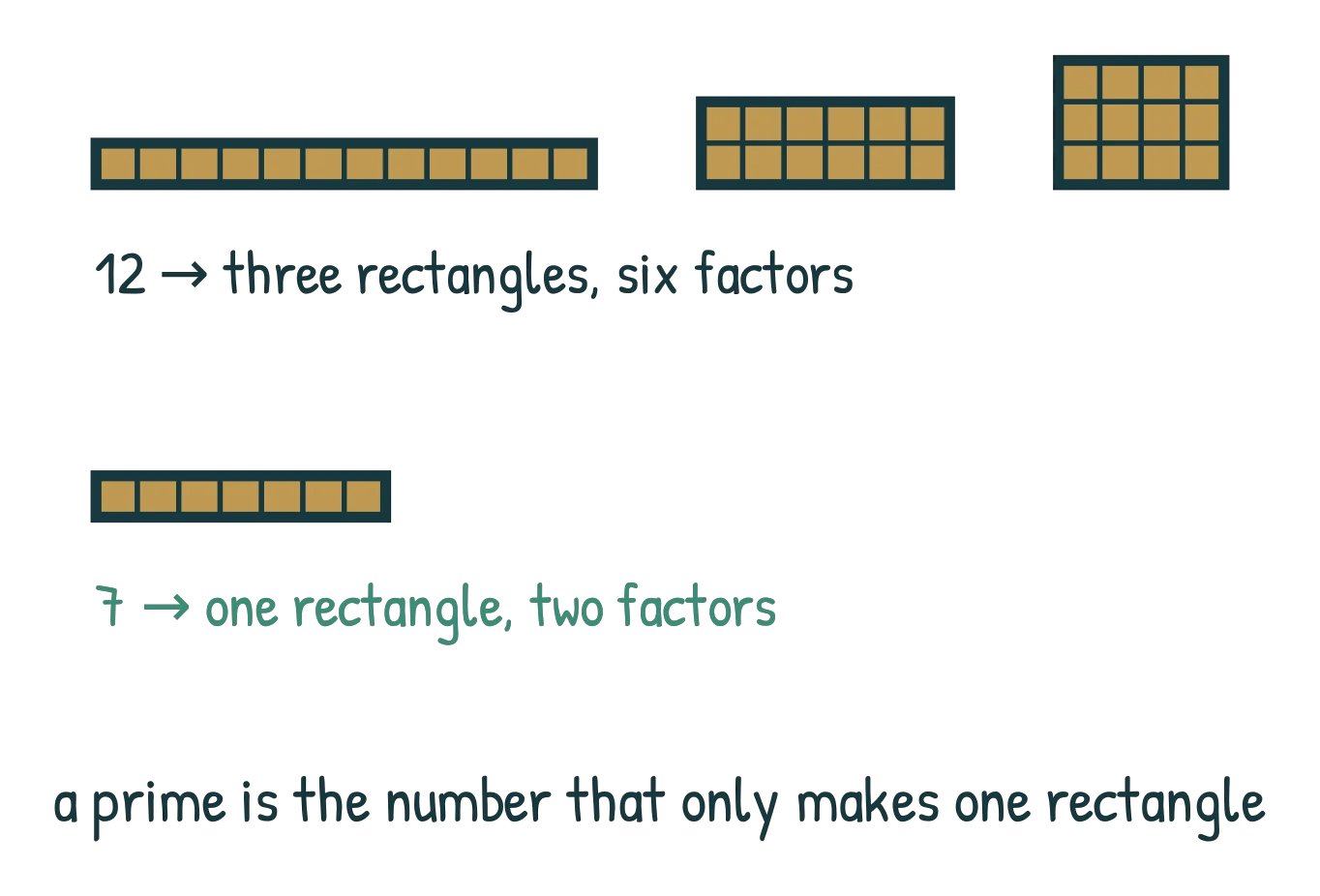
The definition is easy to recite and hard to picture, so start with the picture. Take 12 tiles: you can lay them out as 1 row of 12, 2 rows of 6, or 3 rows of 4. Three different rectangles, six factors. Now take 7 tiles and try the same thing. Two rows leaves one tile over. Three rows leaves one over. The only arrangement that works is a single row of 7, so the only factors are 1 and 7 — and that is what makes 7 prime.
How do you find all the primes up to 30?
You don't test them one at a time. You knock out the ones that can't possibly be prime, and see what survives — a method called a sieve.
Worked example
Find every prime number up to 30
Write the numbers 1 to 30 out, ten to a row, so it reads like a number line folded into three.
Start at 2. 1 is not prime — it has only one factor — so it goes straight away.
2 is prime. But every even number after it has 2 as a factor, so 4, 6, 8, 10 and the rest of that column all go.
3 is prime. Cross out its multiples too: 9, 15, 21 and 27 (6, 12, 18, 24 and 30 have already gone).
5 is prime. Its multiples have nearly all gone already — only 25 is left to cross out.
Now look at 7. Its first multiples — 14, 21, 28 — are all crossed off already, because they sit in the 2 and 3 times tables. The first number 7 could still catch is , which is off the end of the grid.
So nothing left standing has a factor at all, and we can stop.
Ten primes below 30.
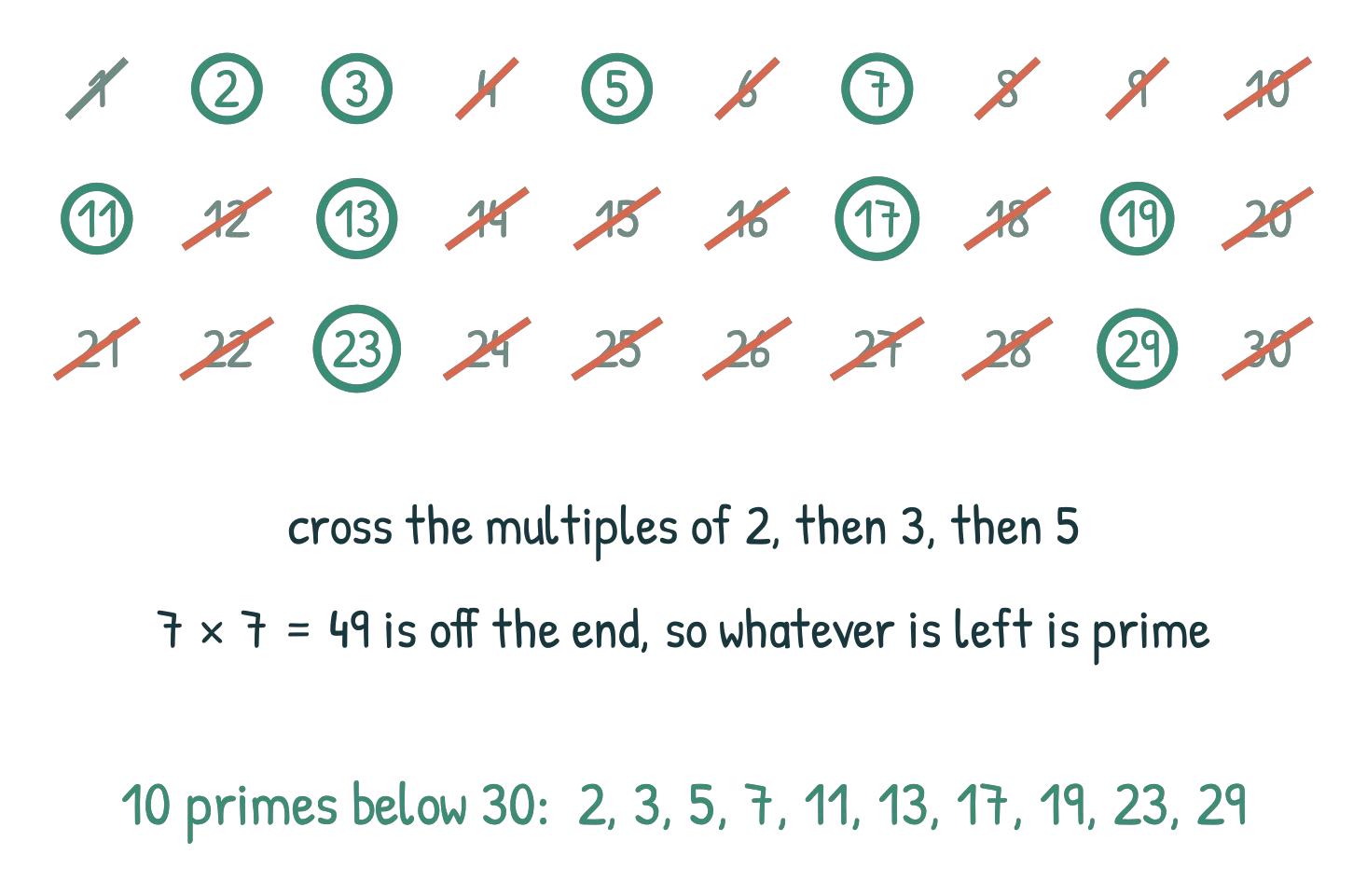
Notice why it stopped where it did. Once you have crossed out the multiples of every prime up to 5, the next prime is 7 — and is already past 30. That is the same stopping rule the next example uses on a much bigger number.
How do you check if a number is prime?
Hunt for a factor pair. If you find one that isn't the number itself, it is not prime. This is where numbers that look prime get caught.
Worked example
Is 51 a prime number?
Try each small number in turn and see whether it divides in exactly.
Does 2 go in? 51 is odd, so no — it cannot split into two equal rows.
Does 3 go in? Yes: .
That is a rectangle — 3 rows of 17 — so it is a factor pair, and 51 has more factors than just 1 and itself.
Four factors, so 51 is not prime. It is composite.
A quick check for 3: add the digits. , and 6 is in the 3 times table, so 3 divides into 51.
How far do you have to test?
Finding a factor proves a number is not prime. But proving one is prime looks harder — you cannot try every number below it. You don't have to.
Worked example
Is 97 a prime number?
Work up through the small numbers.
2? 97 is odd. No.
3? Add the digits: , which is not in the 3 times table. No.
4? No need to try it. If 4 divided 97 then 2 would too, and 2 has already failed.
5? It doesn't end in 0 or 5. No.
6? Built from 2 and 3 — both already ruled out.
7? — one too many. No.
8 and 9? Same reasoning as 4: 8 is built from 2s, and 9 from 3s, so neither can find anything 2 and 3 missed.
Now stop. 97 tiles will not quite fill a 10 by 10 square — they fall three short — so 10 is already too big, and 9 is as far as you need to go. Any other factor would need a partner between 2 and 9, and we have tried all of those.
So the only pair left is : 97 is prime.
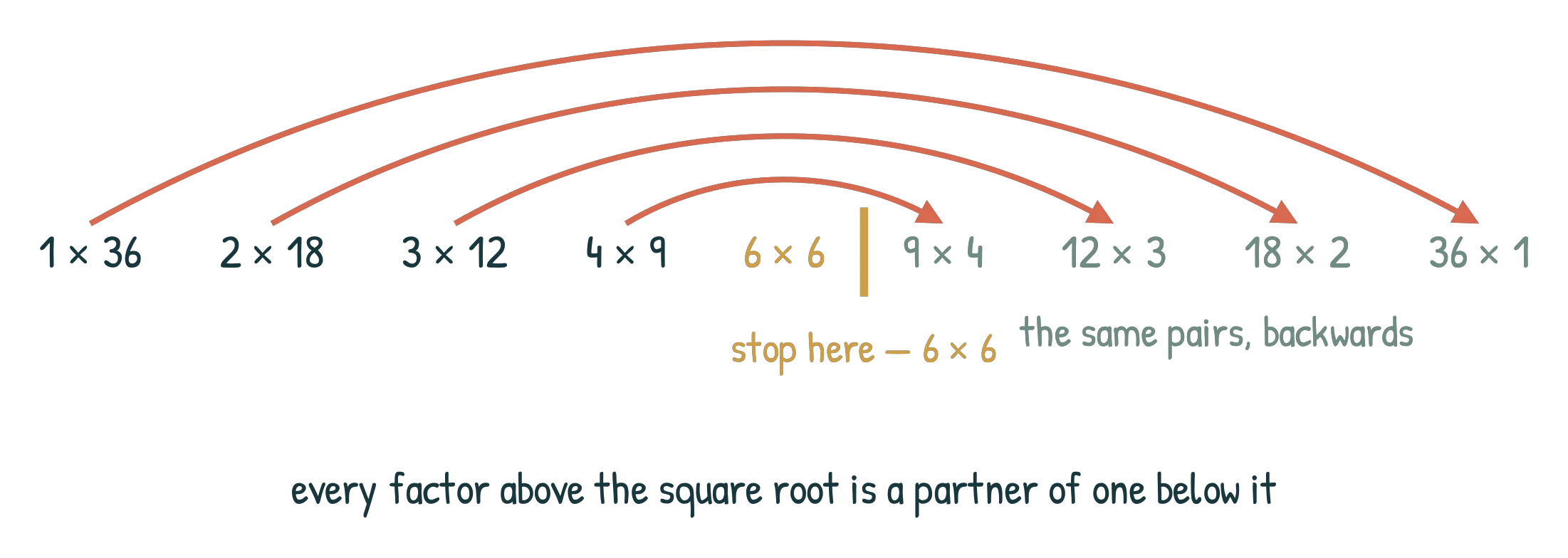
The rule: keep going while your test number multiplied by itself is still below the number you are testing, and stop as soon as it goes past. For 97, is below and is past, so you go up to 9. For 61, is below and is past, so you go up to 7.
That stopping point is the square root of the number, rounded down. If roots are new, they are covered in square and cube roots.
And you only need the primes below it — never the composites. A composite like 6 is built from 2 and 3, so if 6 divided your number then 2 would as well, and you have already tried 2.
Prime numbers up to 50
Worth knowing on sight. There are 15 of them:
| 2 | 3 | 5 | 7 | 11 |
| 13 | 17 | 19 | 23 | 29 |
| 31 | 37 | 41 | 43 | 47 |
Two things to notice. 2 is the only even prime — every other even number has 2 as a factor, so it has at least three. And the list thins out as the numbers grow, but it never stops: there are infinitely many primes.
Going further
Why 1 is left out. The definition says "exactly two factors", and 1 has only one. That looks like a technicality, but it earns its keep: every whole number above 1 breaks down into primes in exactly one way — , and no other set of primes multiplies to 12. If 1 counted as prime, you could write , or with any number of 1s, and that uniqueness would collapse. Mathematicians defined 1 out of the club to keep it.
How far do the primes go? Forever. Euclid proved it more than two thousand years ago with an argument you can follow: if there were a biggest prime, multiply every prime together and add 1. The result isn't divisible by any prime on your list — each one leaves a remainder of 1 — so either it is a new prime, or it has a prime factor you missed. Either way the list was incomplete. (Well beyond what KS3 asks, but it is one of the neatest proofs in mathematics.)
Where you'll use this next
Primes are the building blocks of every other number, and the next lesson uses that directly: prime factorisation breaks a number down into the primes it is made of. From there, finding the highest common factor and lowest common multiple of two numbers becomes a matter of comparing their prime factors rather than listing everything out.
1.Is 11 a prime number?Show answerHide answer
Try the small numbers: 2 doesn't go in (11 is odd), 3 doesn't (). Next would be 4, but is already past 11, so we can stop.
Only works, so yes, 11 is prime.
2.Is 15 a prime number?Show answerHide answer
, so its factors are 1, 3, 5 and 15 — four of them.
No, 15 is not prime. It is composite.
3.Write down all the prime numbers between 10 and 20.Show answerHide answer
Test each: 12, 14, 15, 16, 18 and 20 all have a factor other than 1 and themselves.
11, 13, 17, 19
4.Is every prime number odd?Show answerHide answer
No. 2 is prime — its only factors are 1 and 2 — and it is even. It is the only even prime, because every other even number has 2 as a factor.
5.To check whether 53 is prime, what is the largest number you need to test?Show answerHide answer
7. , which is already past 53, so anything from 8 upwards would need a partner below 8 that you have already tried.
Testing 2, 3, 5 and 7 is enough — none of them divide 53, so it is prime.
6.Marcus says 91 is prime because it is odd and its digits don't add to a multiple of 3. Is he right?Show answerHide answer
No. He has checked 2 and 3 and stopped too early. The largest number he needs to test is 9, since is past 91 — so 5 and 7 are still to try.
, so 91 has factors 1, 7, 13 and 91. It is composite.
7.Is 143 a prime number?Show answerHide answer
is just past 143, so test up to 11: try 2, 3, 5, 7 and 11.
2, 3, 5 and 7 all fail — but .
No, 143 is not prime. This is a good example of why the stopping rule matters: the factor doesn't turn up until the very last number you needed to test.
Practise this skill
A free printable worksheet with 15 questions and a full worked answer key. No sign-up needed.
Get the Number Properties Test Paper with Mark Scheme free
Ready to test the whole topic? Your first paper is on us — exam-style questions with a full plain-English mark scheme. See what’s in it.
More number properties lessons
- How to Find Factors and Multiples | KS3 Maths
- Square and Cube Roots | KS3 Maths
- Multiplying and Dividing Negative Numbers | KS3 Maths
- Square and Cube Numbers | KS3 Maths
- Adding and Subtracting Negative Numbers | KS3 Maths
- How to Use BIDMAS — Order of Operations | KS3 Maths
- Order of Operations (BIDMAS) — Is 8÷2(2+2) 1 or 16? | KS3 Maths