Rounding Decimals to Decimal Places — KS3 Maths
Round decimals to 1, 2 and 3 decimal places with one reliable method: keep, check the next digit, 5 or more rounds up. Free KS3 lesson.
Keep the digits up to the place you want, then look at the next digit: 5 or more rounds up, 4 or less stays. So 3.847 to 2 decimal places is 3.85.
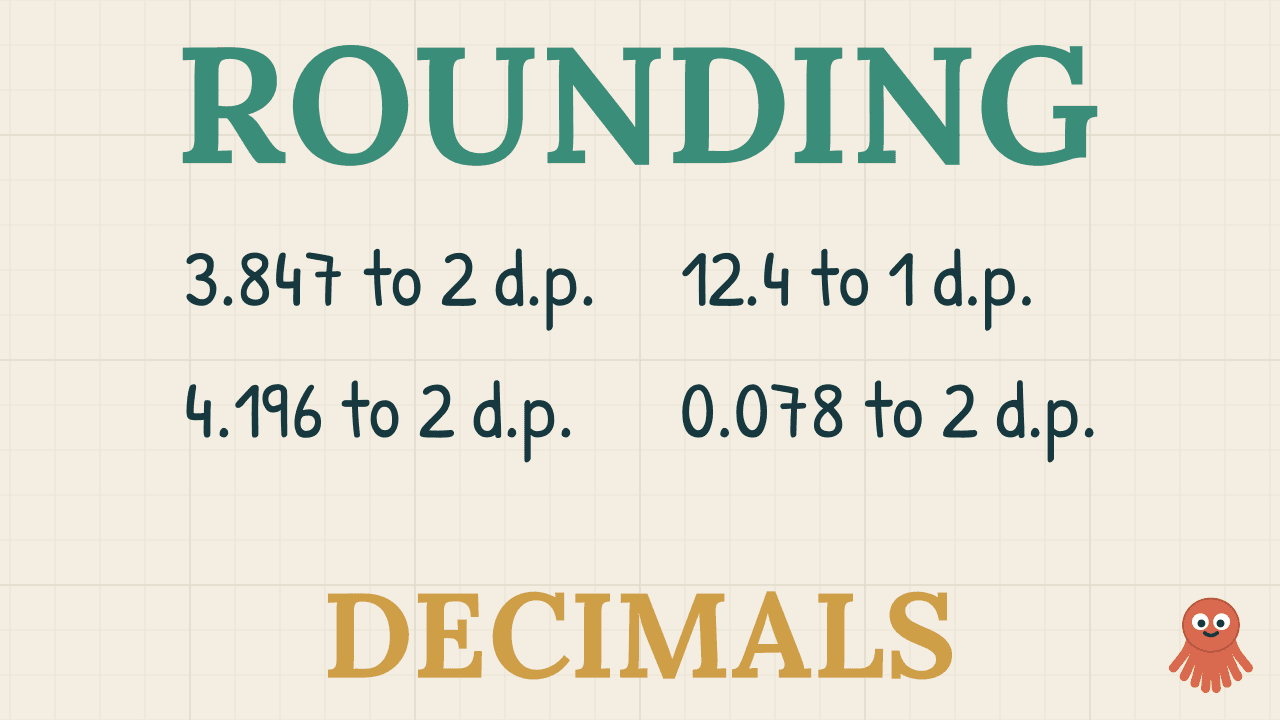
Rounding a decimal means writing it with fewer digits after the point while staying as close to the real value as you can. One digit decides it — the one immediately after the place you're keeping. Everything else is bookkeeping: 5 or more rounds up, 4 or less stays put.
How do you round to a decimal place?
Keep, check, write. Count the places from the point, keep that many, look at the very next digit to decide whether the last kept digit goes up, and write the answer with exactly the number of places you were asked for.
Worked example
Round 3.847 to 2 decimal places
Keep the digits up to the second decimal place: . Now look at the next digit — it's a 7. Seven is 5 or more, so round up: the becomes a .
Worked example
Round 12.432 to 1 decimal place
Keep the digits up to the first decimal place: . The next digit is a 3. Three is 4 or less, so the digit stays the same — just drop the rest.
Worked example
Round 4.196 to 2 decimal places (the trap)
Keep the digits up to the second decimal place: . The next digit is a 6, so round up — but the digit you're rounding is a 9. Nine rounds up to ten, so it carries: the becomes and the beside it goes up to .
It's , not — see the warning below.
Going further
Significant figures work on the same idea, counted differently. Decimal places count from the point; significant figures count from the first non-zero digit. So to 2 decimal places is — useless — but to 2 significant figures it's , which actually says something. Same keep-and-check method, different starting point. Significant figures are the usual choice for very small or very large numbers.
Rounding twice can give the wrong answer. Round to 2 decimal places and you get ; round that to 1 decimal place and you get . But to 1 decimal place directly is . Always round once, from the original number.
Where you'll use this next
- Estimation: rounding each number to 1 significant figure is how you check whether an answer is roughly right.
- Money: amounts round to 2 decimal places, which is why the trailing zero matters — £3.20, never £3.2.
- Multiplying and dividing decimals often leaves long answers that need rounding to be useful.
Practice questions
Keep the digits you need, check the next digit, and write the answer with the exact number of decimal places. Then click to check.
1.Round 5.271 to 2 decimal placesShow answerHide answer
Keep ; next digit is 1 (stays): .
2.Round 8.66 to 1 decimal placeShow answerHide answer
Keep ; next digit is 6 (rounds up): .
3.Round 0.0349 to 2 decimal placesShow answerHide answer
Keep ; next digit is 4 (stays): .
4.Round 2.999 to 2 decimal placesShow answerHide answer
Keep ; next digit is 9 (rounds up). The 9 carries: .
5.Round 7.096 to 2 decimal placesShow answerHide answer
Keep ; next digit is 6 (rounds up). The 9 carries: — keep the zero.
6.Spot the mistake: a student rounds 3.198 to 2 d.p. and writes 3.2. What went wrong?Show answerHide answer
The 9 carried correctly (), but they dropped the trailing zero. To 2 decimal places the answer is , not .
Practise this skill
A free printable worksheet with 16 questions and a full worked answer key. No sign-up needed.
Get the Decimals & Rounding Test Paper with Mark Scheme free
Ready to test the whole topic? Your first paper is on us — exam-style questions with a full plain-English mark scheme. See what’s in it.