Equivalent Fractions (No Calculator) — KS3 Maths
Equivalent fractions: multiply or divide the top and the bottom by the same number and the value stays the same. Free KS3 lesson and worksheet.
Multiply or divide the top and the bottom by the same number and the fraction keeps its value. 1/2 = 3/6 because both were multiplied by 3.
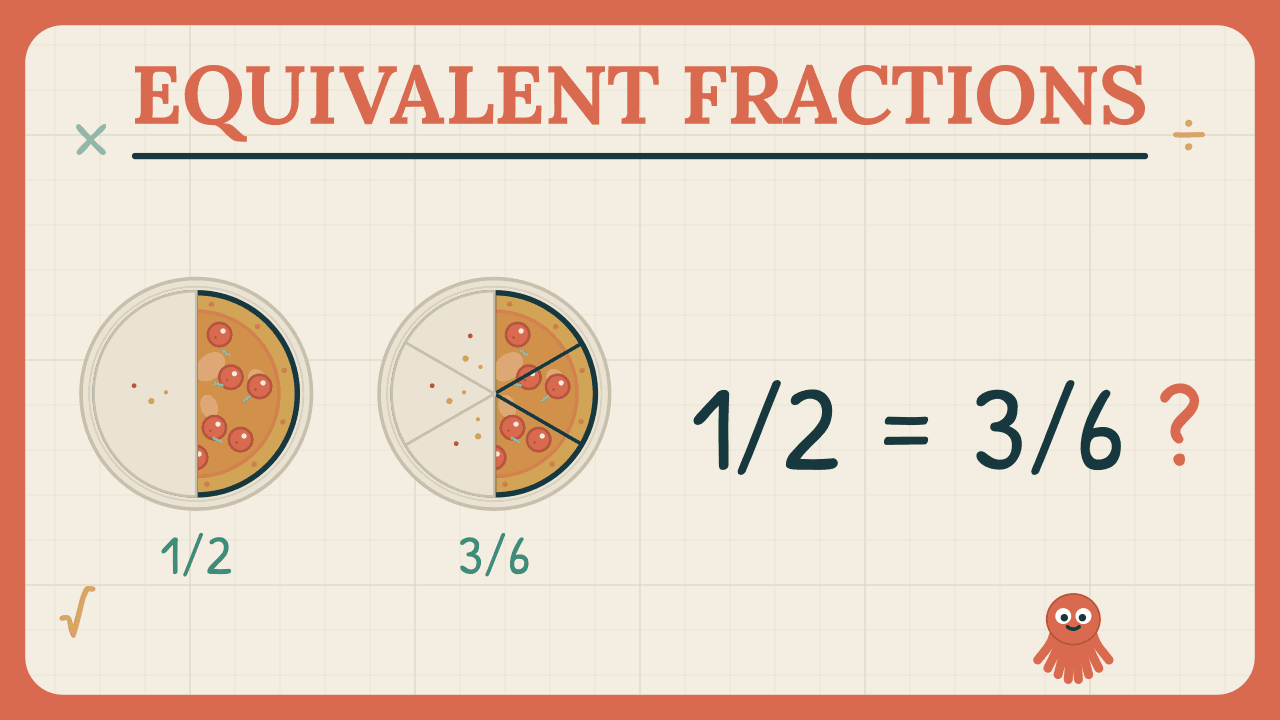
Two fractions are equivalent when they're worth the same amount even though the numbers look different — and are the same quantity written two ways. You move between them by multiplying or dividing the top and the bottom by the same number. That single idea is what simplifying, comparing and adding fractions are all built on.
What does "equivalent" actually mean?
Equivalent fractions look different but are worth exactly the same amount. The pizza test makes it obvious.
Worked example
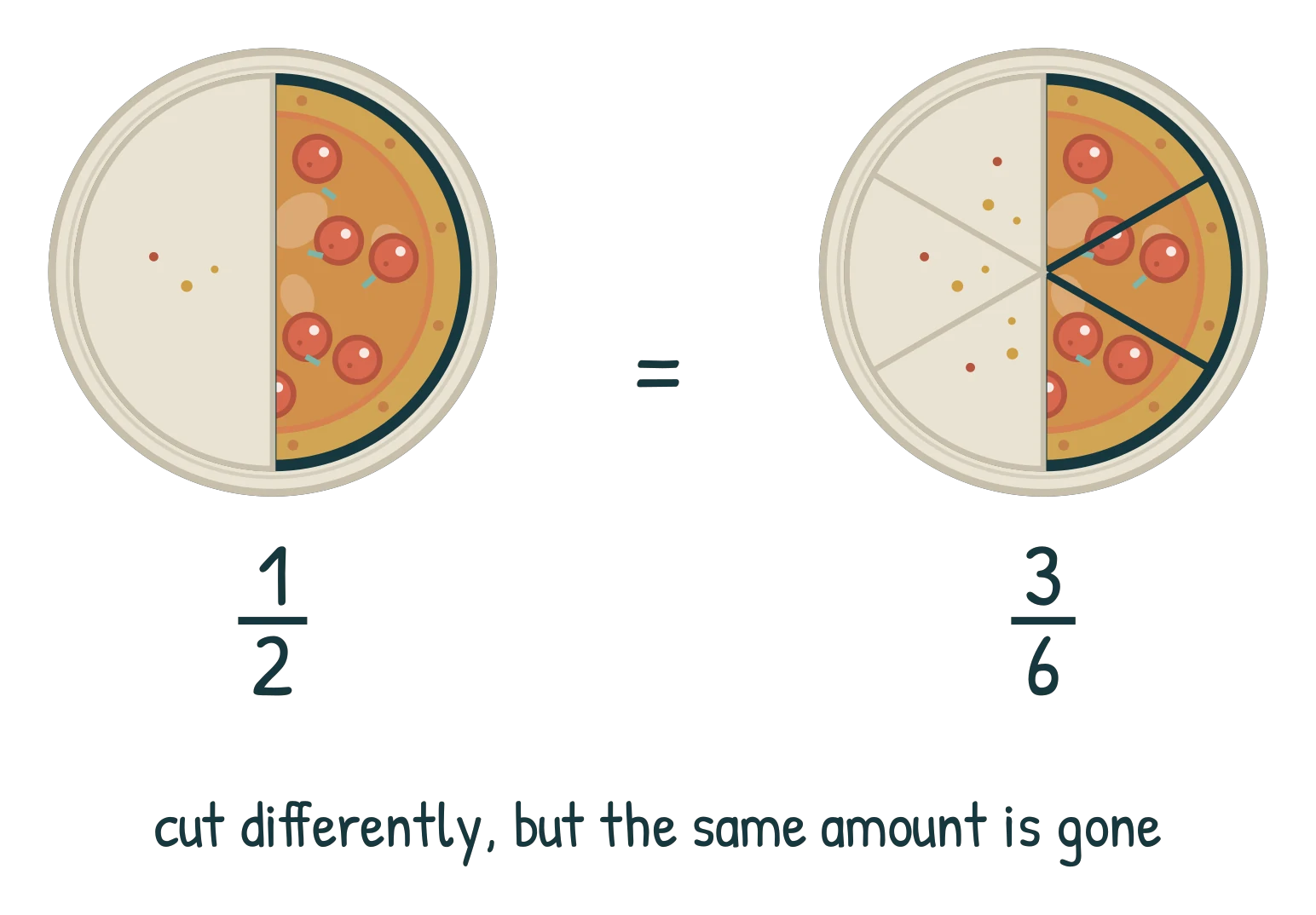
The pizza test: is 1/2 the same as 3/6?
Mia and Ben each get an identical pizza. Mia's is cut into 2 equal slices and she eats 1 — that's . Ben's is cut into 6 slices and he eats 3 — that's .
Ben says he ate more, because three slices beats one. But look at the pizzas: the eaten amount is exactly the same — half of each pizza is gone.
The golden rule connects the two fractions: multiply the top and the bottom by the same number.
And you can see why on the pizzas: three of Ben's small slices, together, make exactly one of Mia's big slices.
Worked example
Find the missing top: 2/3 = ?/12
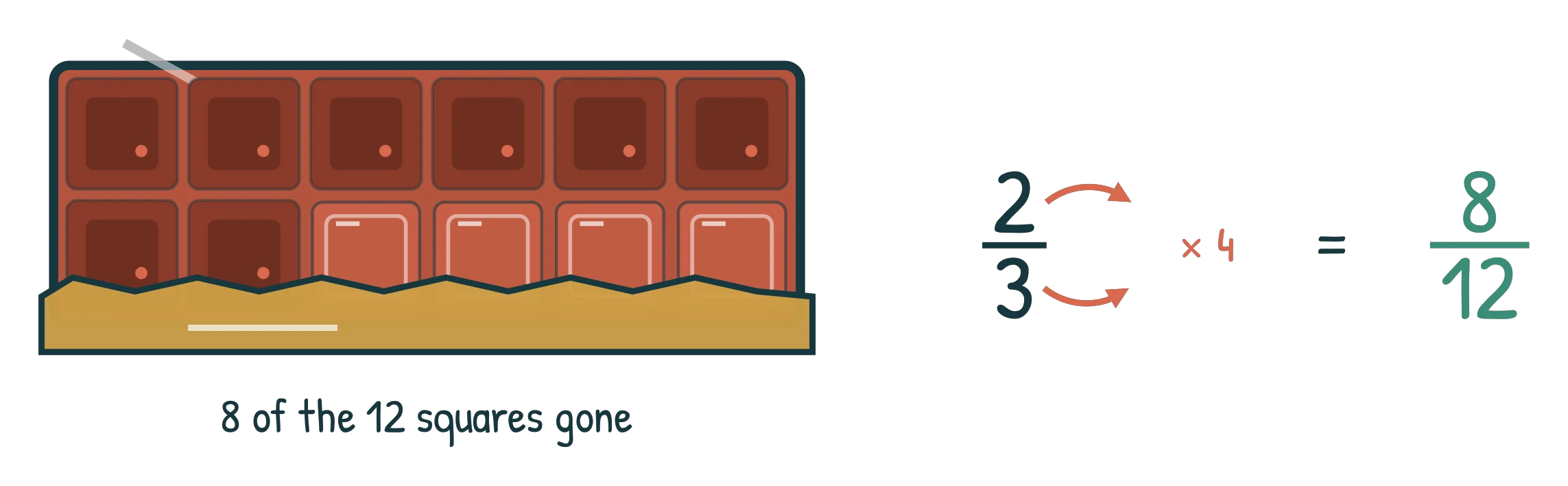
A chocolate bar has 12 squares, and Sam eats two thirds of it. How many squares is that? That's the missing-number question .
Look at the bottoms first: .
So do exactly the same to the top: .
Sam eats 8 squares — and on the bar, that's exactly 2 of its 3 rows. Two thirds, you can see it.
Worked example
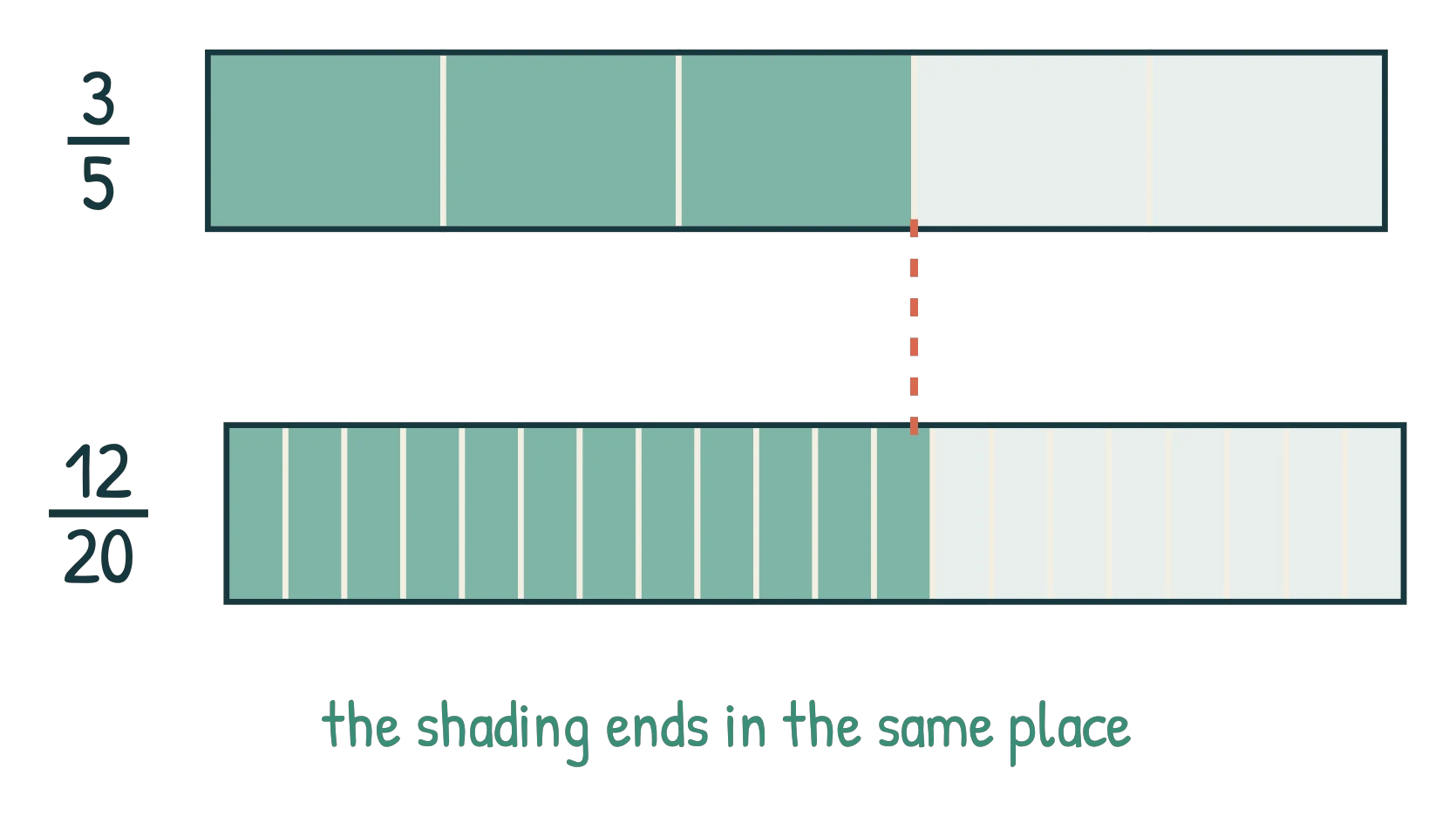
Find the missing bottom: 3/5 = 12/?
This time the top is given: , so multiply the bottom by four as well: .
Draw both as bars and the shaded amounts line up exactly — the second bar is the same bar, just cut into four times as many pieces.
Where you'll use this next
- Adding and subtracting fractions works by rewriting both fractions as equivalents with a matching bottom.
- Simplifying fractions is this same rule run backwards, dividing instead of multiplying.
- Converting to decimals and percentages often means finding an equivalent fraction over 10, 100 or 1000 first.
Practice questions
Try these yourself, then click to check each answer. Every solution uses the golden rule: multiply (or divide) the top and the bottom by the same number.
1.Fill in the missing number: 1/4 = ?/8Show answerHide answer
The bottom went from 4 to 8, so it was multiplied by 2. Do the same to the top: .
2.Fill in the missing number: 2/3 = ?/15Show answerHide answer
, so multiply the top by 5 too: .
3.Fill in the missing number: 3/8 = 9/?Show answerHide answer
This time the top is given: . So multiply the bottom by 3: .
4.Fill in the missing number: 4/5 = ?/30Show answerHide answer
, so the top is .
5.Fill in the missing number: 7/10 = 21/?Show answerHide answer
, so the bottom is .
6.A pizza is cut into 12 equal slices. Mia eats 1/4 of the pizza — how many slices is that?Show answerHide answer
Write it as a missing-number question: .
, so the top is .
Mia eats 3 slices.
7.Spot the mistake: a student writes 2/5 = 3/6 because they added 1 to the top and the bottom. What went wrong, and what does 2/5 equal in tenths?Show answerHide answer
Adding the same number to the top and bottom changes the value — that's the classic mistake. ( is a half; is less than a half.)
Correctly, multiply top and bottom by 2: .
Practise this skill
A free printable worksheet with 16 questions and a full worked answer key. No sign-up needed.
Get the Fractions Test Paper with Mark Scheme free
Ready to test the whole topic? Your first paper is on us — exam-style questions with a full plain-English mark scheme. See what’s in it.