Adding & Subtracting Decimals — KS3 Maths
Add and subtract decimals with the column method: line up the points, fill the gaps with zeros, then bring the point down. Free KS3 lesson.
Line up the decimal points (not the ends), fill any gaps with zeros, add or subtract each column, then bring the point straight down.
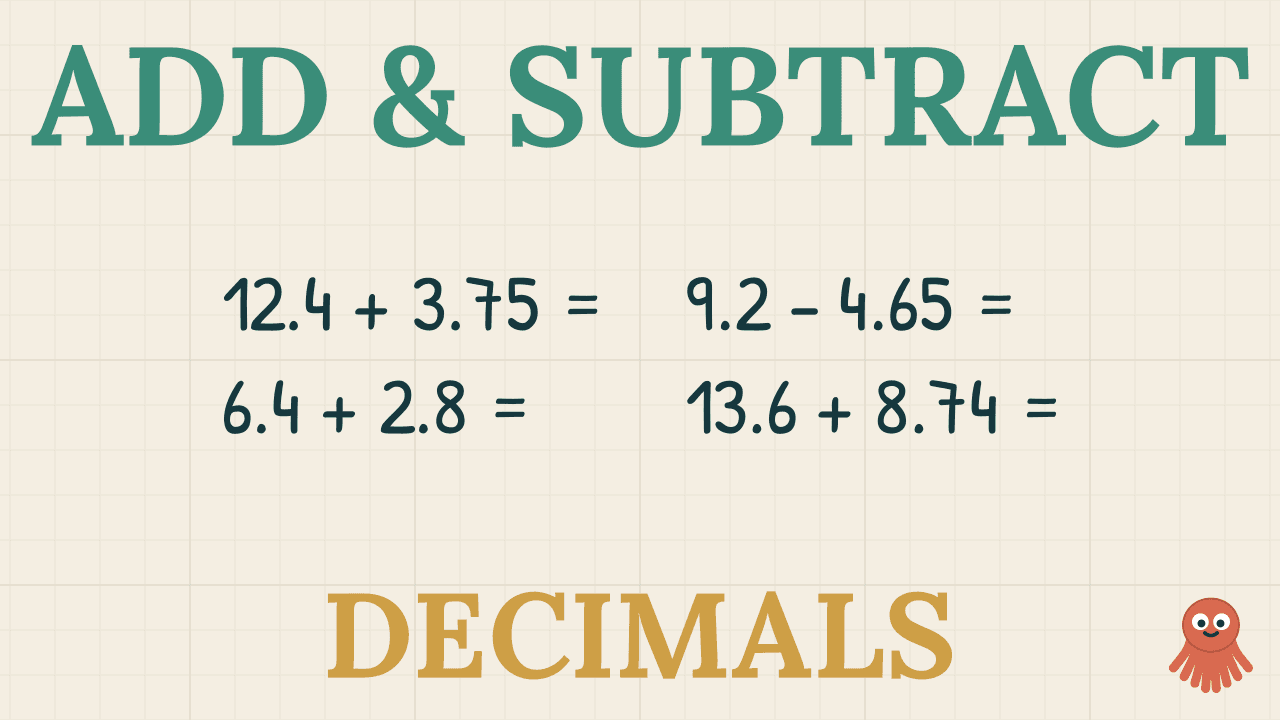
Adding and subtracting decimals is ordinary column arithmetic — once the decimal points are lined up. Stack the points one above the other, fill any gaps with zeros so every column is complete, work column by column as usual, and bring the point straight down into the answer.
Why do you line up the decimal points?
Because column arithmetic only works when digits of the same value sit above each other — tenths above tenths, hundredths above hundredths. The decimal point is the marker that guarantees it, and filling gaps with zeros keeps every column complete.
Writing as doesn't change its value at all: it has nothing in the hundredths column, and a zero says exactly that.
Worked example
Adding: 12.4 + 3.75
Line up the points, and fill the gap — has nothing in the hundredths column, so write it as . Then add each column and bring the point straight down:
  1 2 . 4 0
+    3 . 7 5
-----------
  1 6 . 1 5
So .
Worked example
Subtracting: 9.2 − 4.65
Line up the points and fill the gap — becomes . Then subtract each column, borrowing where you need to:
  9 . 2 0
- 4 . 6 5
---------
  4 . 5 5
So .
Worked example
Adding with a carry: 13.6 + 8.74
Write as , line up the points, and add — carrying from the tenths into the units:
  1 3 . 6 0
+    8 . 7 4
-----------
  2 2 . 3 4
So .
Where you'll use this next
- Money problems are decimal addition and subtraction with two places fixed — change from a note, a bill split, a running total.
- Perimeter and measures add decimal lengths, often mixing 1 and 2 decimal places, which is exactly what the zero-filling handles.
- Multiplying and dividing decimals completes the four operations.
Practice questions
Set each one out in columns, line up the points, and fill the gaps with zeros before you add or subtract. Then click to check.
1.Work out 5.6 + 2.35Show answerHide answer
Line up: .
2.Work out 8.4 − 3.72Show answerHide answer
Line up: .
3.Work out 14.75 + 6.8Show answerHide answer
Line up: .
4.Work out 10 − 3.45Show answerHide answer
Write 10 as : .
5.Work out 0.9 + 0.85 + 1.2Show answerHide answer
Line up all three: .
6.A shopping bill comes to £12.60. You pay with a £20 note. How much change?Show answerHide answer
.
Practise this skill
A free printable worksheet with 16 questions and a full worked answer key. No sign-up needed.
Get the Decimals & Rounding Test Paper with Mark Scheme free
Ready to test the whole topic? Your first paper is on us — exam-style questions with a full plain-English mark scheme. See what’s in it.