Direct Proportion and the Unitary Method | KS3 Maths
Divide to find the value of one, then multiply up. Direct proportion and the unitary method for KS3, with worked examples and best-buy questions.
If 4 burgers cost £12, then 1 burger costs £3, so 7 burgers cost £21. That two-step move — divide to find one, then multiply up — is the unitary method.
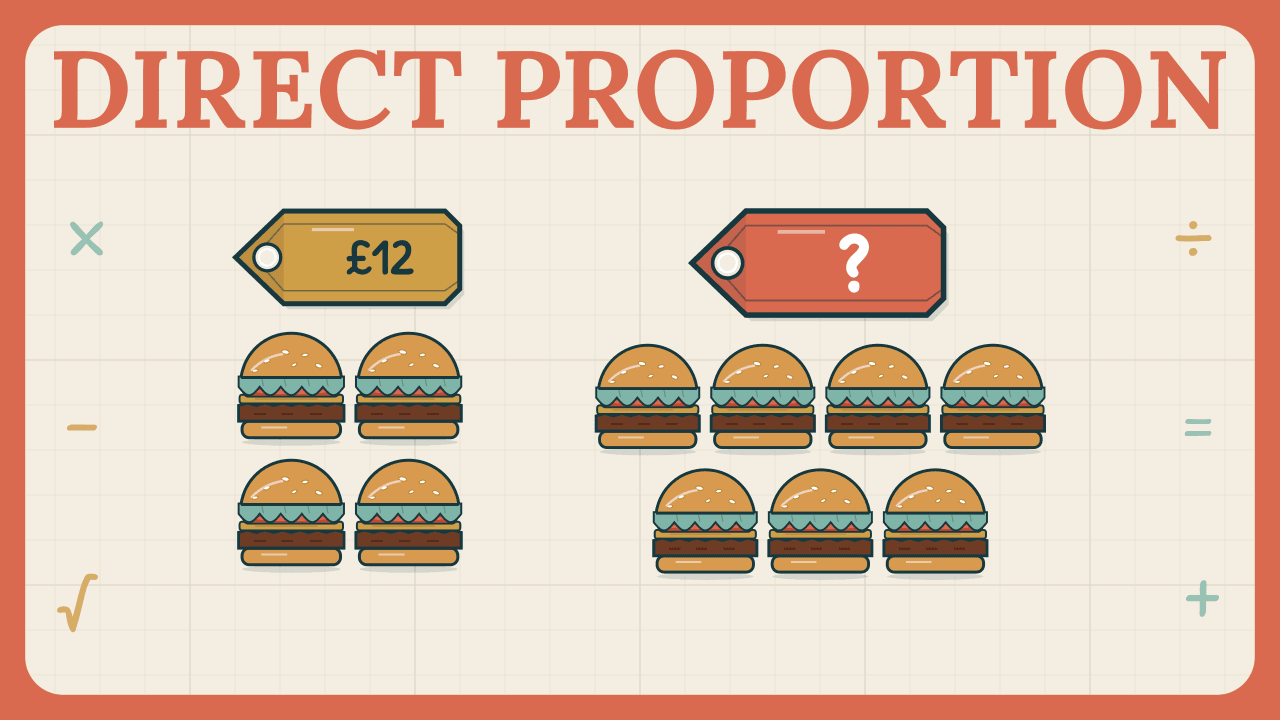
Two amounts are in direct proportion when doubling one doubles the other, and halving one halves the other. Prices work like this: four burgers cost £12, so eight would cost £24. The trick to every question of this kind is to go through one — find what a single item costs, and from there you can build any number you like.
What is the unitary method?
The unitary method is the two-step move above: divide to find the value of one unit, then multiply up to the amount you want. "Unitary" just means "to do with one" — the one unit you pass through in the middle is what gives the method its name, and it is very likely the phrase your teacher uses in class.
It is worth seeing why the middle step earns its place. You could hunt for a shortcut — going from 4 burgers to 8 is just doubling — but that only works when the numbers happen to be friendly. Going from 4 to 7 has no neat shortcut. Passing through one always works, whatever the numbers, which is why it is worth making a habit.
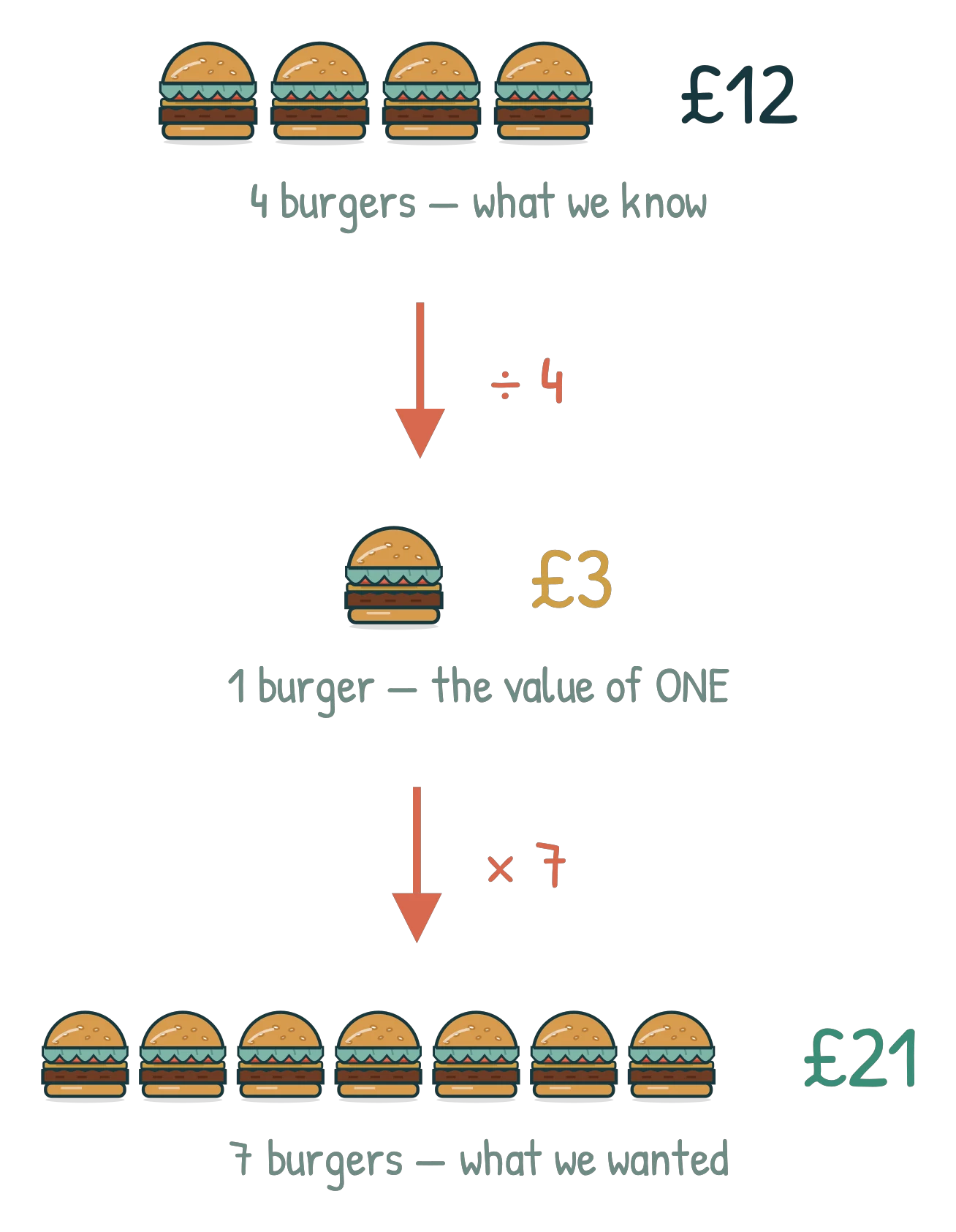
What do 7 burgers cost if 4 cost £12?
Seven burgers cost £21, because one burger costs £3 and .
Worked example
4 burgers cost £12. How much do 7 burgers cost?
Start with the step you can check by counting. The £12 is shared equally between the 4 burgers, so each one takes the same share:
That £3 is the value of one — the number the rest of the question is built on.
Now that one burger is known, seven of them is just seven lots of £3:
Check it the way you should check every proportion answer: seven burgers should cost noticeably more than four, and £21 is comfortably more than £12. It is also not far more — a bit under double, which fits, since 7 is a bit under double 4.
Using the method on a rate
Direct proportion is not only about prices. Anything that scales evenly works the same way — distance per litre of fuel, litres per minute from a tap, pages per minute from a printer. These are called rates, and the unitary method handles them without any change.
Worked example
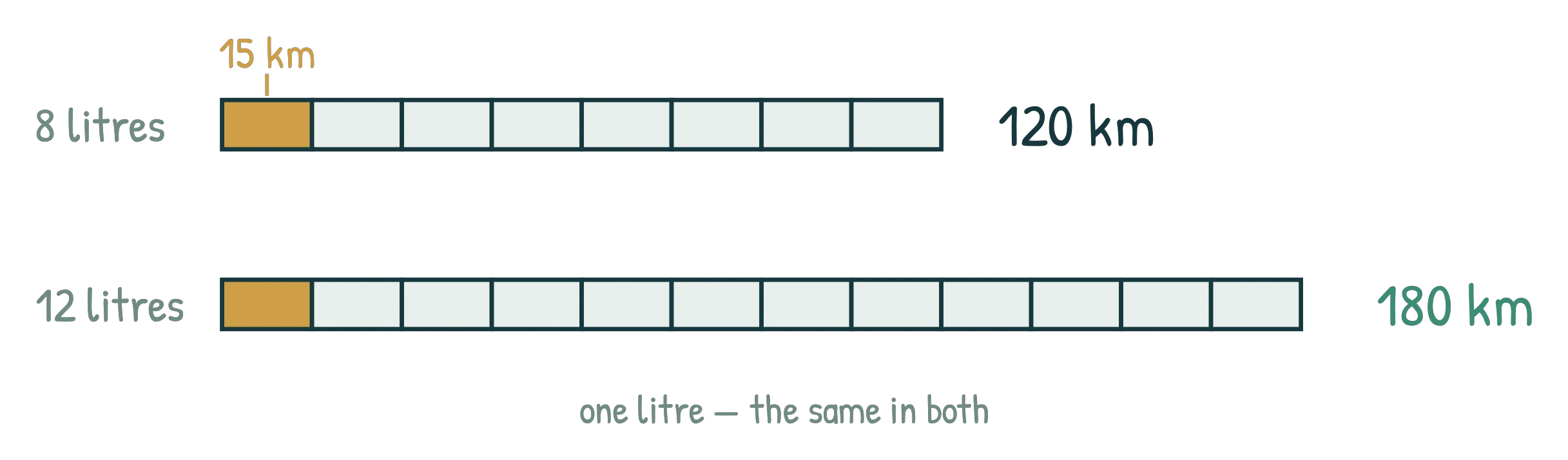
A car travels 120 km on 8 litres of fuel. How far does it go on 12 litres?
Find the value of one litre first:
Then multiply up to twelve litres:
Notice the units doing useful work here. "15" on its own is meaningless; 15 kilometres per litre tells you exactly what the number is, and it makes the next step obvious. Writing the unit into your middle line is a good habit — it is also what stops you multiplying when you meant to divide.
Which pack is better value?
To compare two packs, work out the price of one item in each and pick the smaller. The bigger pack is not automatically the better buy.
Worked example
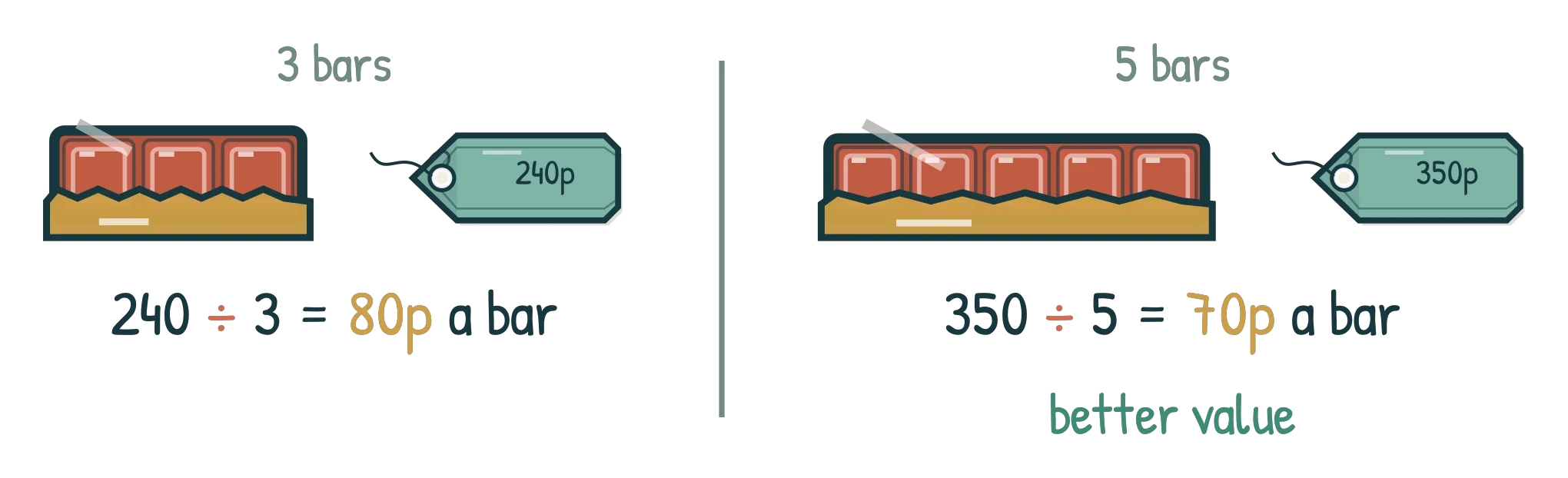
3 bars cost £2.40. 5 bars cost £3.50. Which pack is better value?
Work in pence, so neither division leaves you with a decimal:
70p is less than 80p, so the 5-bar pack is better value.
This is the same unitary method as before, just used twice and then compared. The only new idea is that the answer is a decision rather than a number.
Going further: what direct proportion is not
Not everything that changes together is in direct proportion, and spotting the difference matters more as you go on.
If 1 worker paints a fence in 12 hours, 2 workers do not take 24 hours — they take 6. More workers means less time. That is inverse proportion, and it is the mirror image of what this page covers: instead of multiplying up, you divide. The test is simple — ask yourself whether doubling one amount should double the other or halve it.
There is also a neat check for direct proportion that comes up later. If two amounts are in direct proportion, then dividing one by the other always gives the same number, whatever pair you pick: and . That constant is called the constant of proportionality, and in Year 9 and beyond you will meet it written as . You do not need that notation yet, but you have already been using the idea — is just the value of one.
Where you will use this next
Best-buy questions are the most common place this shows up in KS3 tests, and they are also the version you will genuinely use outside school. Beyond that, direct proportion underpins scale drawings and maps (a scale of 1:50 000 is a unit rate), currency conversion, and recipe scaling. It also connects directly to sharing in a ratio — both are about keeping quantities in step — and to simplifying ratios, where dividing both sides by the same number is the same instinct as dividing down to one.
Common mistakes
Practice questions
1.5 pens cost £10. What does 1 pen cost?Show answerHide answer
2.3 cakes cost £6. What do 7 cakes cost?Show answerHide answer
Find one first: a cake.
Then multiply up: .
3.6 chairs cost £54. What do 10 chairs cost?Show answerHide answer
a chair, then .
4.A tap fills 60 litres in 5 minutes. How many litres does it fill in 8 minutes?Show answerHide answer
litres per minute, then litres.
5.A recipe for 4 people uses 320 g of rice. How much rice is needed for 6 people?Show answerHide answer
g per person, then g.
6.Spot the mistake: 4 tickets cost £20, so a student writes that 6 tickets cost £22. What did they do wrong, and what is the right answer?Show answerHide answer
They added instead of scaling — they saw that 6 is 2 more than 4 and added £2.
Proportion multiplies. One ticket costs , so 6 tickets cost .
A quick sanity check catches this: £22 is barely more than £20, but you are buying half again as many tickets.
7.A 4-pack of juice costs £5. A 6-pack costs £9. Which is better value?Show answerHide answer
p each.
p each.
125p is less than 150p, so the 4-pack is better value — even though it is the smaller pack.
8.2 kg of rice costs £3. 5 kg costs £7. Which is better value, and how much would 8 kg cost at the better rate?Show answerHide answer
p a kilogram. p a kilogram.
140p is less, so the 5 kg bag is better value.
At that rate, 8 kg costs p, which is £11.20.
Practise this skill
A free printable worksheet with 16 questions and a full worked answer key. No sign-up needed.
Get the Ratio & Proportion Test Paper with Mark Scheme free
Ready to test the whole topic? Your first paper is on us — exam-style questions with a full plain-English mark scheme. See what’s in it.