Reverse Percentages (No Calculator) — KS3 Maths
Reverse percentages: find the original amount after a percentage change. Find 1%, then times by 100, no calculator. Free KS3 lesson.
Work out what percentage the amount you were given represents, divide to find 1%, then multiply by 100. £160 after 20% off is 80%, so the original was £200.
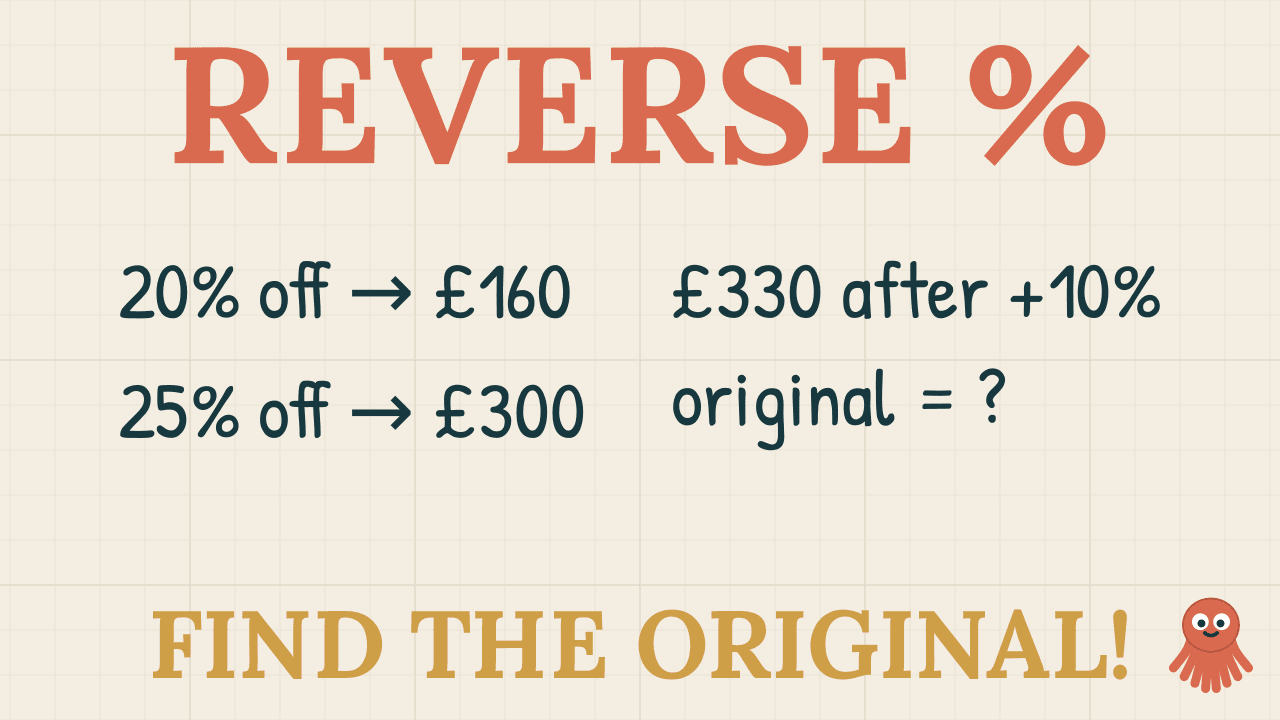
A reverse percentage gives you the amount after a change and asks for the amount before. The key move is realising the number in front of you isn't 100% of anything — after 20% off, £160 is 80% of the original. Name that percentage, step down to 1%, and step back up to 100%.
What percentage are you actually holding?
This is the whole idea, and it's the step people skip. The amount you're given is a percentage of the original, and which percentage depends on what happened to it:
| What happened | What you're holding |
|---|---|
| 20% off | 80% |
| 25% off | 75% |
| 10% added on | 110% |
| 50% added on | 150% |
| VAT at 20% added | 120% |
Once you've named it, one step down to 1% and one step up to 100% gets you back to the original.
Worked example
20% off → £160. What was the original?
Twenty percent came off, so £160 is only of the original. Divide by 80 to find , then times by 100:
The original price was £200.
Worked example
10% rise → £330. What was it before?
A rise means £330 is of the original:
The original was £300.
Worked example
25% off → £300. Find the original.
Twenty-five percent off leaves , so £300 is of the original:
The original was £400.
Where you'll use this next
- Sale prices and VAT — working out a pre-VAT price, or an original price from a sale ticket.
- Percentage increase and decrease is the forward version; check a reverse answer by running it forwards.
- Index numbers and growth in later work use the same before-and-after reasoning.
Practice questions
Decide what percentage you've been given, divide to find 1%, then times by 100. Then click to check.
1.50% off → £30. Find the original.Show answerHide answer
£30 is 50% of the original, so the original is .
2.10% off → £45. Find the original.Show answerHide answer
£45 is 90%. , so .
3.20% rise → £48. Find the original.Show answerHide answer
£48 is 120%. , so .
4.30% off → £140. Find the original.Show answerHide answer
£140 is 70%. , so .
5.15% rise → £230. Find the original.Show answerHide answer
£230 is 115%. , so .
6.A coat is £120 after 40% off. A student adds 40% of 120 back on and says £168. What's wrong, and what's the right answer?Show answerHide answer
The 40% came off the original, not the £120. £120 is 60%: , so the original is £200.
Practise this skill
A free printable worksheet with 16 questions and a full worked answer key. No sign-up needed.
Get the Percentages Test Paper with Mark Scheme free
Ready to test the whole topic? Your first paper is on us — exam-style questions with a full plain-English mark scheme. See what’s in it.