Adding and Subtracting Negative Numbers | KS3 Maths
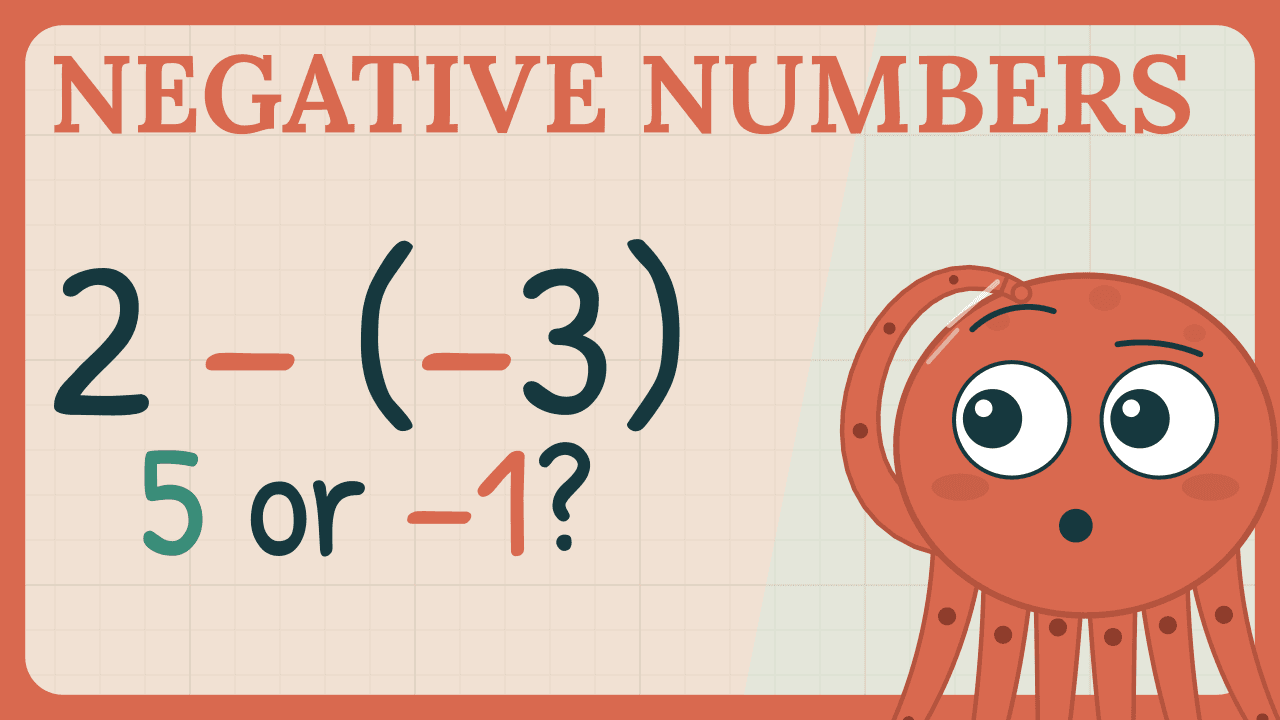
Adding and subtracting negative numbers on a number line: adding moves right, subtracting moves left, and two signs together become one.
Adding moves you right on the number line, subtracting moves you left. Two signs sitting together become one: 2 − (−3) is 2 + 3 = 5.
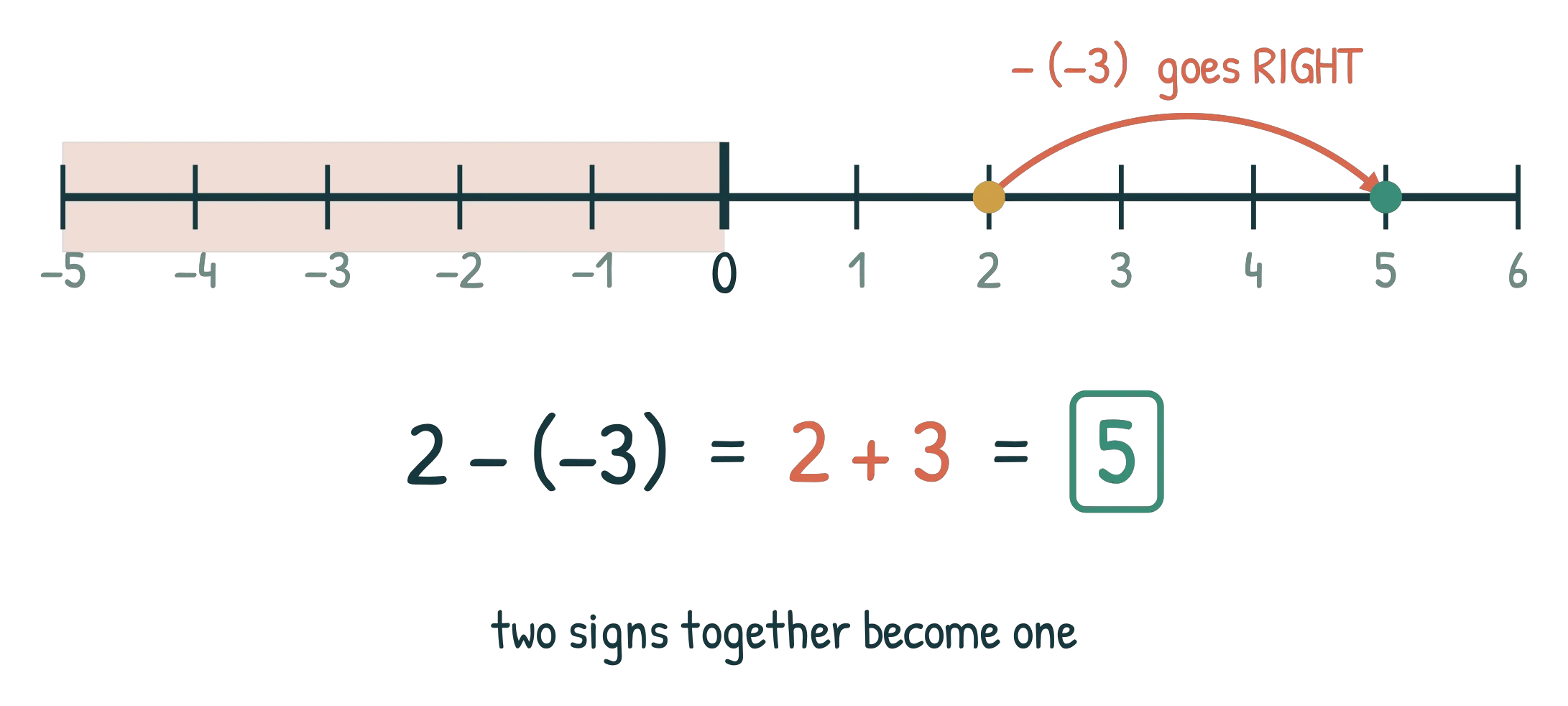
A number line makes every one of these questions concrete: adding moves you right, subtracting moves you left. The only extra idea is what happens when two signs end up next to each other — they combine into one, so becomes . Once you can see the movement, the rules stop feeling arbitrary.
Why does subtracting a negative add?
Worked example
A night below zero: how much did it rise?
At teatime it's degrees. Overnight it falls , so the temperature drops straight past zero to — three degrees below zero. By morning it's back up to degrees. How much did it rise?
A rise is the morning temperature take away the night one: . Count the steps from up to on the line and there are five of them:
The two minus signs sit together and collapse into a plus — and the five you counted on the line is the same five degrees. That's the whole idea: taking away a negative is the same as adding.
Adding a negative
Worked example
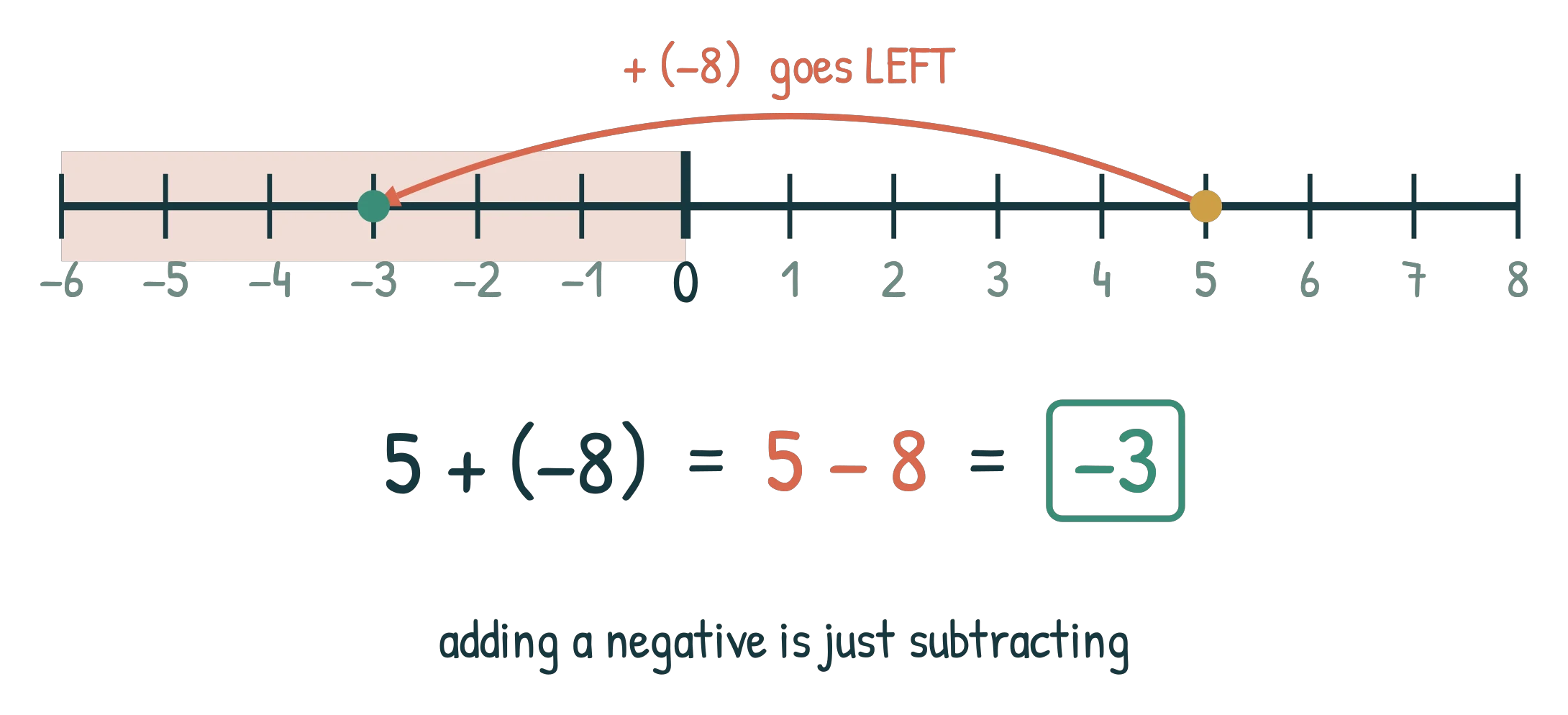
What is 5 + (−8)?
Start at on the number line. Adding a negative doesn't push you up the line — it pulls you left, eight steps, straight across zero:
So is exactly the same as . Adding a negative is just subtracting.
Two negatives together
Worked example
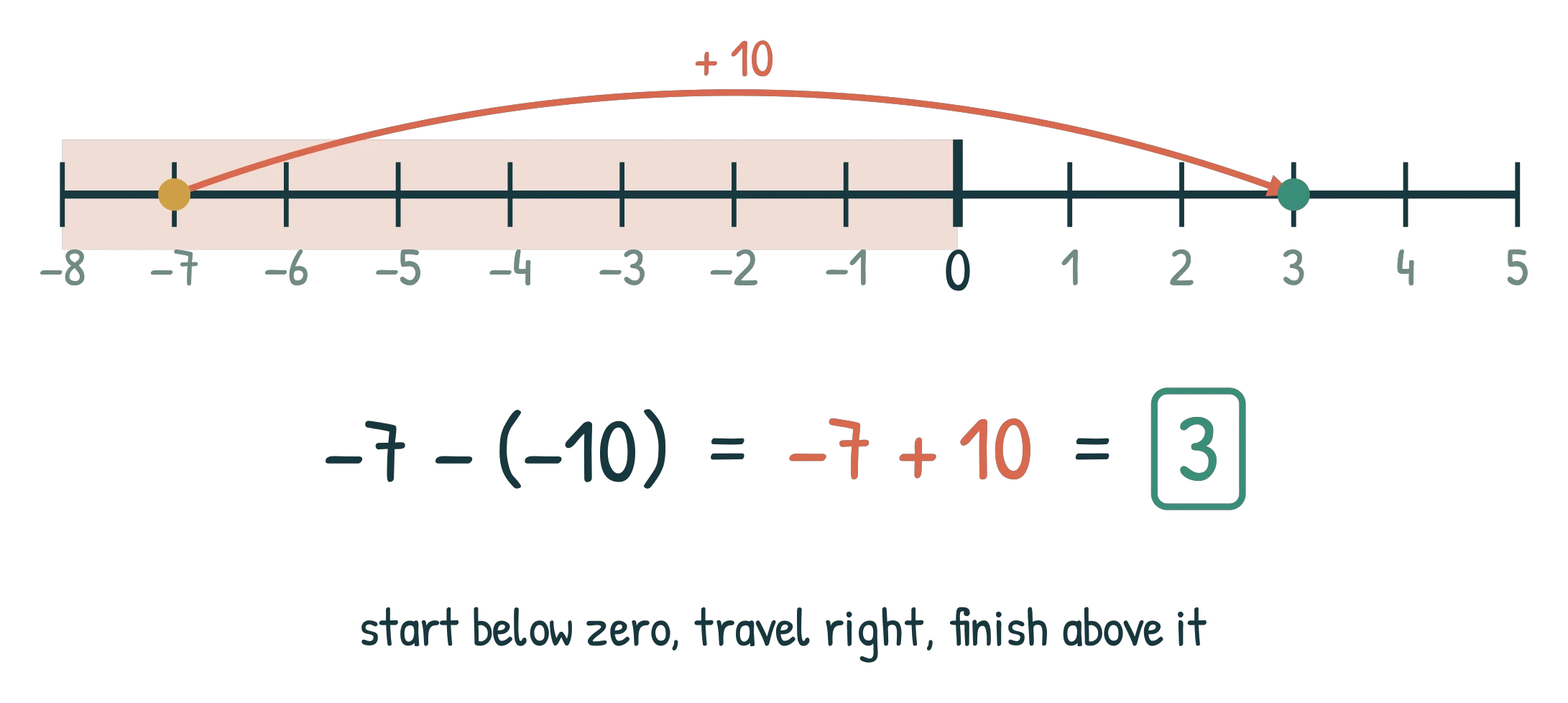
What is −7 − (−10)?
You don't need the number line for this one — just spot the two signs sitting together: the subtract, and the negative right after it. They become a plus:
Starting at and going up takes you past zero to positive .
Where you'll use this next
- Multiplying and dividing negative numbers completes the four operations with negatives — and uses a different rule, so keep them apart.
- Temperature, depth and bank balances are the everyday negatives.
- Solving equations in algebra constantly moves negative terms around.
Practice questions
Try these yourself, then click to check each answer. Picture the number line every time — adding moves you right, subtracting moves you left, and two signs together become one.
1.Work out −4 + 9Show answerHide answer
Start at and go up : that lands on .
2.Work out 7 − (−5)Show answerHide answer
Two signs together, so it's .
3.Work out −3 + (−6)Show answerHide answer
Adding a negative is subtracting: .
4.Work out 3 − 8Show answerHide answer
Count back past zero: .
5.Which is smaller, −8 or −3?Show answerHide answer
— it's further left on the number line. A bigger digit after a minus sign means a smaller number.
6.At midnight it is −6 °C. By noon it has risen to 4 °C. How many degrees warmer is it?Show answerHide answer
The rise is . Two signs together: degrees warmer.
7.Spot the mistake: a student writes −5 − 3 = 8. What went wrong, and what's the real answer?Show answerHide answer
They treated the two minus signs as together and made a plus. But these signs aren't next to each other — you're subtracting from , going further down: .
Practise this skill
A free printable worksheet with 16 questions and a full worked answer key. No sign-up needed.
Get the Number Properties Test Paper with Mark Scheme free
Ready to test the whole topic? Your first paper is on us — exam-style questions with a full plain-English mark scheme. See what’s in it.
More number properties lessons
- How to Find Factors and Multiples | KS3 Maths
- What Is a Prime Number? | KS3 Maths
- Square and Cube Roots | KS3 Maths
- Multiplying and Dividing Negative Numbers | KS3 Maths
- Square and Cube Numbers | KS3 Maths
- How to Use BIDMAS — Order of Operations | KS3 Maths
- Order of Operations (BIDMAS) — Is 8÷2(2+2) 1 or 16? | KS3 Maths