Square and Cube Numbers | KS3 Maths
Square and cube numbers: the small raised number tells you how many to multiply. Where the names come from, with tile and block pictures.
The small raised number says HOW MANY of the number to multiply together. So 5² is 5 × 5 = 25, and 4³ is 4 × 4 × 4 = 64.
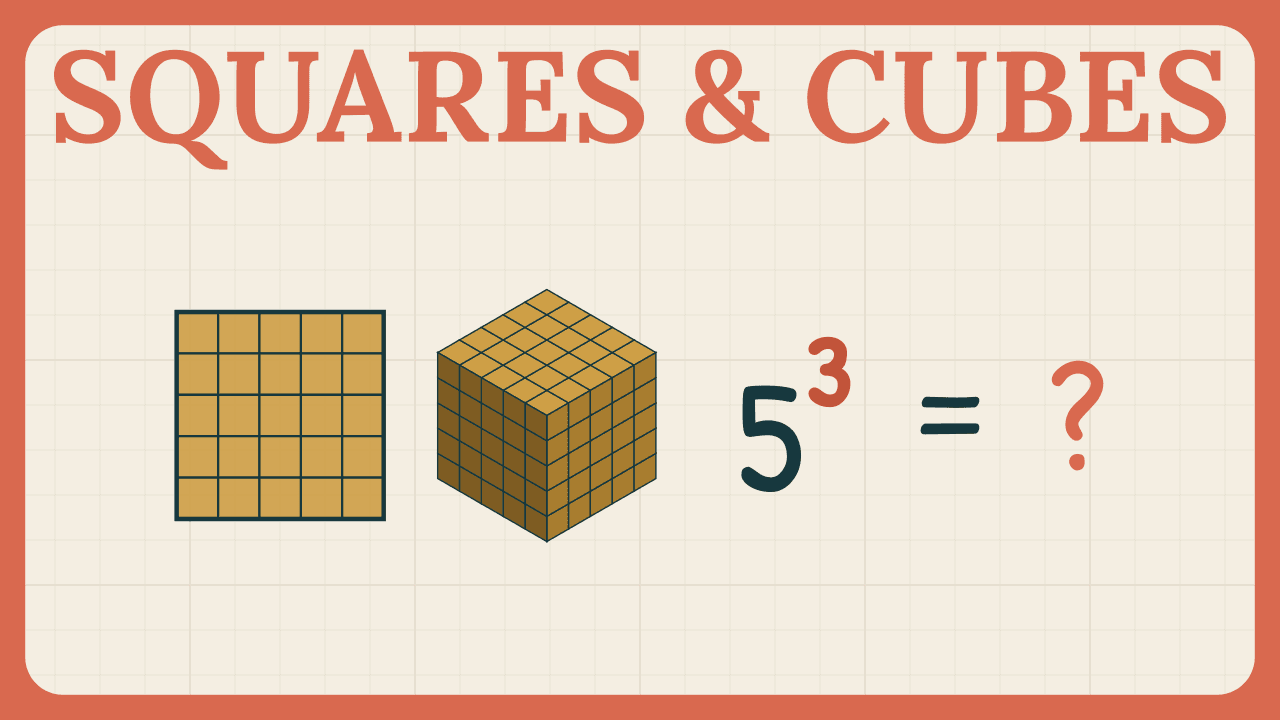
That small raised number tells you how many of the number to multiply together — and the names give the game away. is literally a 5 by 5 square of tiles, and is a 4 by 4 by 4 cube of blocks. Once you've seen the shapes, both the names and the answers make sense.
Why is it called "squared"?
Worked example
What is 5 squared?
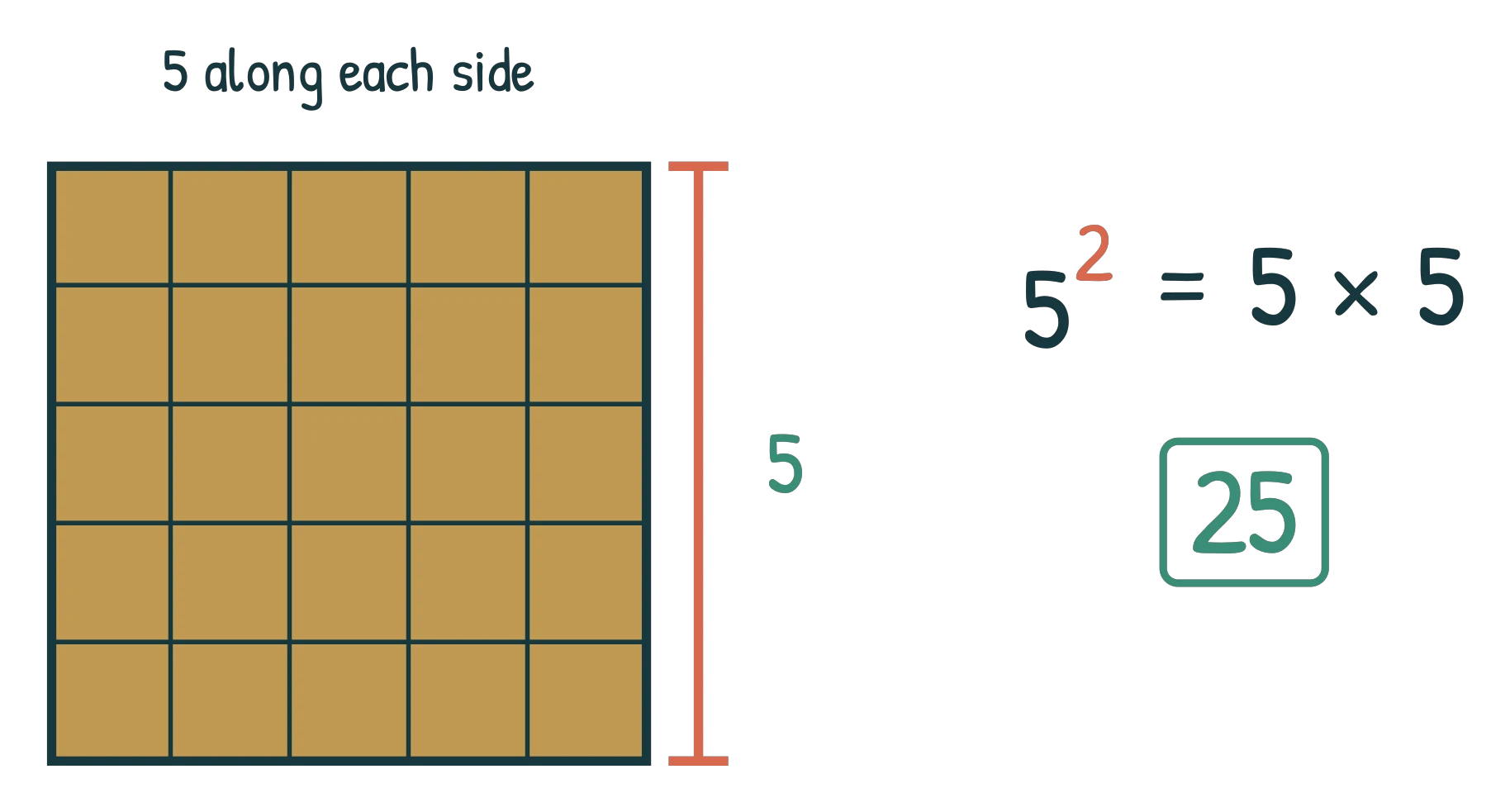
squared means a square with 5 along each side. Build it and count the tiles: 5 rows of 5.
That's where the name comes from — you are literally making a square. And the little is telling you how many fives to multiply, not something to multiply by. This one picture is what stops from ever happening again.
And "cubed"?
Worked example
What is 4 cubed?
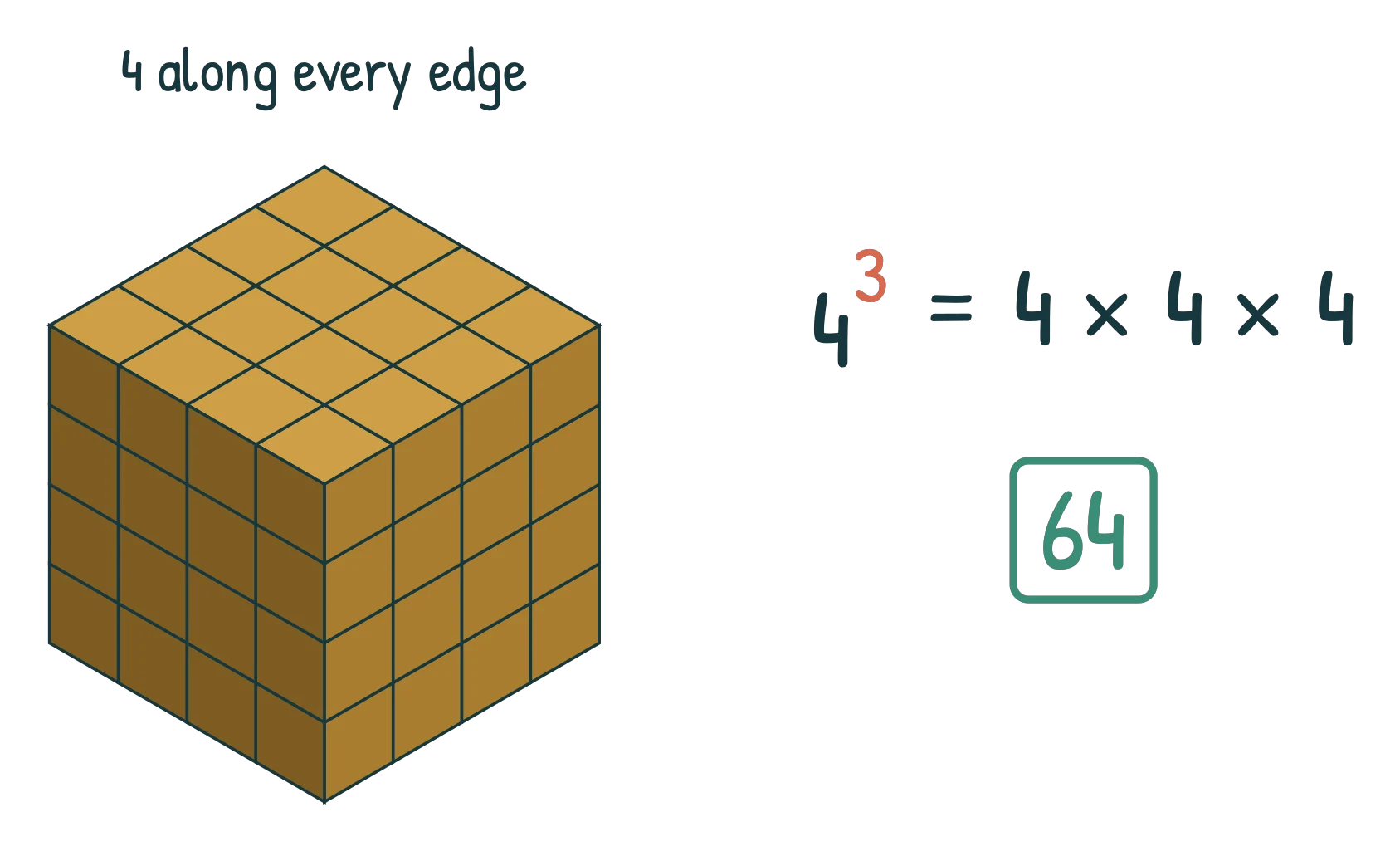
Exactly the same idea, one dimension up: cubed means a cube with 4 along every edge.
One layer of that cube is blocks. And there are 4 layers, so:
Squares and cubes: 1 to 10
These are worth knowing on sight — they turn up constantly, and knowing them forwards also gives you square and cube roots backwards.
| (square) | (cube) | |
|---|---|---|
| 1 | 1 | 1 |
| 2 | 4 | 8 |
| 3 | 9 | 27 |
| 4 | 16 | 64 |
| 5 | 25 | 125 |
| 6 | 36 | 216 |
| 7 | 49 | 343 |
| 8 | 64 | 512 |
| 9 | 81 | 729 |
| 10 | 100 | 1000 |
Look at 64: it appears in both columns, as and as . It's the one number in this range that is both a square and a cube.
Going further: which is bigger, 2⁵ or 5²?
Worked example
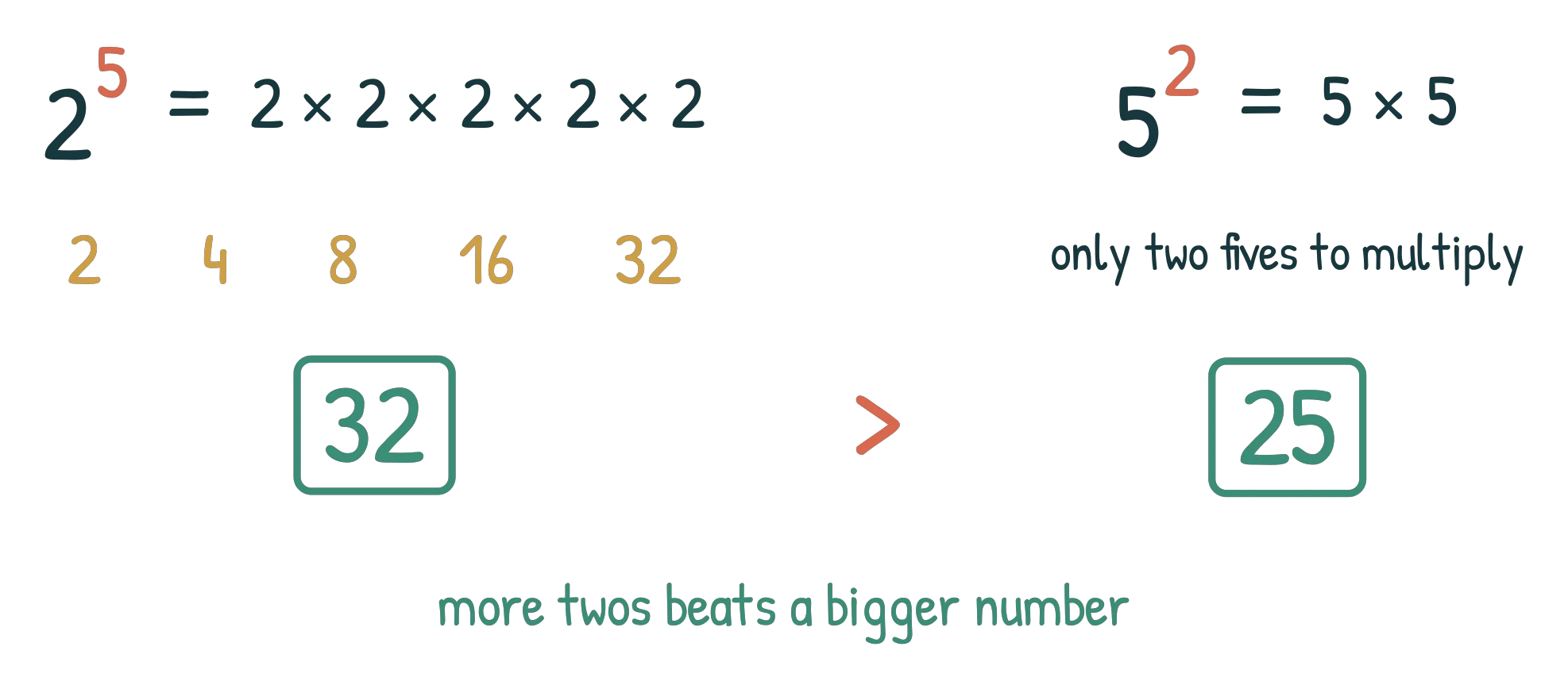
2 to the power 5, or 5 squared?
The rule generalises past squares and cubes — the small number always says how many to multiply:
Doubling up gives . So — 32 beats 25, even though is the bigger number to start with. More twos beats a bigger number, which is worth remembering when you meet indices properly.
Where you'll use this next
- Square and cube roots run this backwards: given the answer, find the number you squared.
- Area and volume are squares and cubes with units — a square 5 cm on each side has area cm².
- Index laws and standard form build directly on what that small raised number means.
Practice questions
Try these yourself, then click to check each answer. Ask "how many of them am I multiplying?" every time.
1.Work out 7²Show answerHide answer
.
2.Work out 3³Show answerHide answer
.
3.Work out 2⁴Show answerHide answer
.
4.Work out 12²Show answerHide answer
.
5.Work out 10³Show answerHide answer
.
6.A square patio has 9 slabs along each side. How many slabs altogether?Show answerHide answer
slabs.
7.Spot the mistake: a student writes 6² = 12. What went wrong, and what's the real answer?Show answerHide answer
They multiplied by the small number instead of using it as a count. means two sixes multiplied: .
Practise this skill
A free printable worksheet with 16 questions and a full worked answer key. No sign-up needed.
Get the Number Properties Test Paper with Mark Scheme free
Ready to test the whole topic? Your first paper is on us — exam-style questions with a full plain-English mark scheme. See what’s in it.
More number properties lessons
- Why Does a Negative Times a Negative Make a Positive? | KS3 Maths
- How to Find Factors and Multiples | KS3 Maths
- What Is a Prime Number? | KS3 Maths
- Square and Cube Roots | KS3 Maths
- Multiplying and Dividing Negative Numbers | KS3 Maths
- Adding and Subtracting Negative Numbers | KS3 Maths
- How to Use BIDMAS — Order of Operations | KS3 Maths
- Order of Operations (BIDMAS) — Is 8÷2(2+2) 1 or 16? | KS3 Maths