Square and Cube Roots | KS3 Maths
A square root asks what number, times itself, gives the total. Square and cube roots for KS3, and how to estimate a root that isn't exact.
The square root of 49 is 7, because 7 × 7 = 49. A root asks: what number, multiplied by itself, gives this total?
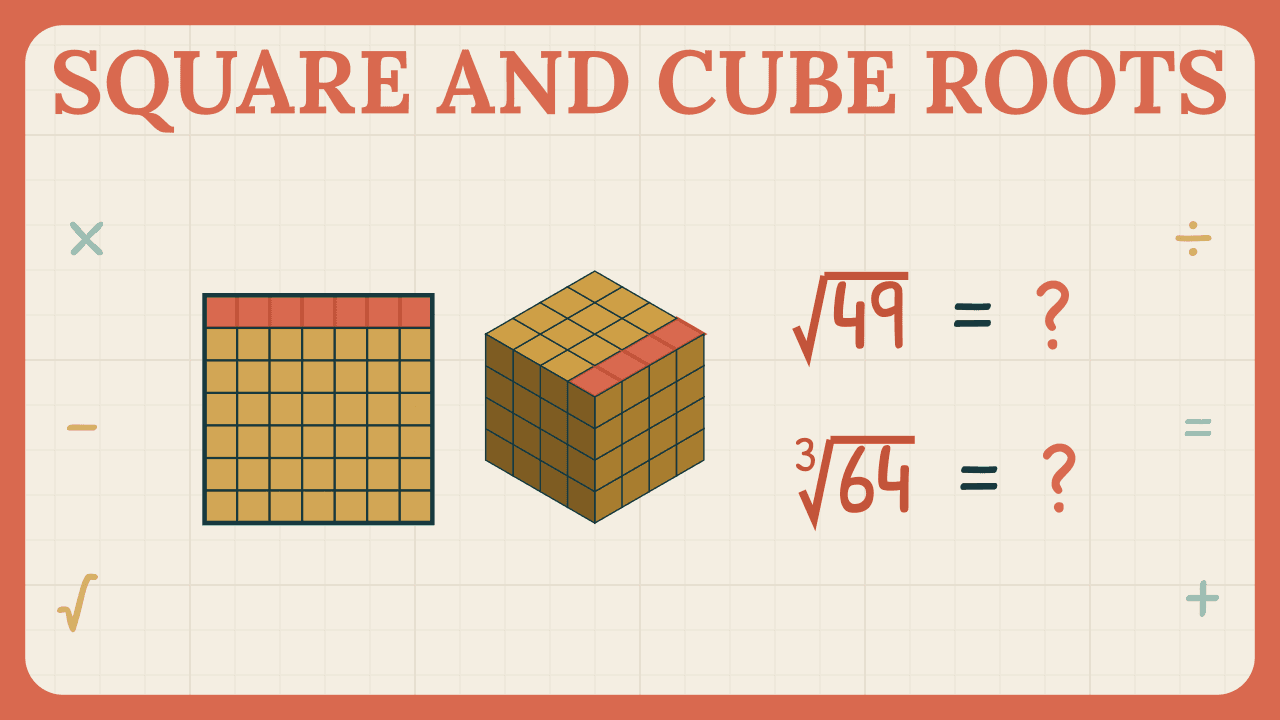
A square root asks one question: what number, multiplied by itself, gives this total? For 49 that number is 7, because . A cube root asks the same thing with three numbers instead of two. Hold on to that one question and every perfect square and cube below becomes something you can read straight off.
What is a square root?
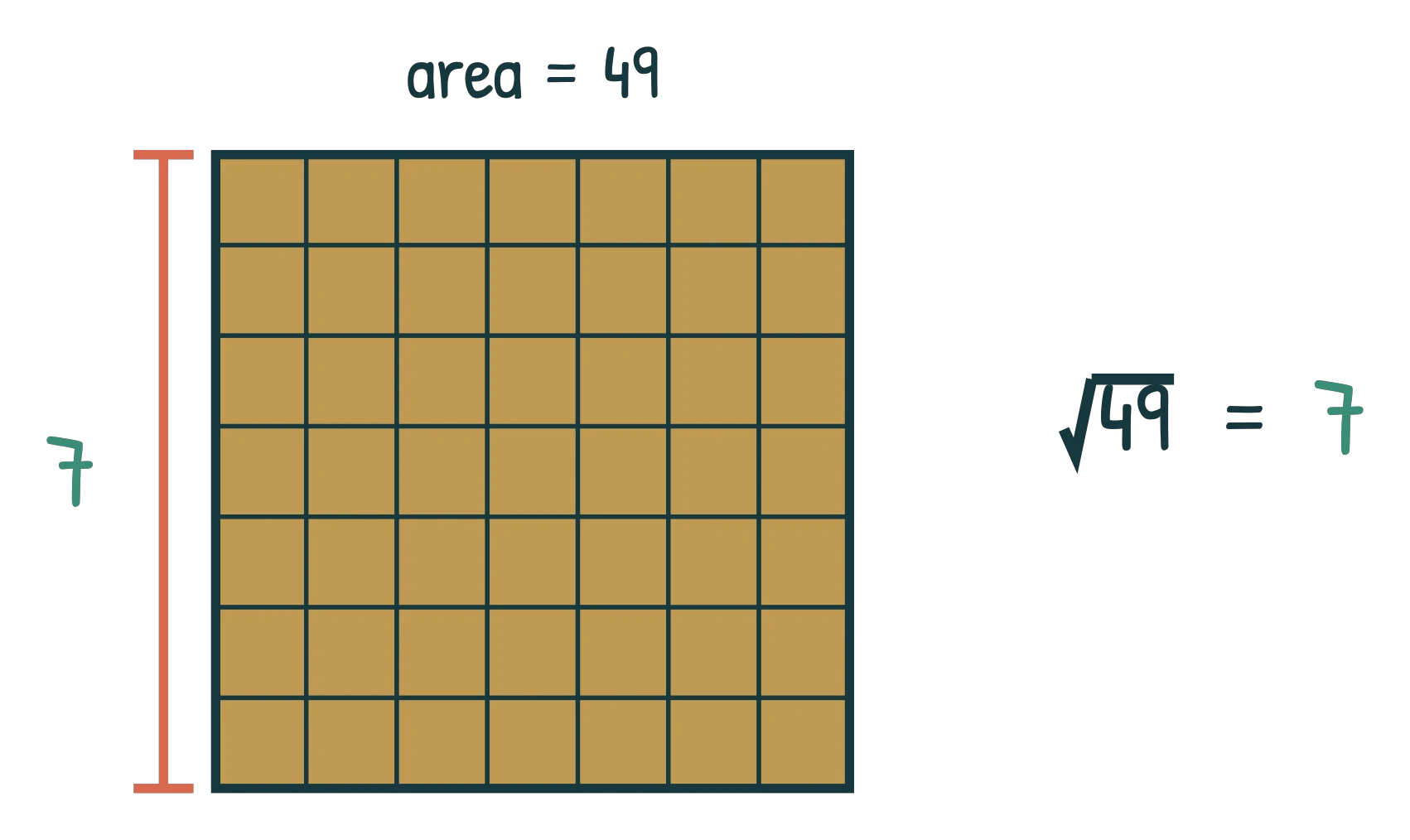
A square root is the side length of a square. That is not a metaphor — it is where the name comes from, and it is the fastest way to make the symbol mean something.
If you build a square out of 49 tiles, it comes out 7 tiles along each side. So we say the square root of 49 is 7, and write it . The little tick with the bar over the number is the radical sign, and it means "the side of a square with this area".
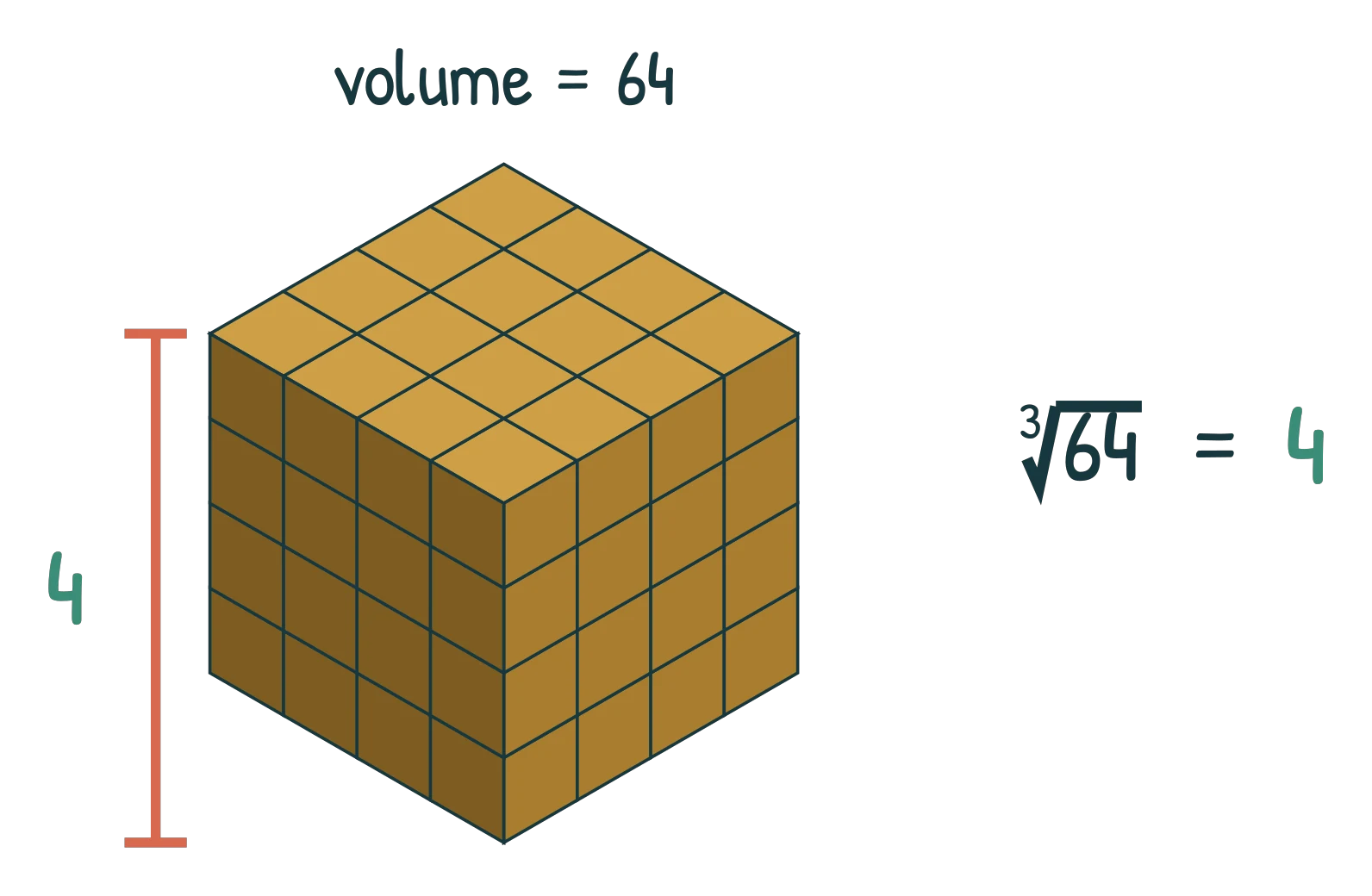
A cube root does the same job one dimension up: it is the edge length of a cube. Its symbol carries a small 3 — — to tell you three numbers are being multiplied, not two.
What is the square root of 49?
The square root of 49 is 7, because .
Worked example
Find the square root of 49
Start from something you can check for yourself: . Build that as a square of tiles — 7 rows of 7 — and you have 49 tiles.
Now turn the question round. Suppose all you know is that the square holds 49 tiles altogether. How long is each side? Count one row: 7.
Check it the way you should check every root: multiply your answer by itself and see whether you land back where you started. , so 7 is right.
What is the cube root of 64?
The cube root of 64 is 4, because .
Worked example
Find the cube root of 64
Same move, one dimension up. A cube built from 64 small blocks measures 4 along every edge, because .
Given the volume, count one edge: 4.
Notice the small 3 on the radical sign. Without it you would be asking for the square root of 64, which is 8 — a different question with a different answer.
What if the number isn't a perfect square?
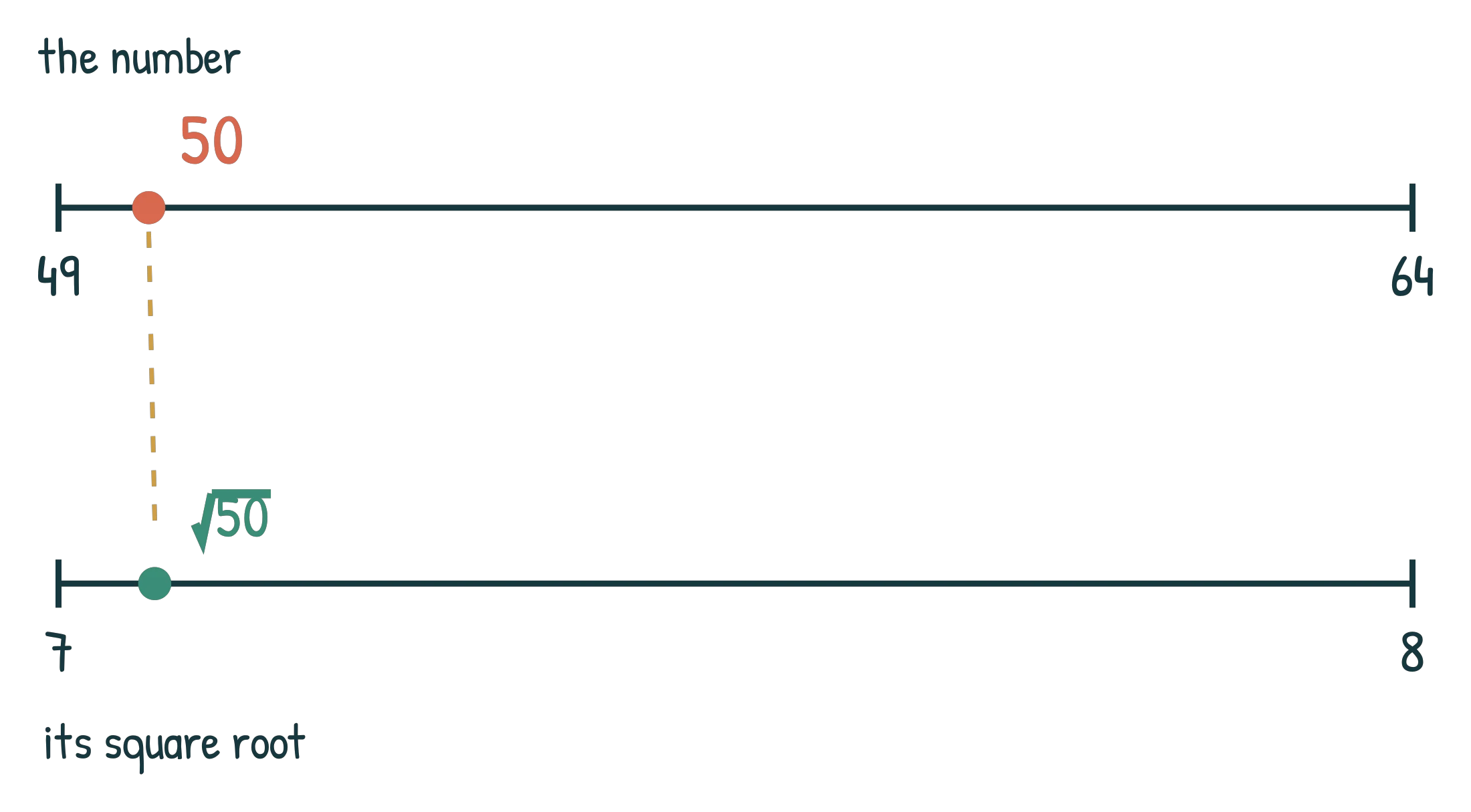
Most numbers aren't. You can still pin the root down precisely enough to be useful by trapping it between two roots you already know.
Worked example
Between which two whole numbers does the square root of 50 lie?
Find the perfect squares either side of 50:
Since , the square root of 50 must sit between the roots of those two:
And you can do better than "somewhere between". 50 is only just past 49, but a long way short of 64 — so its root is only just past 7. (To three decimal places it is .)
Squares, cubes and their roots: 1 to 10
Read this table left to right for squares and cubes, and right to left for roots. If , then — it is the same fact read backwards, which is why learning the squares gets you the roots free.
| (square) | (cube) | |
|---|---|---|
| 1 | 1 | 1 |
| 2 | 4 | 8 |
| 3 | 9 | 27 |
| 4 | 16 | 64 |
| 5 | 25 | 125 |
| 6 | 36 | 216 |
| 7 | 49 | 343 |
| 8 | 64 | 512 |
| 9 | 81 | 729 |
| 10 | 100 | 1000 |
Worth noticing: 64 appears in both columns. It is and also , so while . That single number is behind a lot of dropped marks.
Going further
Two questions that always come up, both slightly beyond what KS3 asks — useful to have met, not something you'll be tested on yet.
Every positive number actually has two square roots. We say , but works too: , because two negatives make a positive. Mathematicians call the principal square root, and that's the one the symbol means. So is right — just know that squares to 49 as well.
Some roots never come out exactly. isn't 7.07, or 7.071, or any decimal that ever stops or repeats. Nor is or . Numbers like these are called irrational, and no fraction can capture them either. This is why "trap it between two you know" matters so much — for most numbers, an estimate is the only exact thing you can say without a calculator.
Where you'll use this next
Square roots are the step that finishes a huge number of problems:
- Area questions run backwards. Given a square field of 81 m², each side is m.
- Pythagoras' theorem ends in a square root every single time — you add two squares, then root the total to get the missing side.
- Standard form and index laws build directly on the square and cube numbers this lesson reverses.
Practice questions
Try these yourself, then click to check each answer. Ask "what number, times itself, gives this?" every time.
1.What is the square root of 9?Show answerHide answer
, so .
2.What is the square root of 100?Show answerHide answer
, so .
3.What is the cube root of 27?Show answerHide answer
, so .
4.What is the cube root of 125?Show answerHide answer
, so .
5.Work out the square root of 36, plus the cube root of 8.Show answerHide answer
and , so the answer is .
6.Between which two whole numbers does the square root of 40 lie?Show answerHide answer
and , and , so it lies between and . It's closer to 6, since 40 is nearer 36 than 49.
7.Spot the mistake: a student says the square root of 64 is 32, because they halved it. What's the real answer?Show answerHide answer
Halving isn't rooting. Check it: , not 64. The square root of 64 is , because .
8.A square patio has an area of 121 square metres. How long is each side?Show answerHide answer
, because . Each side is metres.
Practise this skill
A free printable worksheet with 15 questions and a full worked answer key. No sign-up needed.
Get the Number Properties Test Paper with Mark Scheme free
Ready to test the whole topic? Your first paper is on us — exam-style questions with a full plain-English mark scheme. See what’s in it.
More number properties lessons
- Why Does a Negative Times a Negative Make a Positive? | KS3 Maths
- How to Find Factors and Multiples | KS3 Maths
- What Is a Prime Number? | KS3 Maths
- Multiplying and Dividing Negative Numbers | KS3 Maths
- Square and Cube Numbers | KS3 Maths
- Adding and Subtracting Negative Numbers | KS3 Maths
- How to Use BIDMAS — Order of Operations | KS3 Maths
- Order of Operations (BIDMAS) — Is 8÷2(2+2) 1 or 16? | KS3 Maths