How to Simplify Fractions — KS3 Maths
Simplify fractions by dividing top and bottom by the highest common factor, with an egg-box picture that makes it obvious. Free KS3 lesson.
Divide the top and the bottom by the highest common factor, and keep going until nothing divides both. 8/12 divided by 4 gives 2/3.
Simplifying a fraction means writing it with the smallest numbers possible without changing what it's worth. It is equivalent fractions run in reverse: instead of multiplying the top and bottom by the same number, you divide them by the same number. A fraction is finished when nothing divides into both any more.
What does "simplest form" actually mean?
Worked example
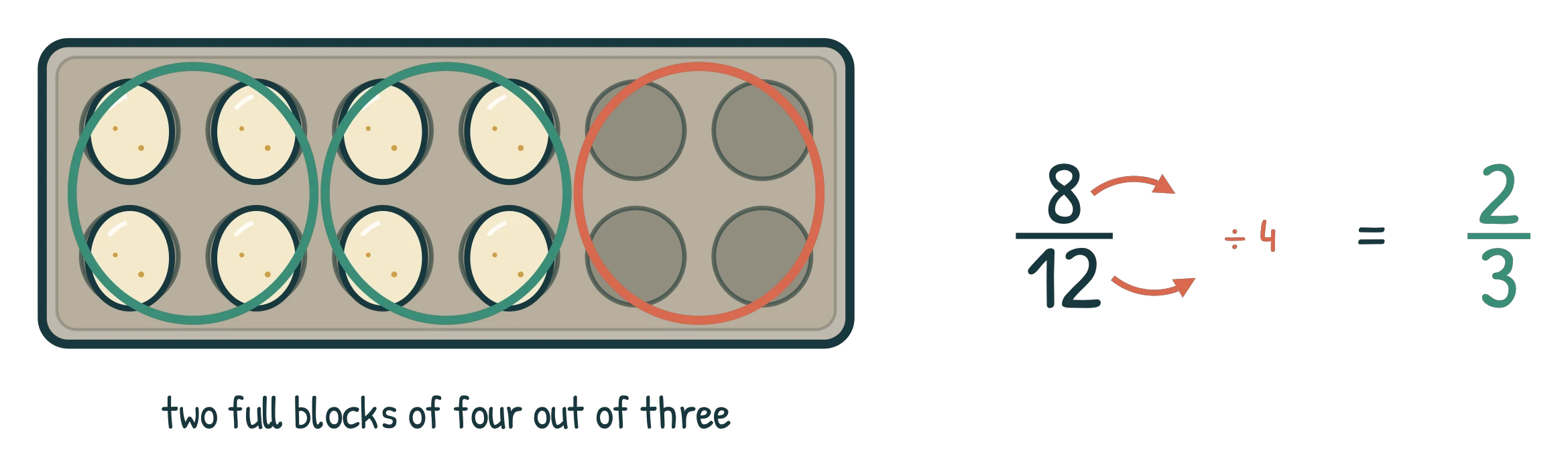
The egg box: what is 8/12 in its simplest form?
A box has room for 12 eggs, and 8 of them are full — the box is full.
The biggest number that divides into both 8 and 12 is 4 — that's the highest common factor. Divide the top and the bottom by it:
2 and 3 share no common factor, so is fully simplified. And you can see it on the box: ring the eggs in blocks of 4 and there are three blocks — exactly two of the three blocks are full. Two thirds.
Worked example
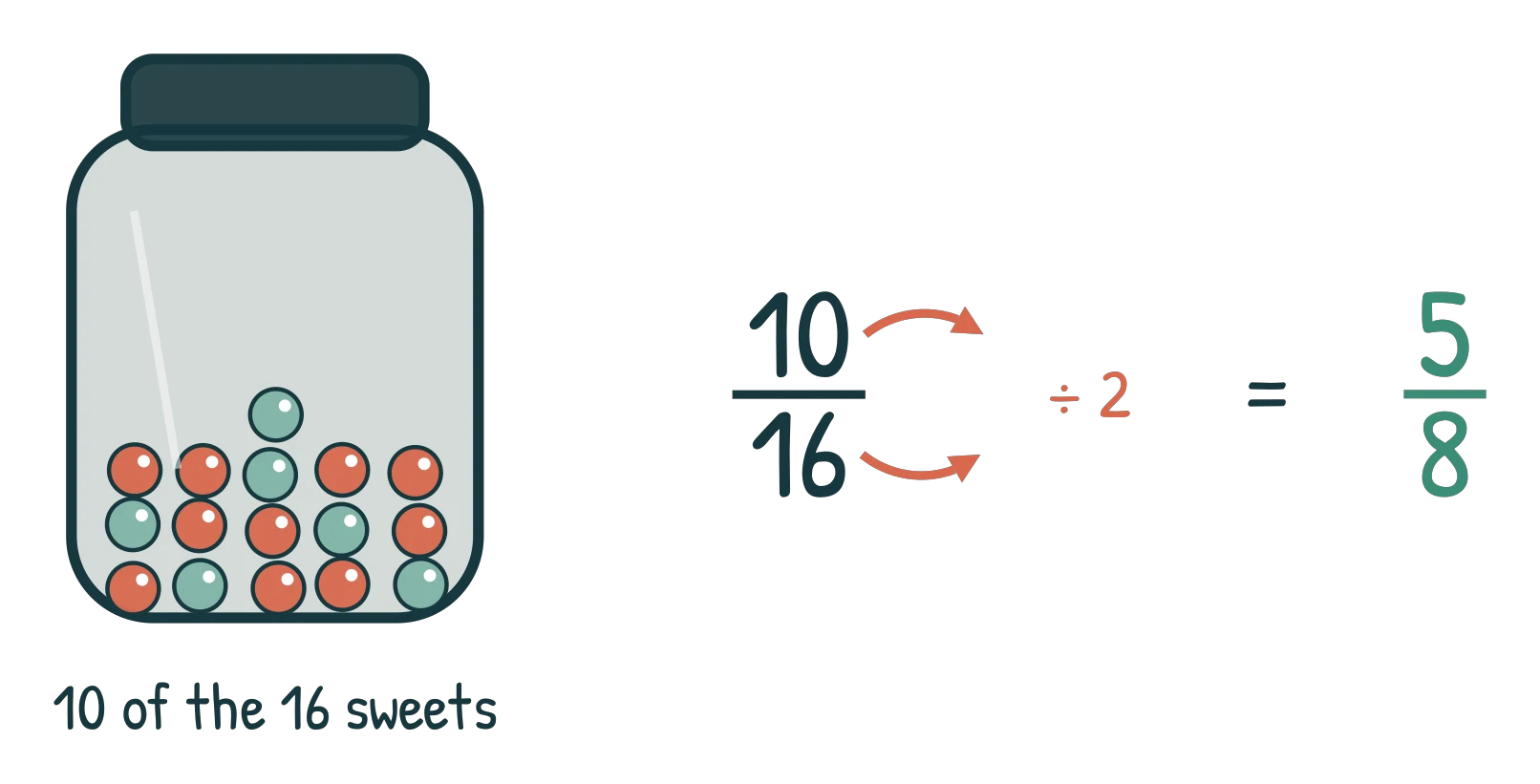
The sweet jar: 10 of 16 sweets
A jar holds 16 sweets and 10 of them are strawberry. What fraction is strawberry, in simplest form?
The highest common factor of 10 and 16 is just 2:
5 and 8 share no common factor — done. of the jar is strawberry.
Worked example
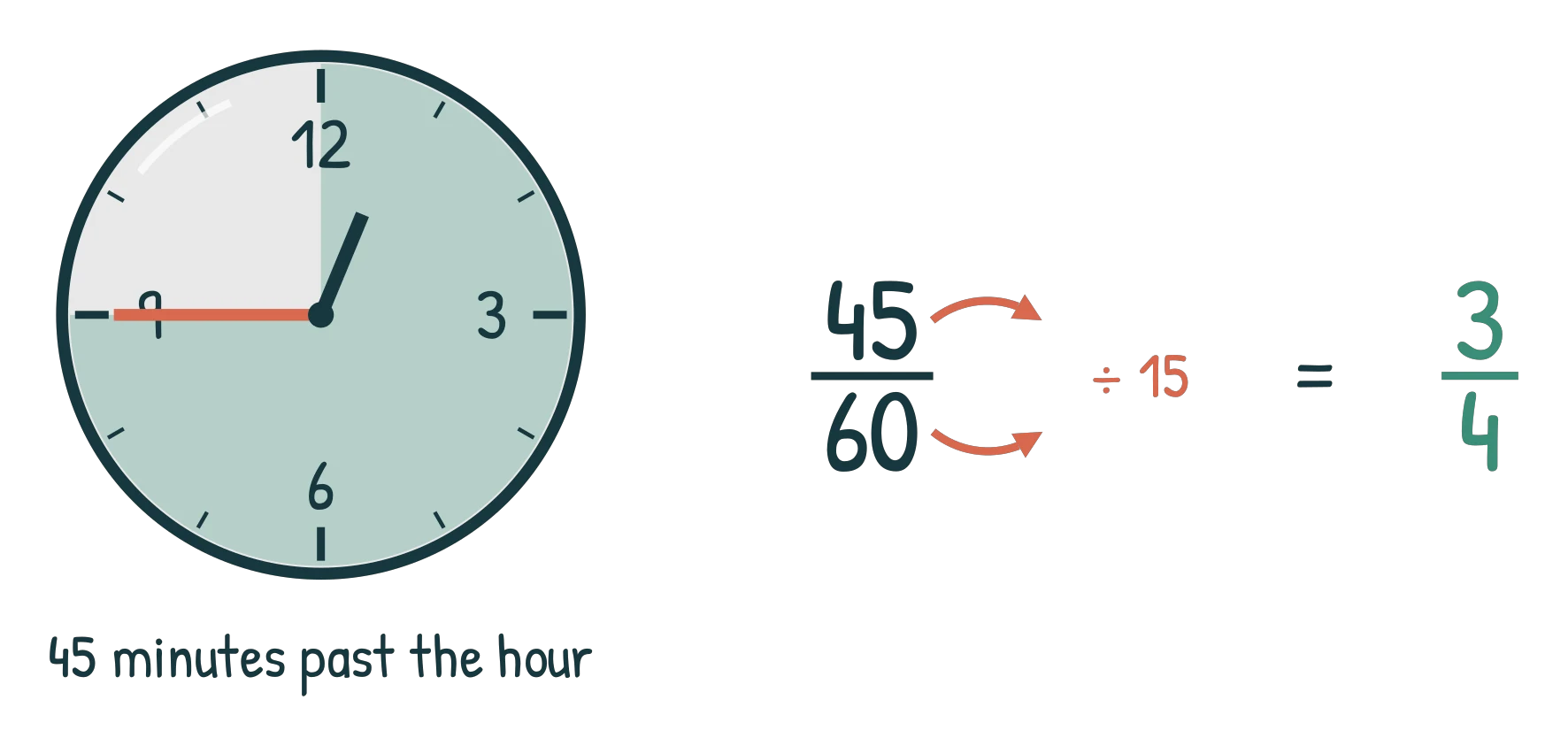
45 minutes of an hour — bigger numbers
45 minutes is what fraction of an hour? An hour is 60 minutes, so the fraction is .
The highest common factor of 45 and 60 is 15:
Didn't spot 15? No problem. Divide by anything that works and keep going: . Every route lands in the same place.
Where you'll use this next
- Every fraction answer is expected in its simplest form, so this is the last step of adding, multiplying and dividing fractions.
- Simplifying ratios uses the identical highest-common-factor move on two numbers instead of one fraction.
- Comparing fractions is far easier once both are in simplest form.
Practice questions
Try these yourself, then click to check each answer. Every solution divides the top and the bottom by the same number — and keeps going until nothing divides both.
1.Write 5/10 in its simplest formShow answerHide answer
The highest common factor of 5 and 10 is 5: .
2.Write 8/10 in its simplest formShow answerHide answer
8 and 10 share a factor of 2: .
3.Write 9/15 in its simplest formShow answerHide answer
9 and 15 share a factor of 3: .
4.Write 20/24 in its simplest formShow answerHide answer
The highest common factor of 20 and 24 is 4: .
5.Write 21/28 in its simplest formShow answerHide answer
21 and 28 share a factor of 7: .
6.Spot the mistake: a student simplifies 16/24 to 8/12 and stops. What should they do next?Show answerHide answer
8 and 12 still share a factor of 4 — they stopped too soon. Keep going: .
(One step would also do it: the highest common factor of 16 and 24 is 8.)
7.In a class of 40 students, 16 walk to school. What fraction walk, in simplest form?Show answerHide answer
— the highest common factor is 8: .
Practise this skill
A free printable worksheet with 16 questions and a full worked answer key. No sign-up needed.
Get the Fractions Test Paper with Mark Scheme free
Ready to test the whole topic? Your first paper is on us — exam-style questions with a full plain-English mark scheme. See what’s in it.