Ordering Decimals & Place Value — KS3 Maths
Order and compare decimals by place value: line up the points, fill the gaps with zeros, compare from the left. Free KS3 lesson and worksheet.
0.3 is bigger than 0.25. Compare decimals place by place from the left — 3 tenths beats 2 tenths, however many digits follow.
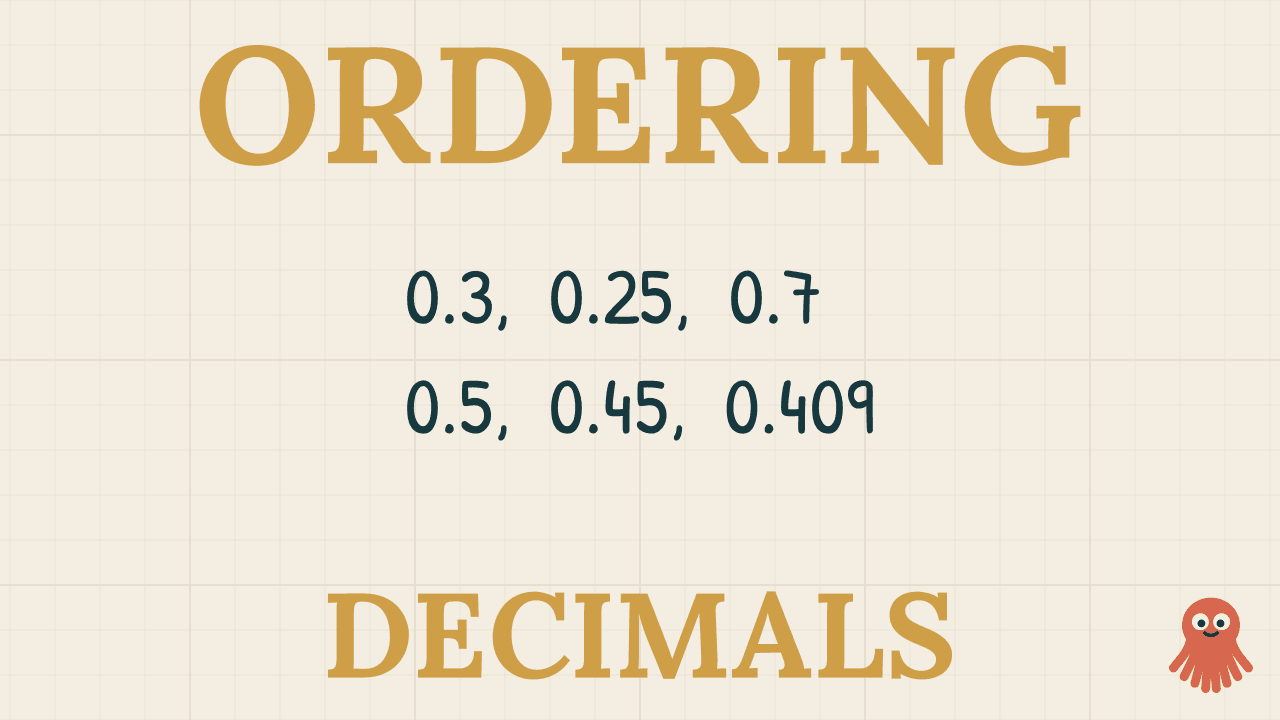
Comparing decimals works one place at a time, from the left. Tenths decide it first; only if those tie do the hundredths get a say. Line the points up, fill any gaps with zeros so every column is complete, and the order falls out — including the ties that look hardest.
What does each decimal place mean?
Every position after the point is worth ten times less than the one before it. That is the whole reason comparing works from the left — a single tenth outweighs everything to its right combined.
| Place | 1st | 2nd | 3rd |
|---|---|---|---|
| Name | tenths | hundredths | thousandths |
| Worth | |||
| In | 4 tenths | 7 hundredths | 2 thousandths |
So is 3 tenths and is 2 tenths and 5 hundredths. 3 tenths beats 2 tenths, so is the bigger number — the extra digit in buys hundredths, and hundredths never outrank tenths.
Worked example
Order 0.3, 0.25, 0.7 (smallest to biggest)
Line up the points and fill the gaps, so becomes :
Compare the tenths: , and . That's enough to order them:
Notice lands above : three tenths beats two tenths, and the tenths column settles it before anything further right gets a vote.
Worked example
Order 1.4, 1.35, 1.6
The whole numbers are all , so compare after the point. Fill the gaps (, ) and compare the tenths: , and :
Worked example
Order 0.5, 0.45, 0.409 (breaking a tie)
Fill the gaps so all three have three decimal places:
Compare the tenths: , , . So is the biggest — but two numbers tie on tenths. Break the tie in the next place, the hundredths: beats , so :
Going further
Negative decimals reverse the order. With negatives, the number further from zero is the smaller one — so while , it's the other way round for . Compare the digits exactly as above, then flip the result. There's more on this in the adding and subtracting negative numbers lesson.
Some decimals never stop. Write as a decimal and you get going on forever. Comparing still works the same way — take enough places that one of them differs.
Where you'll use this next
- Rounding to decimal places uses the same place-value columns to decide which digit is the "decider".
- Money and measures are decimal comparisons in disguise — which is cheaper, £0.85 or £0.9?
- Converting between fractions, decimals and percentages relies on reading place value fluently.
Practice questions
Line up the points, fill the gaps with zeros, and compare from the left. Then click to check.
1.Which is bigger: 0.6 or 0.58?Show answerHide answer
vs — tenths: , so is bigger.
2.Order smallest to biggest: 0.8, 0.75, 0.9Show answerHide answer
Tenths : .
3.Which is bigger: 0.409 or 0.41?Show answerHide answer
vs — tie on tenths (4), then hundredths , so is bigger.
4.Order smallest to biggest: 2.3, 2.03, 2.13Show answerHide answer
Compare after the point: .
5.Which is bigger: 0.5 or 0.48?Show answerHide answer
vs — tenths , so is bigger.
6.Spot the mistake: a student says 0.125 is bigger than 0.2 because it has more digits. What's right?Show answerHide answer
Line them up: vs . Tenths: , so is bigger. More digits doesn't mean larger.
Practise this skill
A free printable worksheet with 16 questions and a full worked answer key. No sign-up needed.
Get the Decimals & Rounding Test Paper with Mark Scheme free
Ready to test the whole topic? Your first paper is on us — exam-style questions with a full plain-English mark scheme. See what’s in it.