How to Multiply Fractions — KS3 Maths
Multiply fractions: tops, then bottoms, then simplify, and see why 'of' means times, with a tray of brownies. Free KS3 lesson and worksheet.
Multiply the tops, multiply the bottoms, then simplify. No common denominator needed: 2/3 × 3/4 = 6/12 = 1/2.
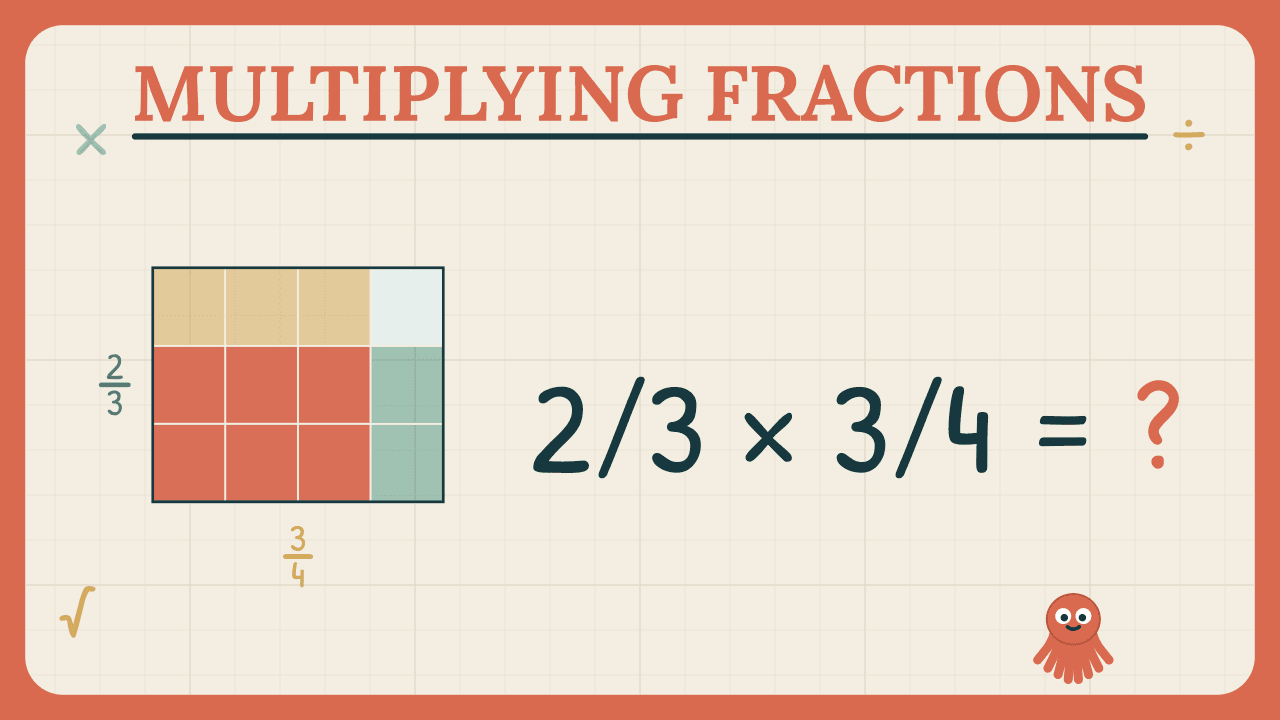
Multiplying fractions is the most straightforward of the four operations: multiply the tops, multiply the bottoms, simplify. There's no common denominator to find — that step belongs to adding and subtracting. It's also worth knowing that the word of means multiply, which is why two thirds of three quarters is a multiplication.
Why does "of" mean multiply?
Worked example
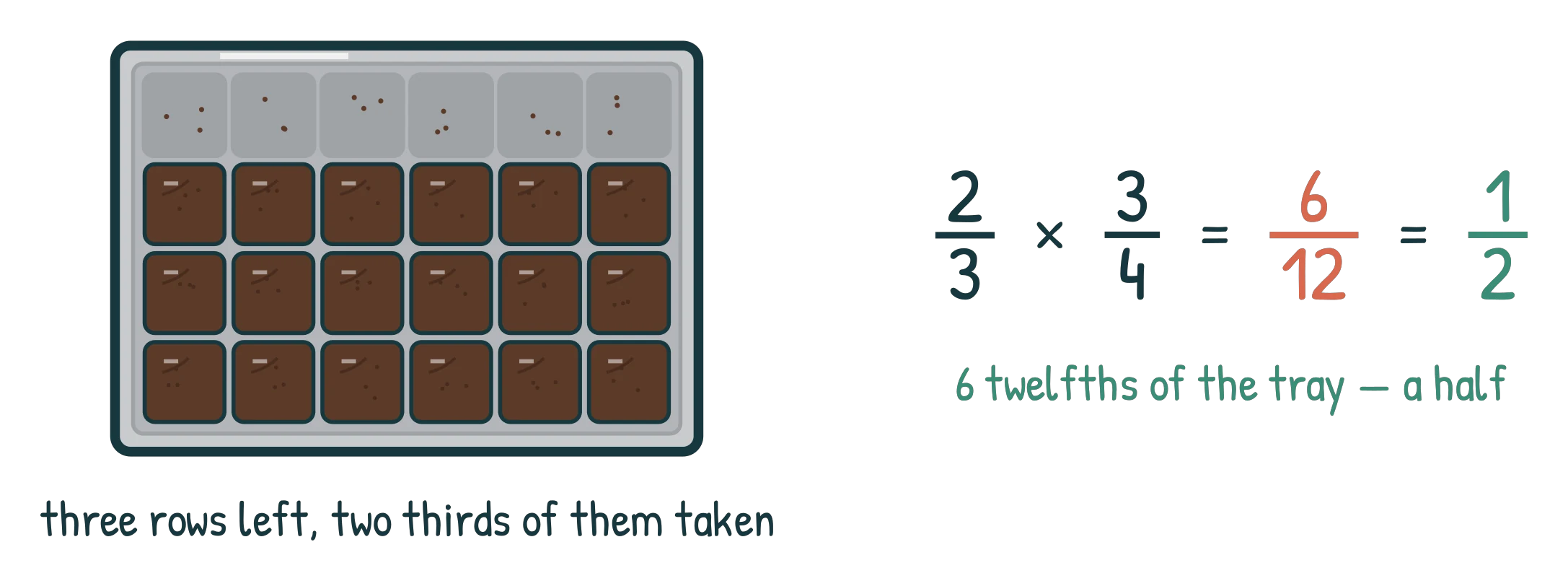
The brownie tray: what is 2/3 of 3/4?
After a party, three quarters of a brownie tray is left. Priya eats two thirds of what's left. What fraction of the whole tray does she eat?
The tray held 24 brownies in four rows of six. At the party the top row went — the rows are quarters, so with three of the four rows left, of the tray is left.
Now the key word: Priya eats two thirds OF what's left, and in maths of means multiply. So the question is really .
Watch it happen on the tray: three rows are left, so the rows are now thirds, and Priya takes two of the three — twelve brownies. And the rule gets the same answer straight across:
The tray proves it: count Priya's brownies — twelve, and twelve of the twenty-four is exactly half the tray.
Worked example
Half a recipe: 1/2 × 4/5 of a jug of water
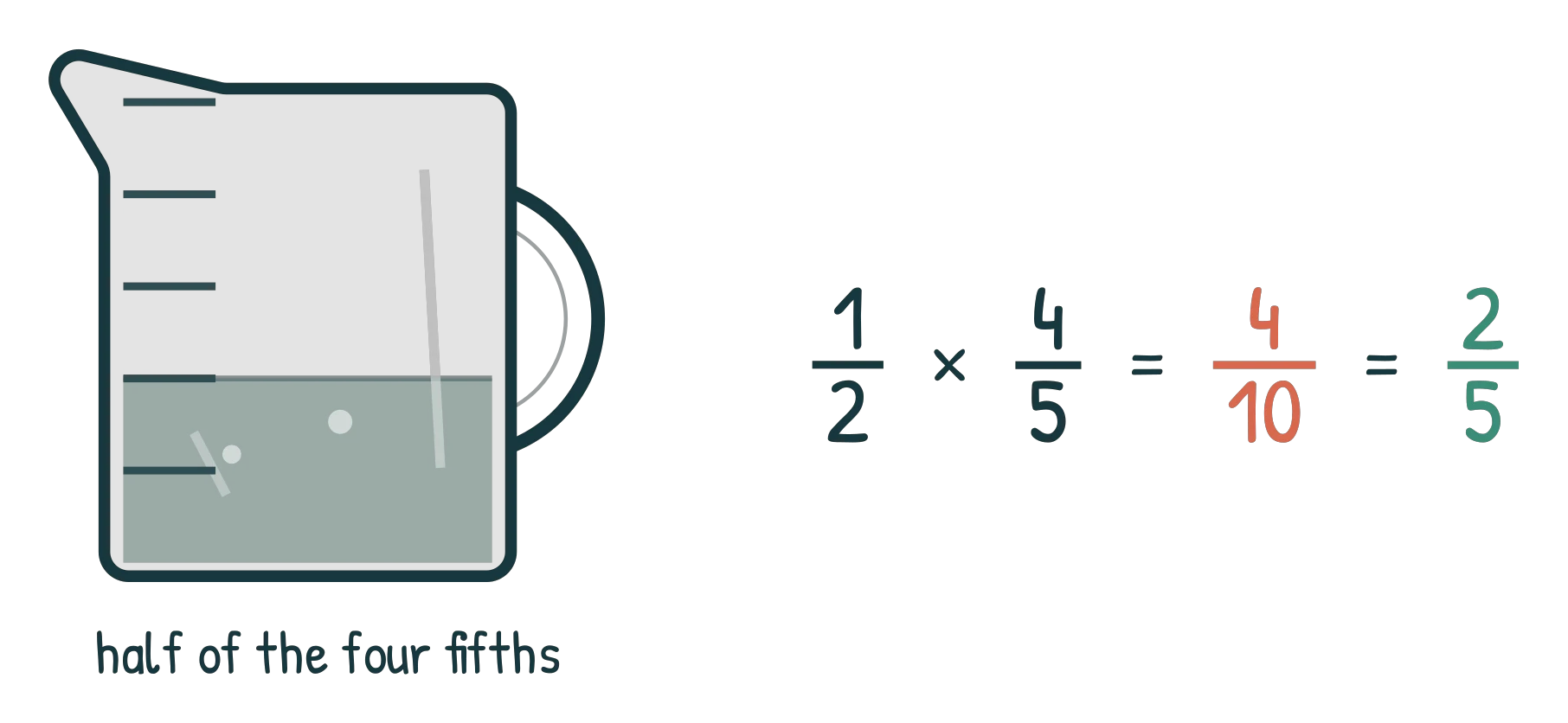
A recipe needs of a jug of water, but you're only making half the recipe. How much water do you need?
Half of the water — of means multiply: . Straight across:
Four tenths simplifies (divide the top and the bottom by 2) to two fifths of a jug — and on the jug's scale, the water comes down to exactly the mark.
Worked example
Apple pie: 2/5 × 5/8
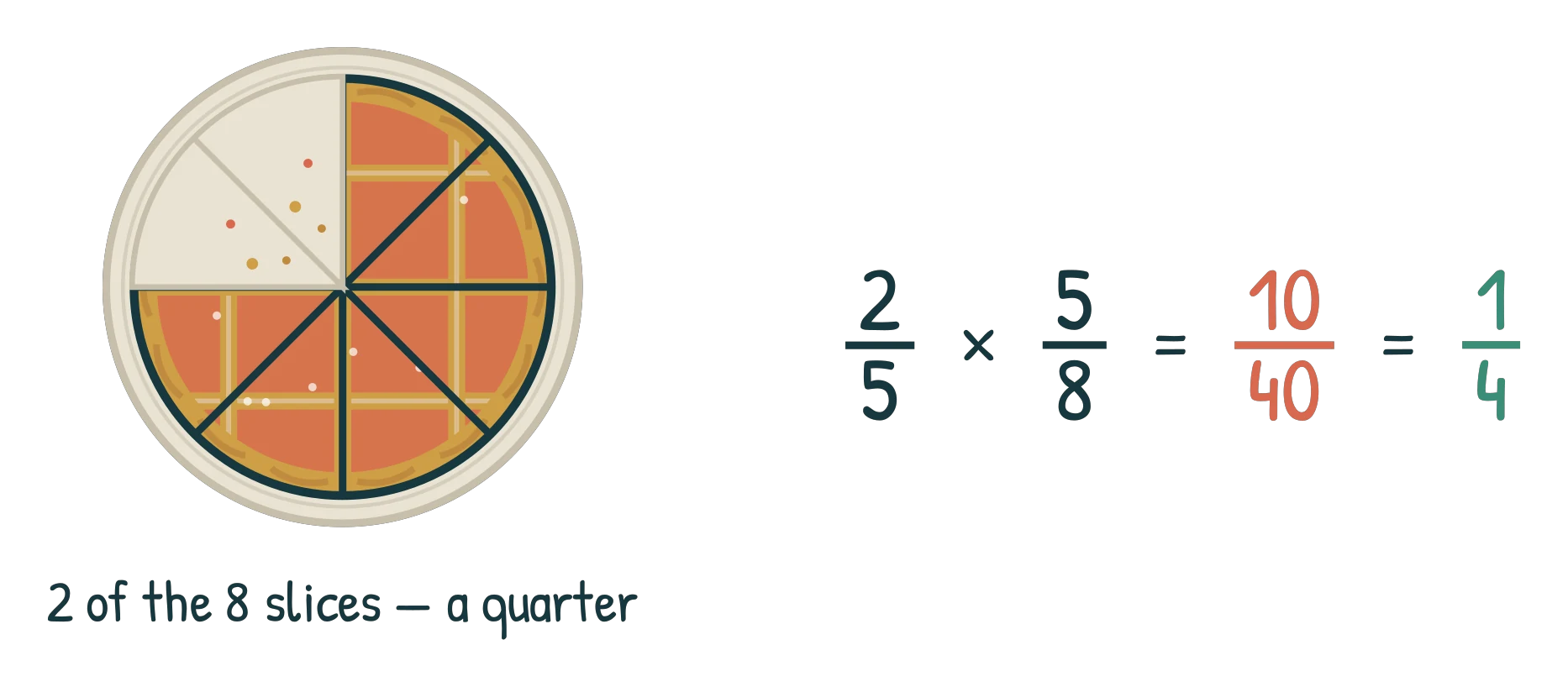
An apple pie was cut into eight slices. After lunch, five slices are left. Ben eats two fifths of what's left. What fraction of the whole pie does he eat?
Two fifths of five eighths — the same rule works: .
And look how friendly the picture is: five slices are left, so each slice is one fifth of what's left — two fifths is simply two slices. Now the rule:
Ten and forty both divide by ten, so Ben eats one quarter of the whole pie. Check it on the pie: he ate two of the eight slices, and two eighths is exactly a quarter.
Where you'll use this next
- Dividing fractions turns straight into a multiplication, so this method is the engine behind that one too.
- Fractions of an amount is multiplying a fraction by a whole number.
- Scaling recipes, probability and area all multiply fractions in context.
Practice questions
Try these yourself, then click to check each answer. Every solution multiplies straight across — tops times tops, bottoms times bottoms — and simplifies at the end.
1.Work out 1/2 × 1/3Show answerHide answer
Straight across: .
2.Work out 2/3 × 3/5Show answerHide answer
, and 6 and 15 both divide by 3: .
3.Work out 3/4 × 2/9Show answerHide answer
.
4.What is 2/3 of 3/8?Show answerHide answer
"of" means multiply: .
5.Spot the mistake: a student writes 3/7 × 2/7 = 6/7. What went wrong, and what's the real answer?Show answerHide answer
They multiplied the tops but kept the bottom — that's the adding rule. The bottoms multiply too: .
6.Two fifths of a class walk to school. Half of the walkers are boys. What fraction of the whole class are boys who walk?Show answerHide answer
Half of two fifths: of the class.
7.A cake recipe uses 3/4 of a bag of flour. Maya makes 2/3 of the recipe. What fraction of the bag does she use?Show answerHide answer
— exactly half the bag (the brownie-tray sum in disguise!).
Practise this skill
A free printable worksheet with 16 questions and a full worked answer key. No sign-up needed.
Get the Fractions Test Paper with Mark Scheme free
Ready to test the whole topic? Your first paper is on us — exam-style questions with a full plain-English mark scheme. See what’s in it.