How to Divide Fractions — KS3 Maths
Divide fractions with Keep, Change, Flip, and see why flipping the second fraction actually works. Free KS3 lesson with a worksheet.
Keep the first fraction, change the divide to a multiply, and flip the second fraction. 1/2 ÷ 3/4 becomes 1/2 × 4/3 = 2/3.
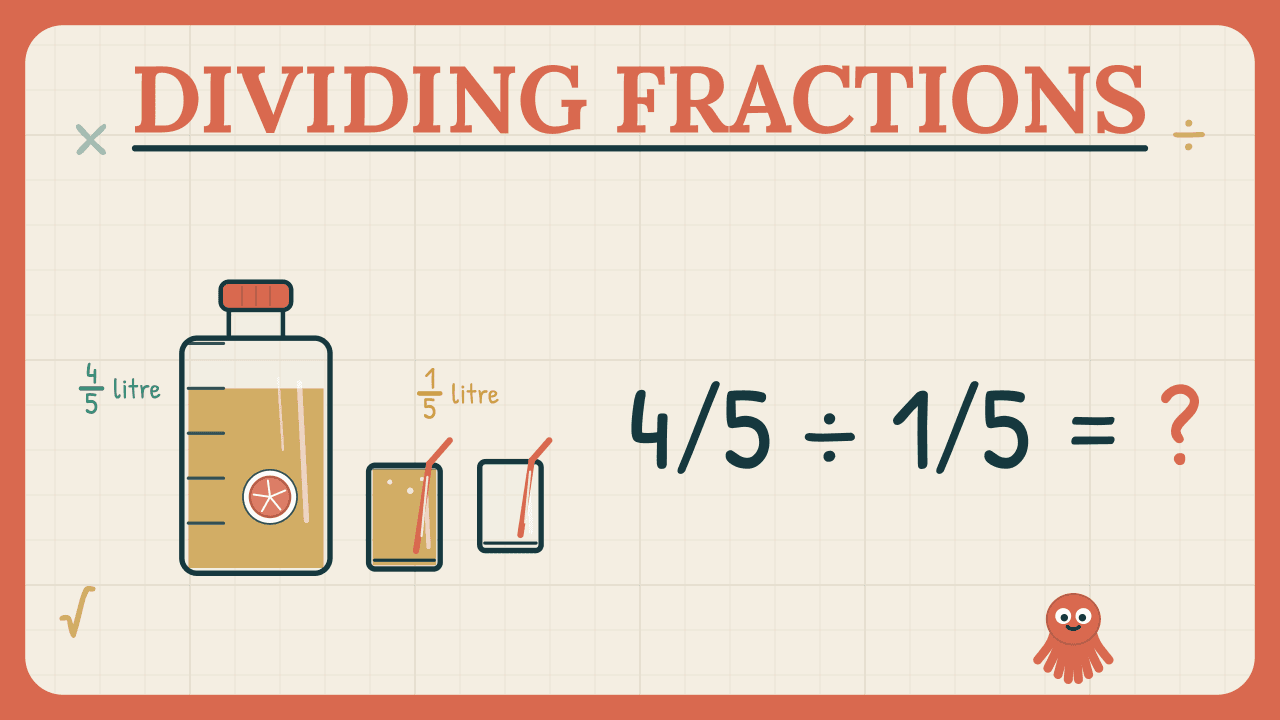
Dividing by a fraction asks a question you can picture: how many of these fit into that? How many three-quarters fit into a half? The method that answers it every time is Keep, Change, Flip — keep the first fraction, change the divide to a multiply, flip the second — and the picture is what makes it more than a trick to memorise.
Why does flipping work?
Worked example
The juice bottle: 4/5 ÷ 1/5
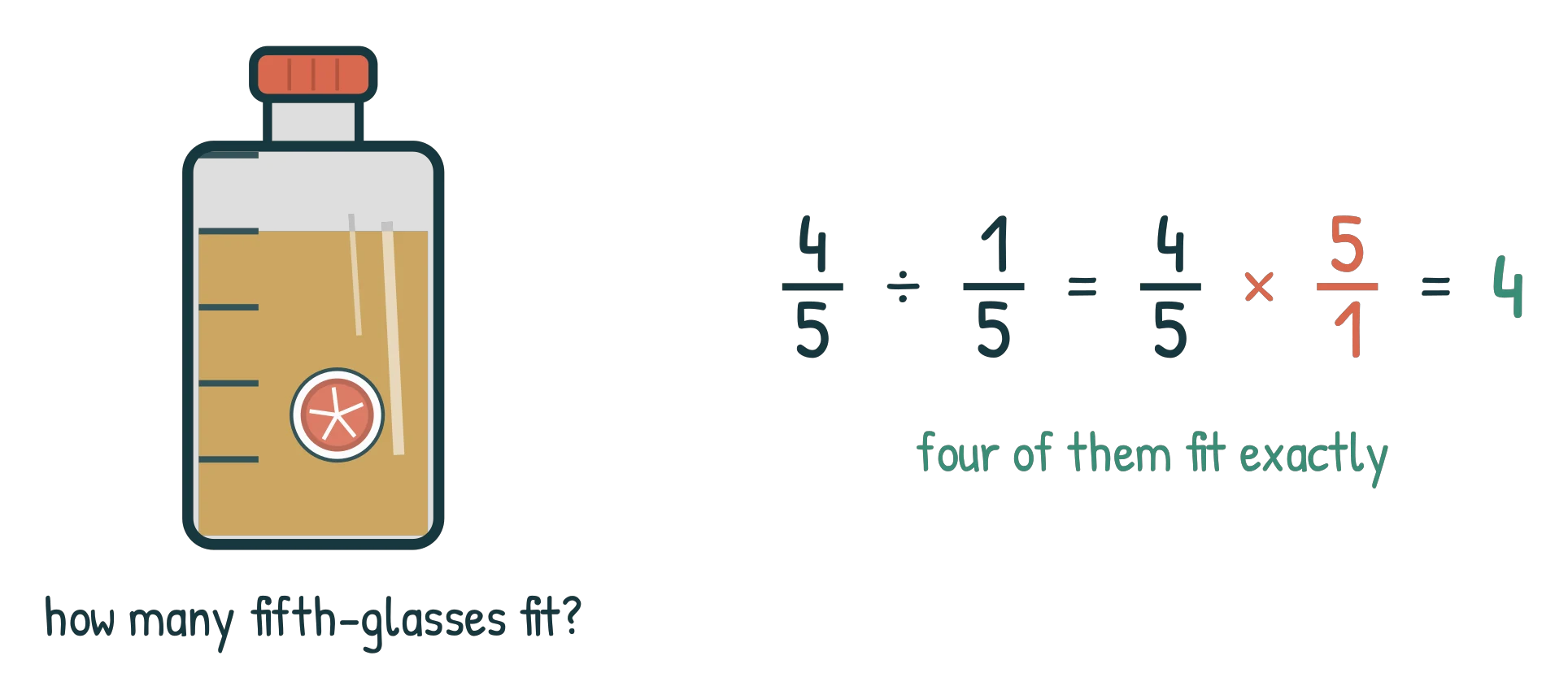
A bottle holds four fifths of a litre of juice. A glass holds one fifth of a litre. How many glasses can you fill?
That's — and keep, change, flip answers it. Keep . Change the into . Flip upside down to . From here it's just multiplying fractions:
Four glasses — but why does flipping work? Look at what the question actually asks: how many one-fifths fit into four-fifths? So simply pour and count — one glass, two, three, four, and the bottle's empty. And the reason the trick works: a whole litre holds five fifths, so dividing by one fifth is exactly the same as multiplying by five.
Worked example
The chocolate bar: 3/4 ÷ 3/8
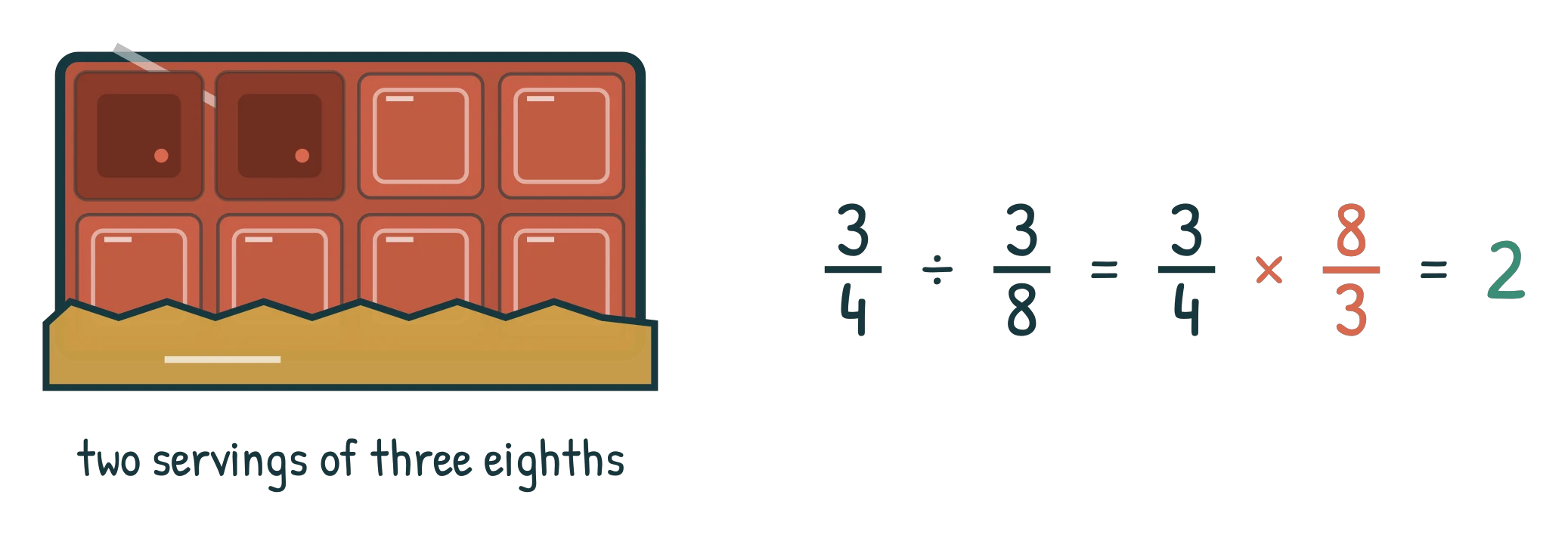
Three quarters of a chocolate bar is left. A serving is three eighths of a bar. How many servings are left?
The bar had eight squares and two are gone, so six of the eight squares are left — and is . A serving is three squares, and you can see two servings fit on the bar. Now the rule — keep , change to multiply, flip to :
Two servings — the picture and the rule agree.
Worked example
Sharing a pizza: 3/4 ÷ 2
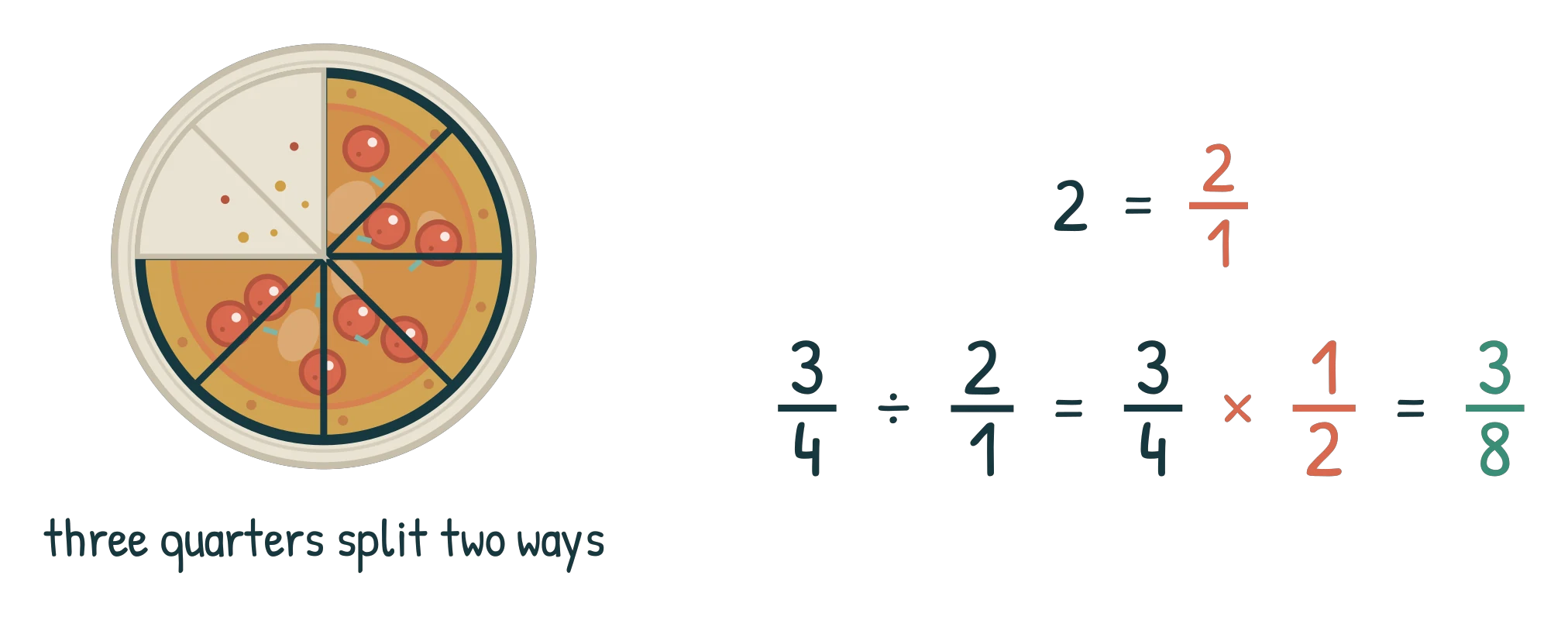
Three quarters of a pizza is left, shared equally between two friends. What fraction of the whole pizza does each friend get?
This one looks different — we're dividing by a whole number. But any whole number is already a fraction: is just . So the same trick works. Keep , change to multiply, flip to — which makes sense, because sharing between two people means each gets half of what's there:
Each friend gets three eighths of the whole pizza — already in its simplest form. Check it on the pizza: six slices dealt out is three each, and three of the eight slices is exactly .
Where you'll use this next
- Multiplying fractions is what every division becomes after the flip.
- Converting improper fractions and mixed numbers — mixed numbers must be made improper before you divide.
- Rates and unit conversion are fraction divisions wearing a context.
Practice questions
Try these yourself, then click to check each answer. Every solution keeps the first fraction, changes the divide to a multiply, flips the second fraction, then multiplies straight across and simplifies.
1.Work out 1/2 ÷ 1/4Show answerHide answer
Flip to : . (Two quarters fit in a half.)
2.Work out 2/5 ÷ 3/4Show answerHide answer
Flip to : .
3.Work out 4/5 ÷ 2Show answerHide answer
is , which flips to : .
4.Work out 5/6 ÷ 1/3Show answerHide answer
Flip to : — two and a half thirds fit.
5.Spot the mistake: a student writes 1/3 ÷ 2/5 = 3/1 × 2/5 = 6/5. What went wrong, and what's the real answer?Show answerHide answer
They flipped the first fraction — keep the first, flip the second: . (Sense-check: doesn't quite fit into , so the answer must be less than 1 — couldn't have been right.)
6.A bottle holds 9/10 of a litre. A cup holds 3/10 of a litre. How many cups can you fill?Show answerHide answer
How many s fit into ? cups.
7.Two thirds of a cake is shared equally between four people. What fraction of the whole cake does each person get?Show answerHide answer
, and flips to : of the cake each.
Practise this skill
A free printable worksheet with 16 questions and a full worked answer key. No sign-up needed.
Get the Fractions Test Paper with Mark Scheme free
Ready to test the whole topic? Your first paper is on us — exam-style questions with a full plain-English mark scheme. See what’s in it.