Multiplying and Dividing Negative Numbers | KS3 Maths
Multiplying and dividing negative numbers: same signs give a positive, different signs give a negative, plus the minus-sign shortcut.
Same signs give a positive, different signs give a negative — the same rule for × and ÷. So (−3) × (−5) = 15.
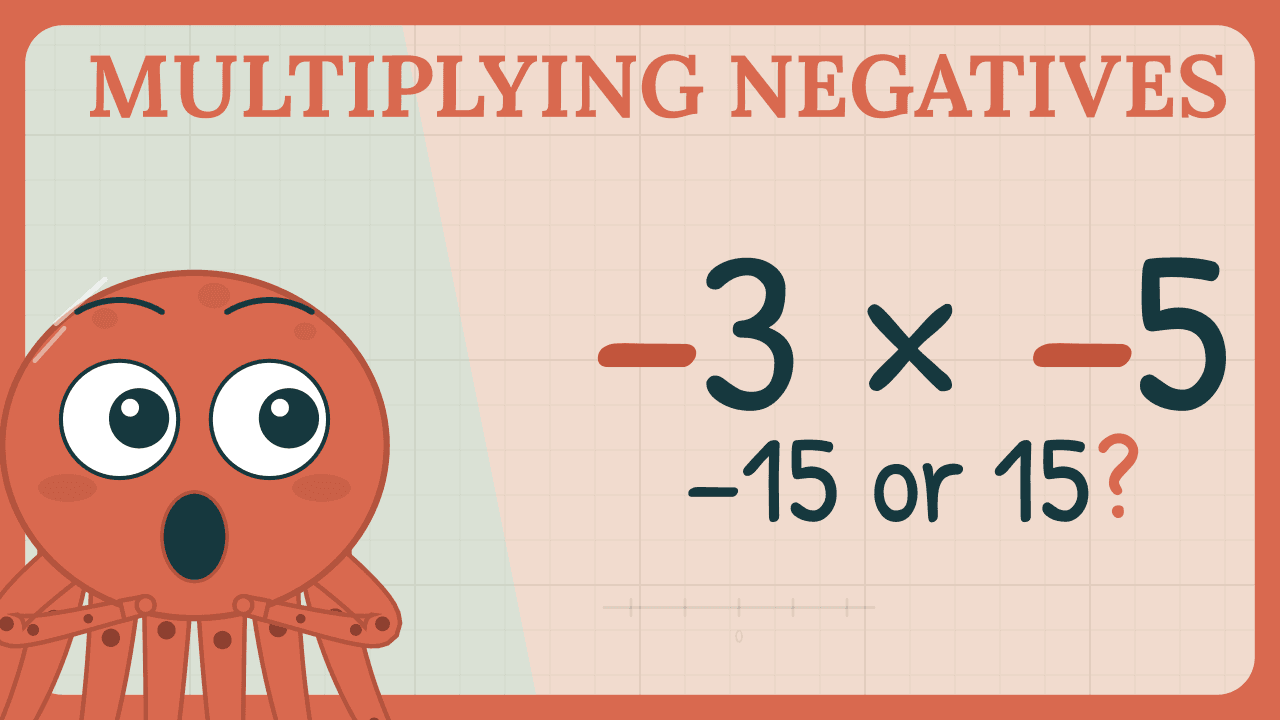
One rule covers both operations: same signs give a positive, different signs give a negative. It works identically for and — work out the sign first, then multiply or divide the sizes. Rather than asking you to take that on trust, this lesson builds the pattern that forces it to be true.
Why do two negatives make a positive?
Worked example
The pattern that proves it
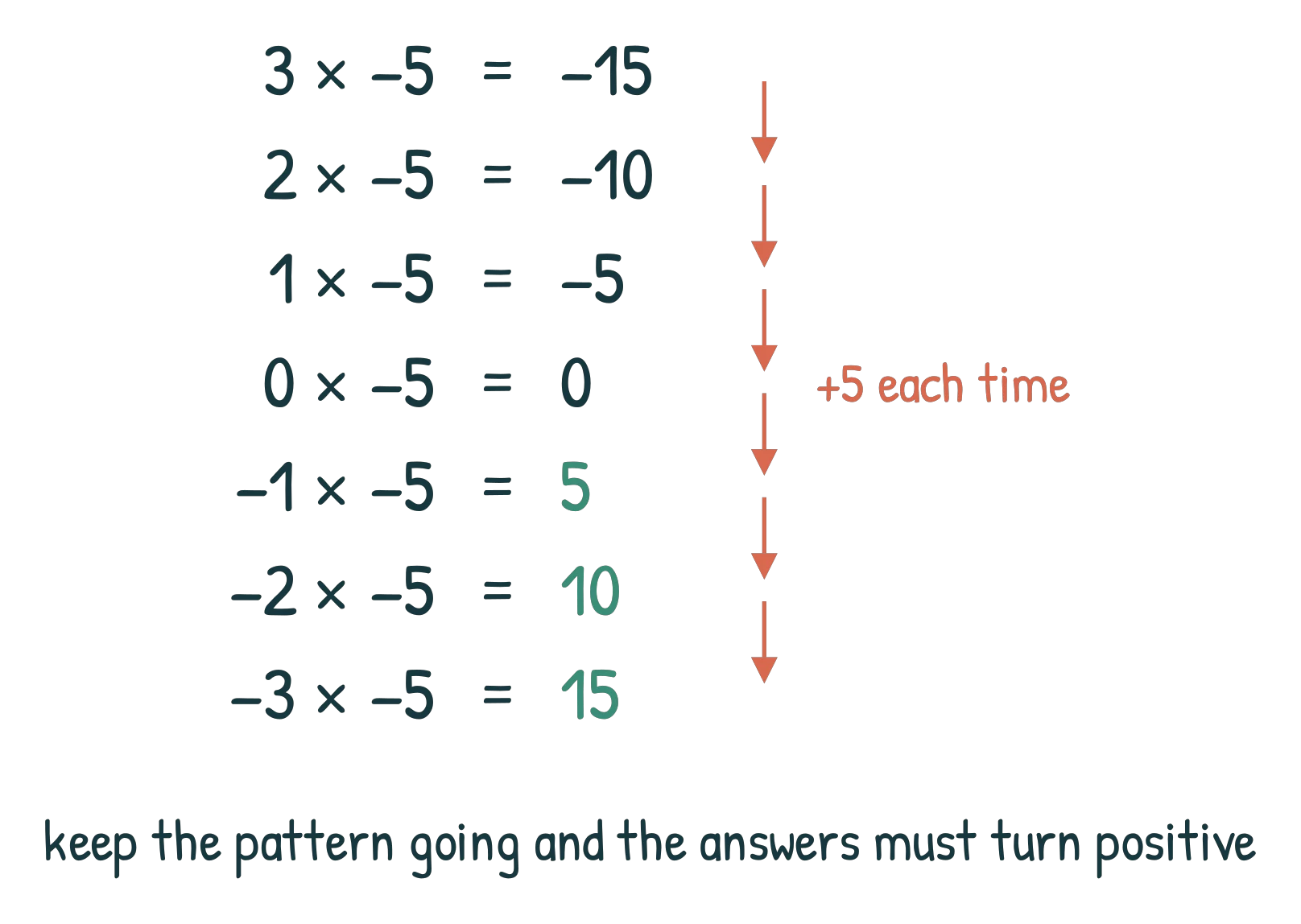
Start from something you can check for yourself. means three lots of negative five — count them up and you get , then , then . Now walk the multiplier down one step at a time and watch the answers:
Every time the multiplier drops by one, the answer climbs by five. Keep the pattern going past zero and it has no choice but to carry on climbing:
The pattern forces the answers positive. Negative three times negative five is positive fifteen — not because a rule says so, but because anything else would break the staircase.
The same rule for dividing
Worked example
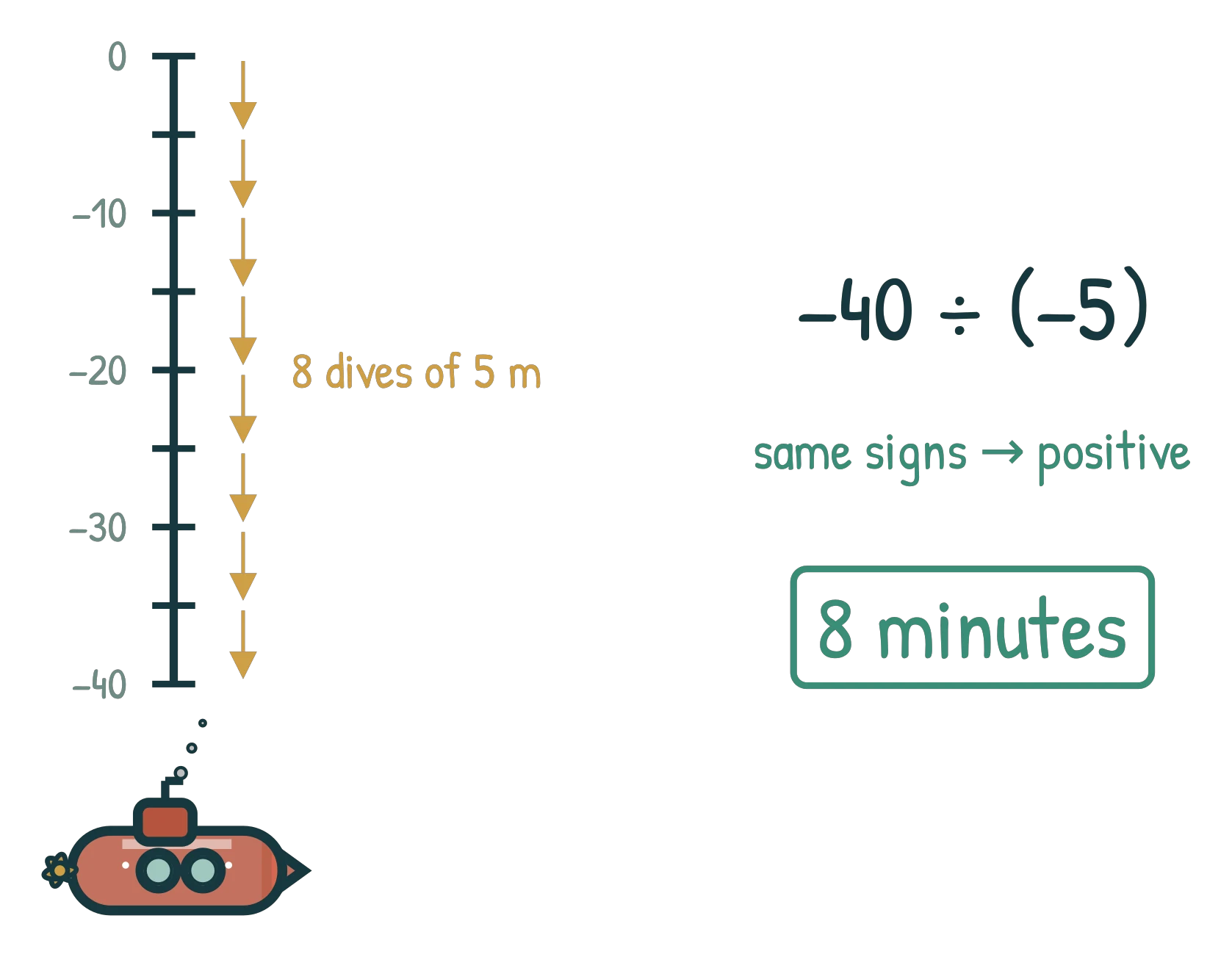
A submarine dives 5 m every minute. It stops at −40 m. How long did the dive take?
Down five metres a minute is a rate of ; the finishing depth is . Time is depth divided by rate:
Count the five-metre dives down the depth scale — one, two, three… eight of them reach m. And the signs agree: a negative divided by a negative is same signs, so positive — which is reassuring, because a dive can't take negative eight minutes!
Three or more numbers: count the minus signs
Worked example
What is −4 × (−2) × (−3)?
With a chain of negatives, don't work sign-by-sign — count the minus signs first. Here there are three, and three is odd, so the answer is negative. Then just multiply the sizes:
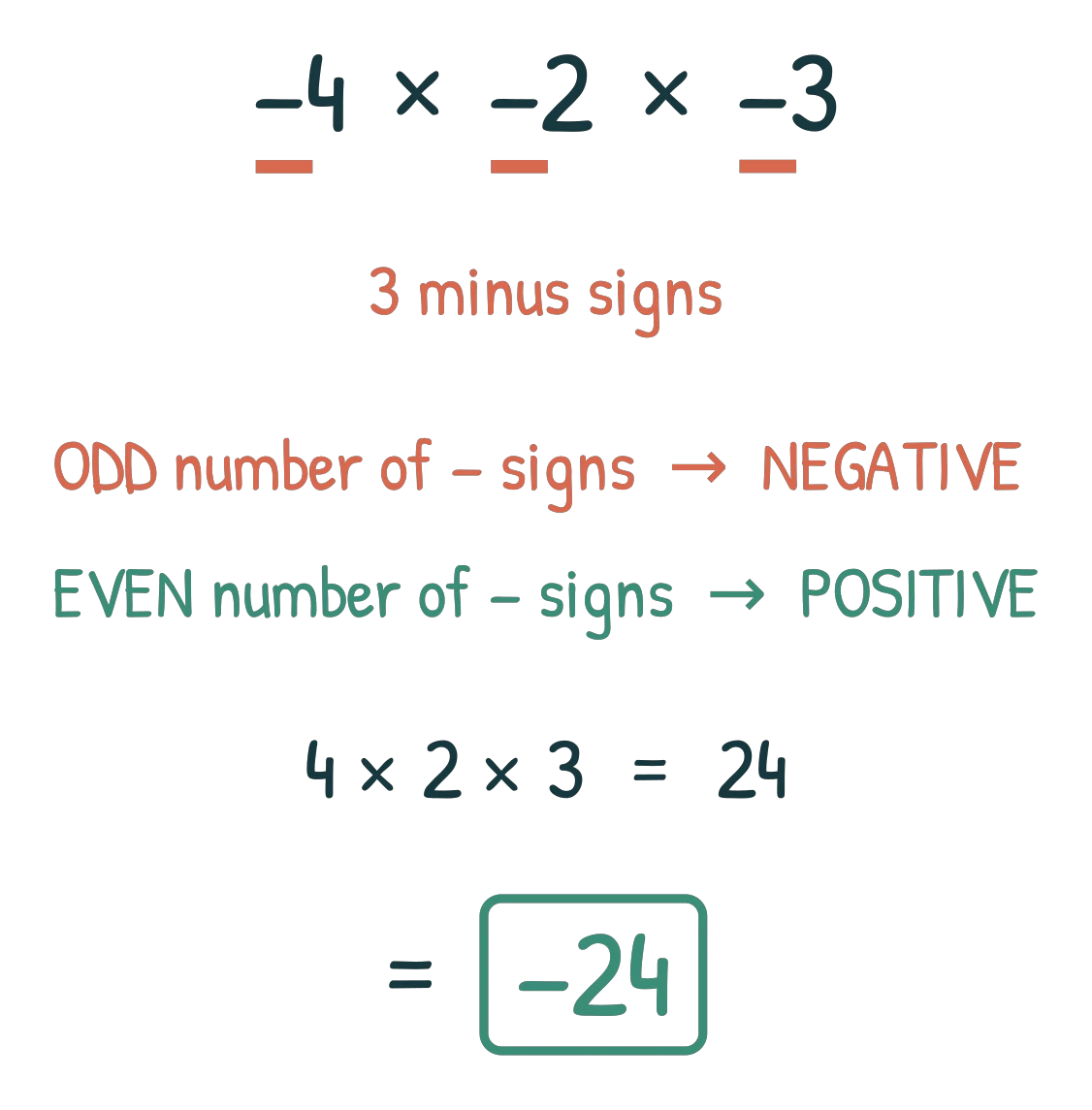
Try it with four minus signs: . Four is even, so the answer is positive: .
Where you'll use this next
- Adding and subtracting negative numbers is the other half — and a genuinely different rule.
- Why does a negative times a negative make a positive? gives a second reason, by turning around on a number line.
- Square and cube numbers — squaring a negative always gives a positive, which is why .
- Coordinates and gradients use negatives in all four quadrants.
Practice questions
Try these yourself, then click to check each answer. Sign first, size second, every time.
1.Work out 7 × (−3)Show answerHide answer
Different signs → negative. , so the answer is .
2.Work out −20 ÷ (−4)Show answerHide answer
Same signs → positive. .
3.Work out −6 × (−8)Show answerHide answer
Same signs → positive. .
4.Work out −45 ÷ 5Show answerHide answer
Different signs → negative. , so the answer is .
5.Work out −2 × (−6) × (−1)Show answerHide answer
Three minus signs — odd, so negative. , giving .
6.A diver descends 6 m every minute for 5 minutes. What is her depth, as a negative number?Show answerHide answer
: different signs → negative, so she is at m.
7.Spot the mistake: a student writes −5 + (−3) = 8, saying 'two minuses make a plus'. What went wrong?Show answerHide answer
That rule is for multiplying and dividing — this is an addition. Adding a negative is subtracting: .
Practise this skill
A free printable worksheet with 16 questions and a full worked answer key. No sign-up needed.
Get the Number Properties Test Paper with Mark Scheme free
Ready to test the whole topic? Your first paper is on us — exam-style questions with a full plain-English mark scheme. See what’s in it.
More number properties lessons
- Why Does a Negative Times a Negative Make a Positive? | KS3 Maths
- How to Find Factors and Multiples | KS3 Maths
- What Is a Prime Number? | KS3 Maths
- Square and Cube Roots | KS3 Maths
- Square and Cube Numbers | KS3 Maths
- Adding and Subtracting Negative Numbers | KS3 Maths
- How to Use BIDMAS — Order of Operations | KS3 Maths
- Order of Operations (BIDMAS) — Is 8÷2(2+2) 1 or 16? | KS3 Maths