How to Find a Fraction of an Amount — KS3 Maths
Find a fraction of an amount: divide by the bottom, multiply by the top. Worked examples with a bar model. Free KS3 lesson and worksheet.
Divide by the bottom number, then multiply by the top. For 3/4 of 24: 24 ÷ 4 = 6, then 6 × 3 = 18.
Finding a fraction of an amount is two steps in a fixed order: divide by the bottom, then multiply by the top. The bottom number tells you how many equal parts to break the amount into; the top tells you how many of those parts to take.
What does the bottom number actually do?
It says how many equal parts to cut the amount into. The top says how many of those parts you keep.
So for of 24: the 4 breaks 24 into four equal parts of 6, and the 3 keeps three of them. You never need to think about it as anything more complicated than that.
What is 3/4 of 24?
of 24 is 18.
Worked example
Find 3/4 of 24
Divide by the bottom. Four equal parts of 24:
So one quarter is 6.
Multiply by the top. You want three of those quarters:
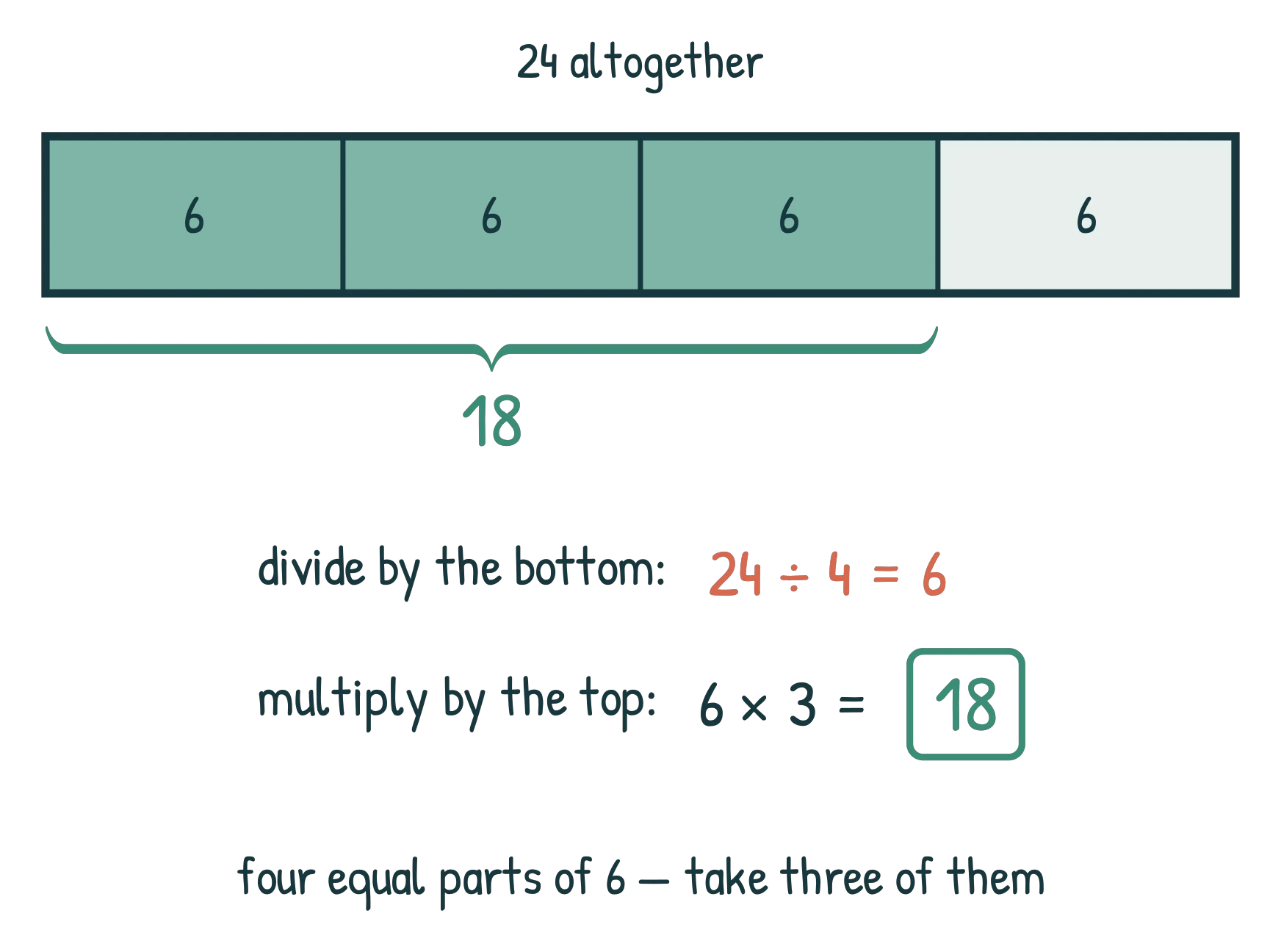
Sense-check it: three quarters is most of the amount, and 18 is most of 24. If your answer had come out smaller than 6, something went wrong.
Worked example
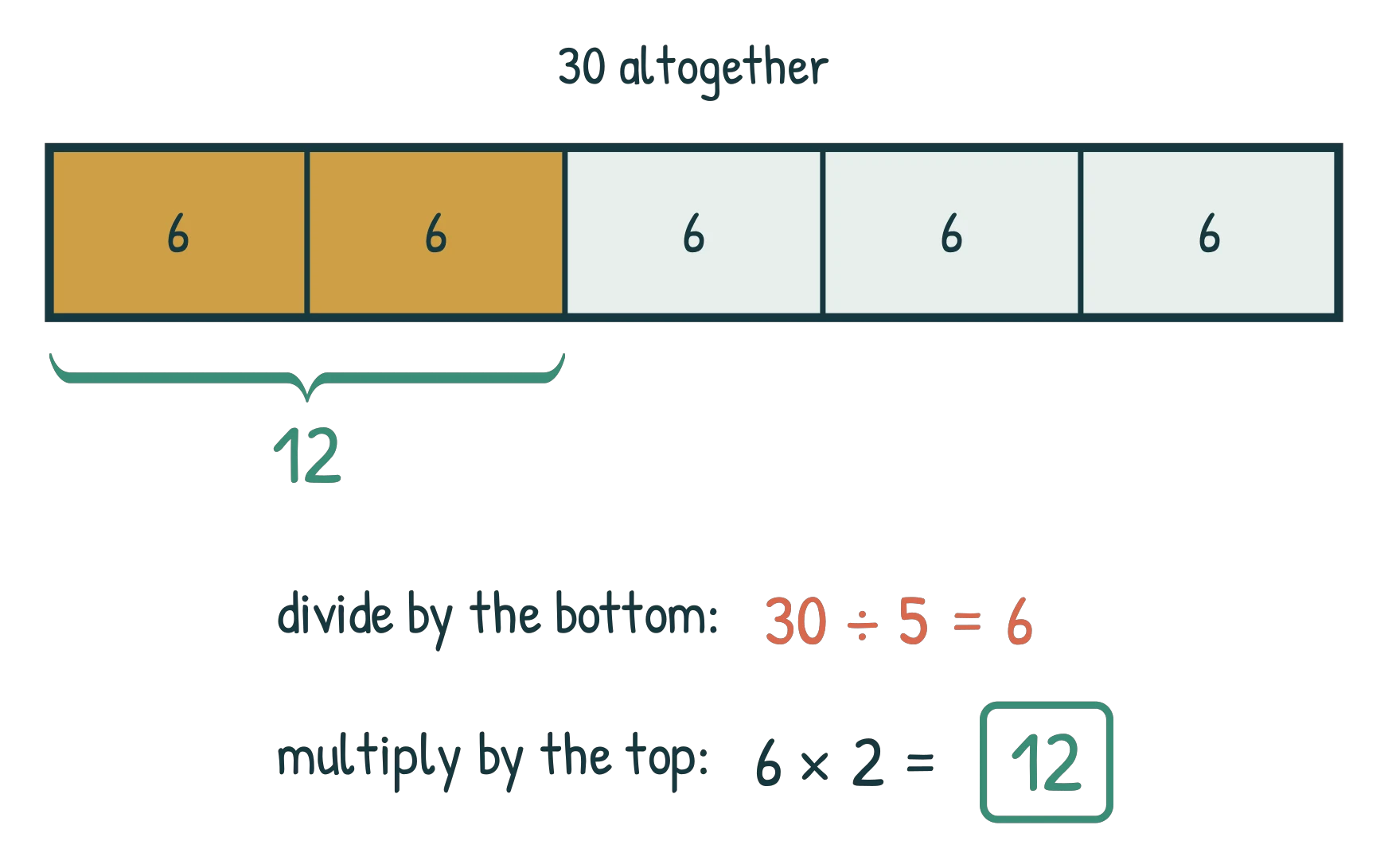
Find 2/5 of 30
Divide by the bottom: , so one fifth is 6.
Multiply by the top: .
Worked example
Find 5/8 of 40
Divide by the bottom: .
Multiply by the top: .
Here the answer is more than half, which fits — is just over a half.
Does the order matter?
Mathematically, no — and both give 18. In practice, divide first. Dividing first keeps the numbers small and easy: , then . Multiplying first means handling before dividing, which is harder without a calculator and easier to slip up on.
The exception is when the division isn't exact. For of 20, dividing first gives , so multiply first instead: , then .
Where you'll use this next
- Percentage of an amount is the same skill in different clothing — 25% of something is of it.
- Sharing in a ratio uses the same divide-then-multiply move on each share.
- Discounts, recipe scaling and problem solving all reduce to finding a fraction of an amount.
Practice questions
Divide by the bottom, then multiply by the top. Then click to check.
1.Find 2/3 of 60Show answerHide answer
, then .
2.Find 3/4 of 200Show answerHide answer
, then .
3.Find 4/7 of 35Show answerHide answer
, then .
4.Find 5/6 of 18Show answerHide answer
, then .
5.Find 2/9 of 45Show answerHide answer
, then .
6.A jacket costs £250. It has 2/5 off. How much money is taken off?Show answerHide answer
, then off. (The price you'd pay is .)
7.Spot the mistake: to find 3/4 of 24 a student works out 24 ÷ 3 × 4 = 32. What went wrong?Show answerHide answer
They divided by the top and multiplied by the bottom. The bottom number is the number of parts, so it does the dividing: , then . A check that catches it instantly — three quarters of 24 can't be bigger than 24.
Practise this skill
A free printable worksheet with 16 questions and a full worked answer key. No sign-up needed.
Get the Fractions Test Paper with Mark Scheme free
Ready to test the whole topic? Your first paper is on us — exam-style questions with a full plain-English mark scheme. See what’s in it.