Improper Fractions & Mixed Numbers — KS3 Maths
Convert improper fractions to mixed numbers and back, one simple method each way, with a bar model showing why it works. Free KS3 lesson.
Improper to mixed: divide the top by the bottom — 7/3 = 2 remainder 1, so 2 1/3. Mixed to improper: times the whole number by the bottom and add the top.
An improper fraction is top-heavy — its top number is bigger than its bottom, like . A mixed number writes the same value as a whole number plus a fraction, like . They're two ways of saying exactly the same amount, and one short method converts each way.
What is an improper fraction?
A fraction is improper when its top number is at least as big as its bottom. That sounds like something has gone wrong, but nothing has — just means seven thirds, and since three thirds make a whole, seven of them make more than one whole.
Picture three-slice pizzas. Seven slices fills two whole pizzas with one slice left over — which is exactly . Both notations describe the same seven slices.
Improper fractions are easier to calculate with; mixed numbers are easier to picture. That's why you need both.
How do you turn an improper fraction into a mixed number?
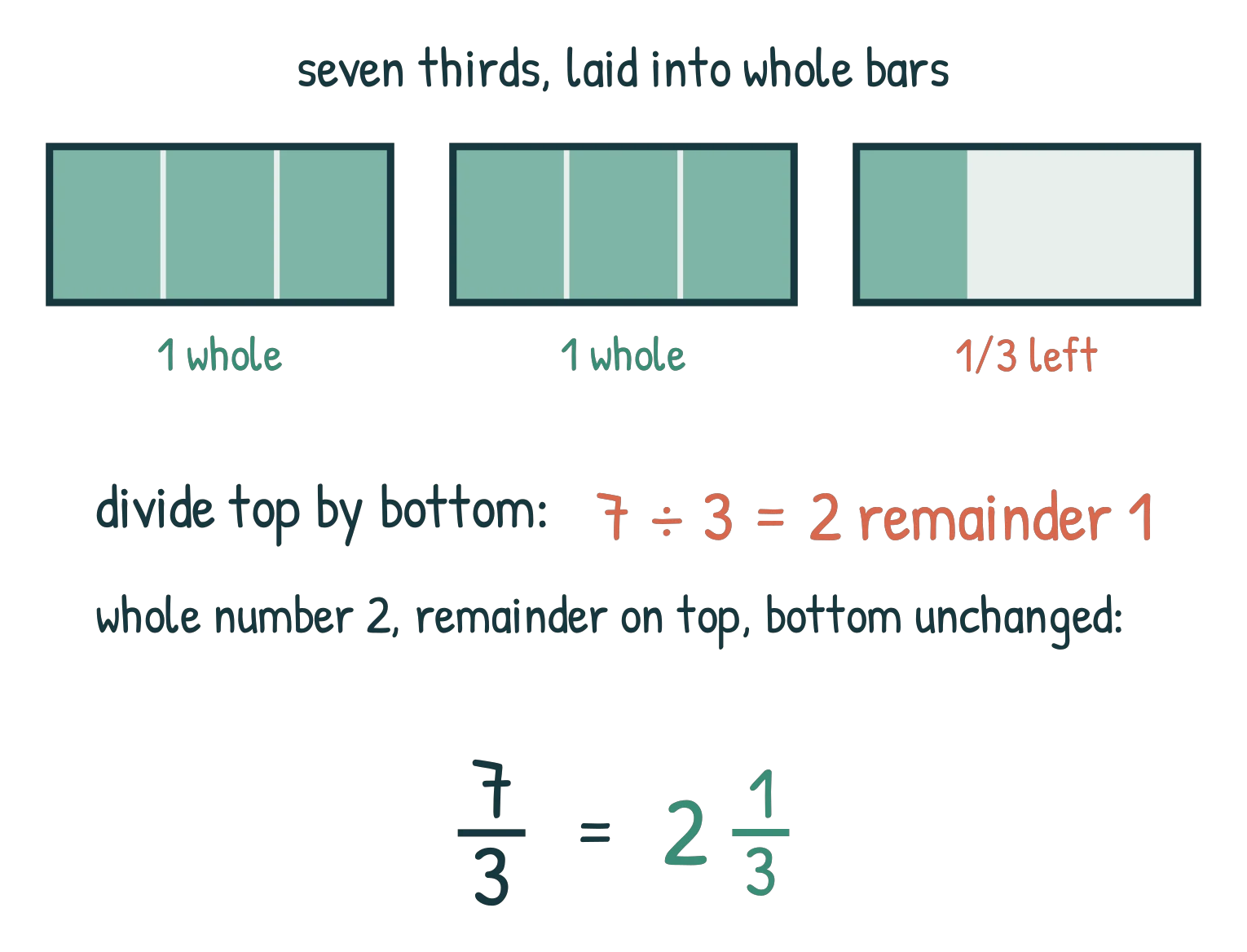
Divide the top by the bottom. The answer is the whole number, the remainder is the new top, and the bottom never changes.
Worked example
Convert 7/3 to a mixed number
Divide the top by the bottom:
The 2 is the whole number, the remainder 1 goes on top, and the bottom stays 3:
Worked example
Convert 17/5 to a mixed number
Worked example
Convert 8/4 to a mixed number (no remainder)
There's nothing left over, so there's no fraction part at all:
A remainder of zero means the answer is a whole number — write , not .
How do you turn a mixed number back into an improper fraction?
Times the whole number by the bottom, then add the top. The bottom stays the same.
Worked example
Convert 2 3/5 to an improper fraction
The whole number is 2 and the bottom is 5, so the two wholes are worth fifths. Add the 3 fifths already there:
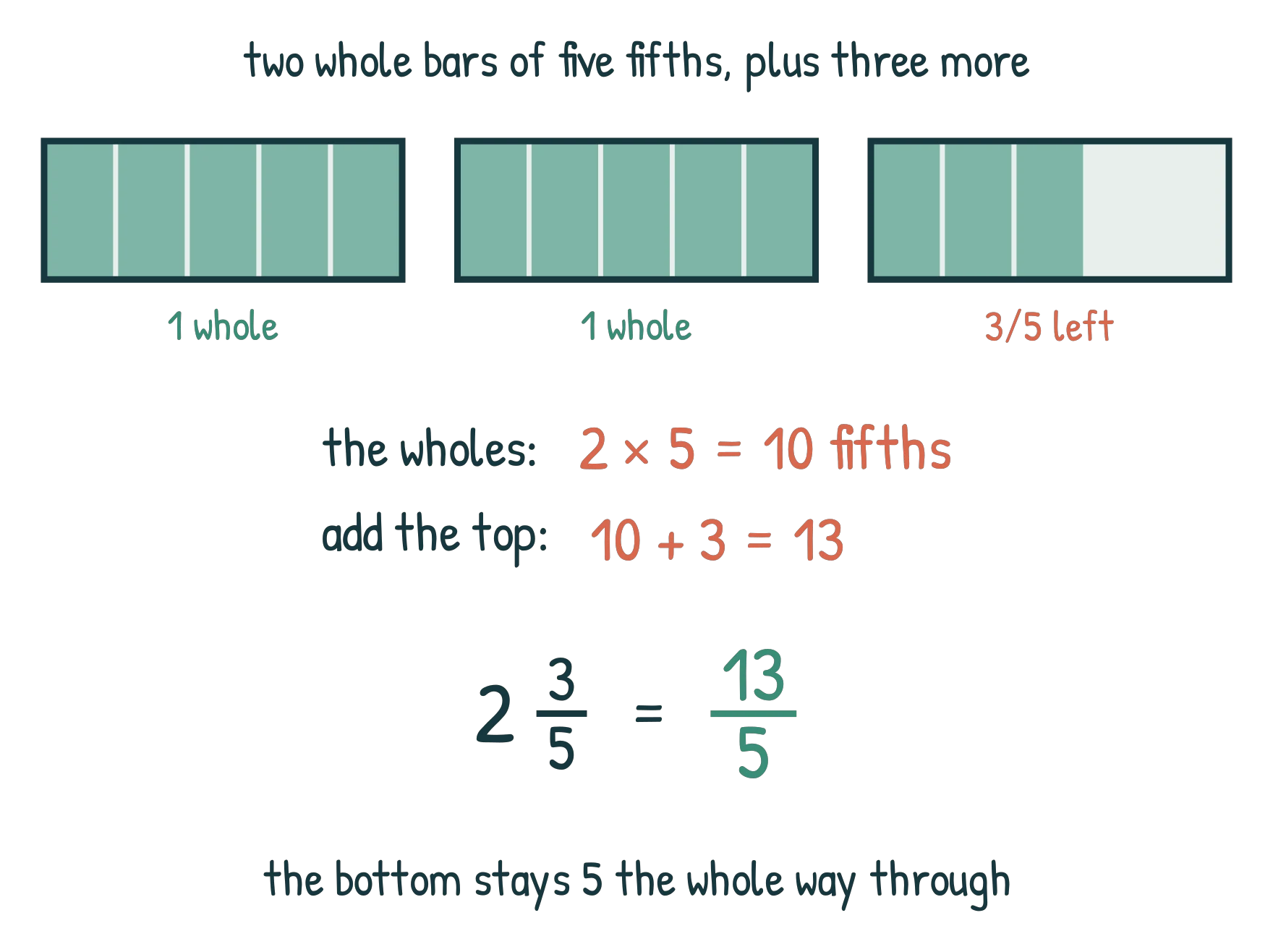
Check it by going back the other way: remainder , giving . Every conversion can be checked by reversing it.
Where you'll use this next
- Adding and subtracting fractions often produces a top-heavy answer that should be written as a mixed number.
- Multiplying and dividing fractions need mixed numbers converted to improper first — the methods don't work on mixed numbers.
- Measurements and recipes are usually written as mixed numbers, so you convert in both directions constantly.
Practice questions
Divide the top by the bottom one way; times and add the other. Then click to check.
1.Convert 11/4 to a mixed numberShow answerHide answer
remainder , so .
2.Convert 9/2 to a mixed numberShow answerHide answer
remainder , so .
3.Convert 20/3 to a mixed numberShow answerHide answer
remainder , so .
4.Convert 4 1/5 to an improper fractionShow answerHide answer
, so .
5.Convert 3 2/4 to an improper fractionShow answerHide answer
, so . (That simplifies to — see simplifying fractions.)
6.Convert 24/10 to a mixed number, then simplify itShow answerHide answer
remainder , so . Both 4 and 10 divide by 2, so it simplifies to .
7.Spot the mistake: a student converts 2 3/5 and writes 10/5. What did they forget?Show answerHide answer
They did but never added the top. The 3 fifths still need including: , so the answer is .
Practise this skill
A free printable worksheet with 16 questions and a full worked answer key. No sign-up needed.
Get the Fractions Test Paper with Mark Scheme free
Ready to test the whole topic? Your first paper is on us — exam-style questions with a full plain-English mark scheme. See what’s in it.