How to Use BIDMAS — Order of Operations | KS3 Maths
BIDMAS and the order of operations, step by step: brackets, indices, then divide and multiply, then add and subtract. Free KS3 lesson.
BIDMAS gives the order: brackets, indices, divide and multiply (left to right), then add and subtract (left to right). So 2 + 3 × 4 = 14.
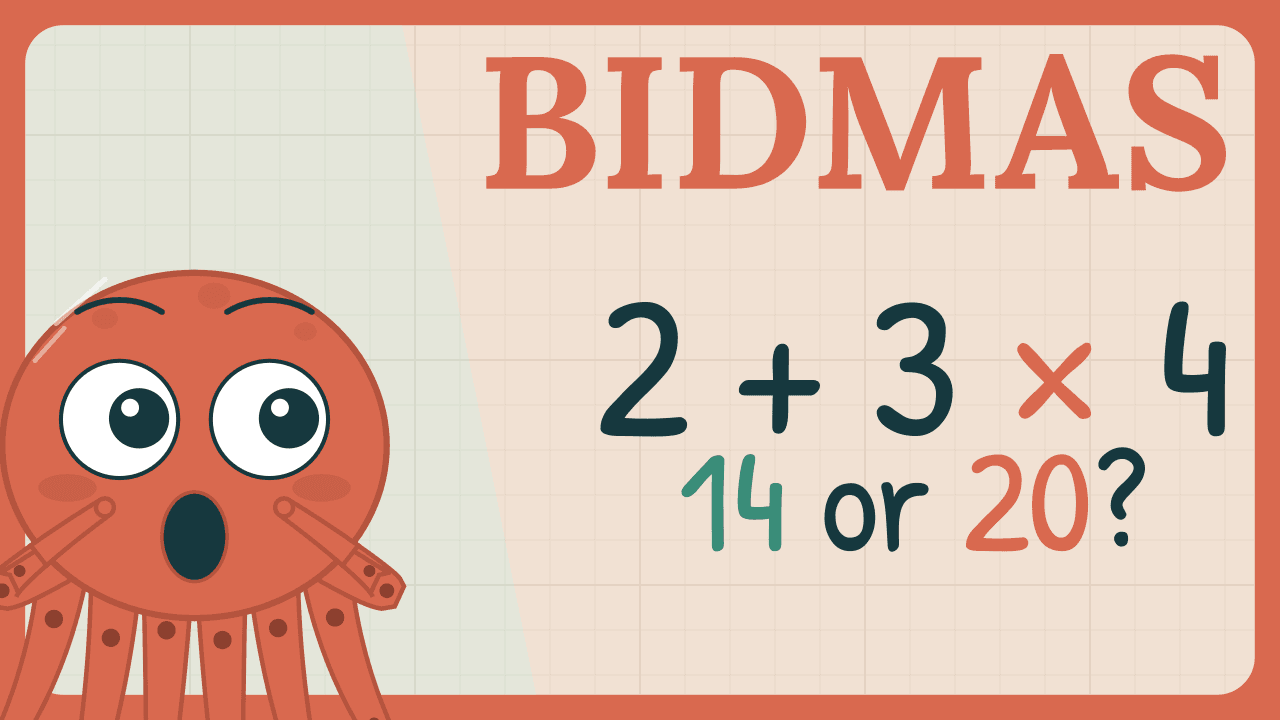
Maths has a fixed order for working things out, so that everyone who reads a calculation gets the same answer. BIDMAS is the name for that order: brackets, indices, divide and multiply, add and subtract. Work down the ladder a rung at a time and has exactly one correct answer — .
Why does multiplication come before addition?
Worked example
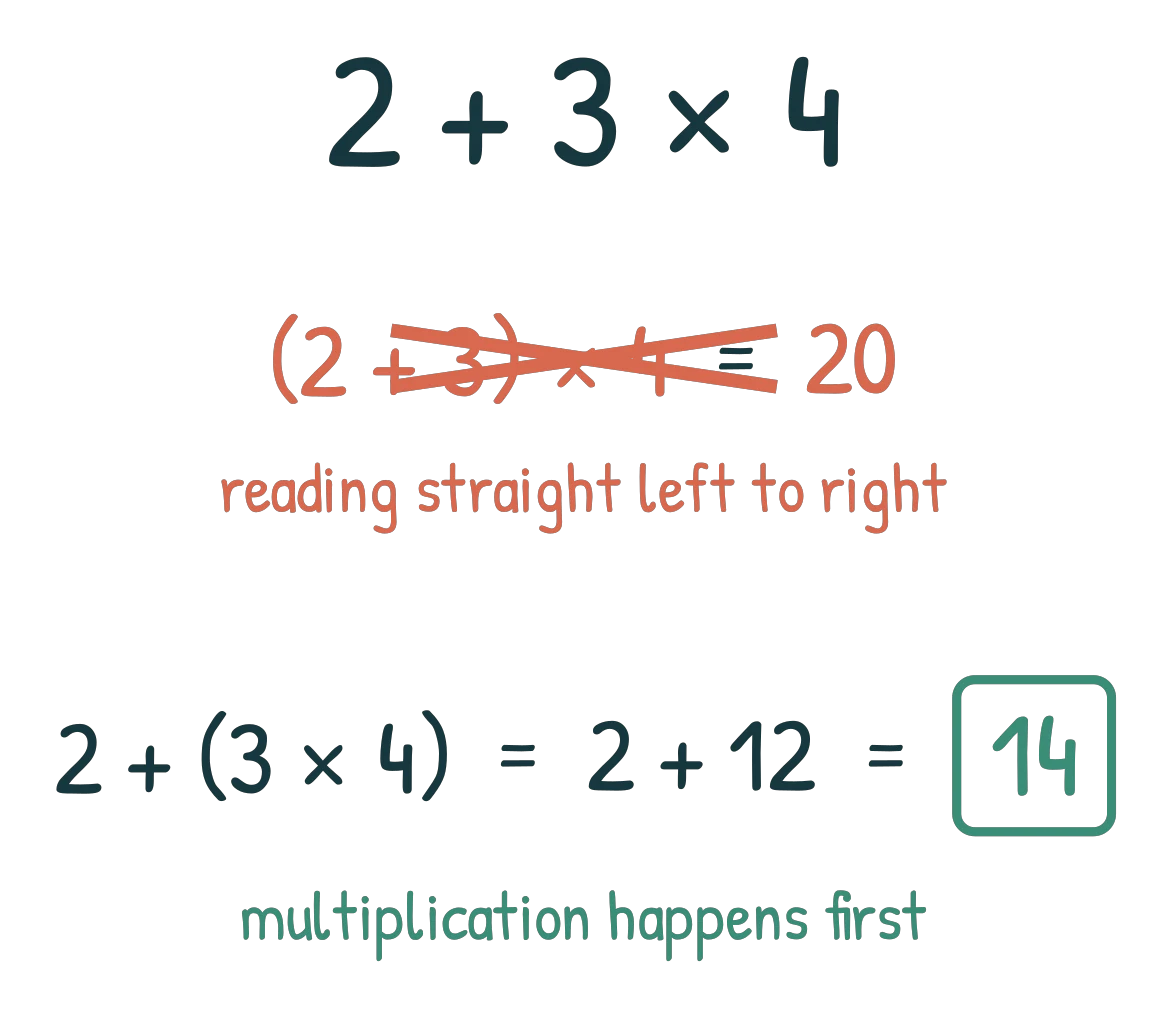
Is 2 + 3 × 4 fourteen or twenty?
Reading left to right, you'd do , then . But that's wrong — the rule is that multiplication comes before addition, so you do first:
Fourteen. And brackets show exactly what each order really means. Going left to right secretly adds first — that's . But the times sign binds the 3 and the 4 into one quantity, so the real sum is . Same numbers, completely different answer — which is why the order isn't optional.
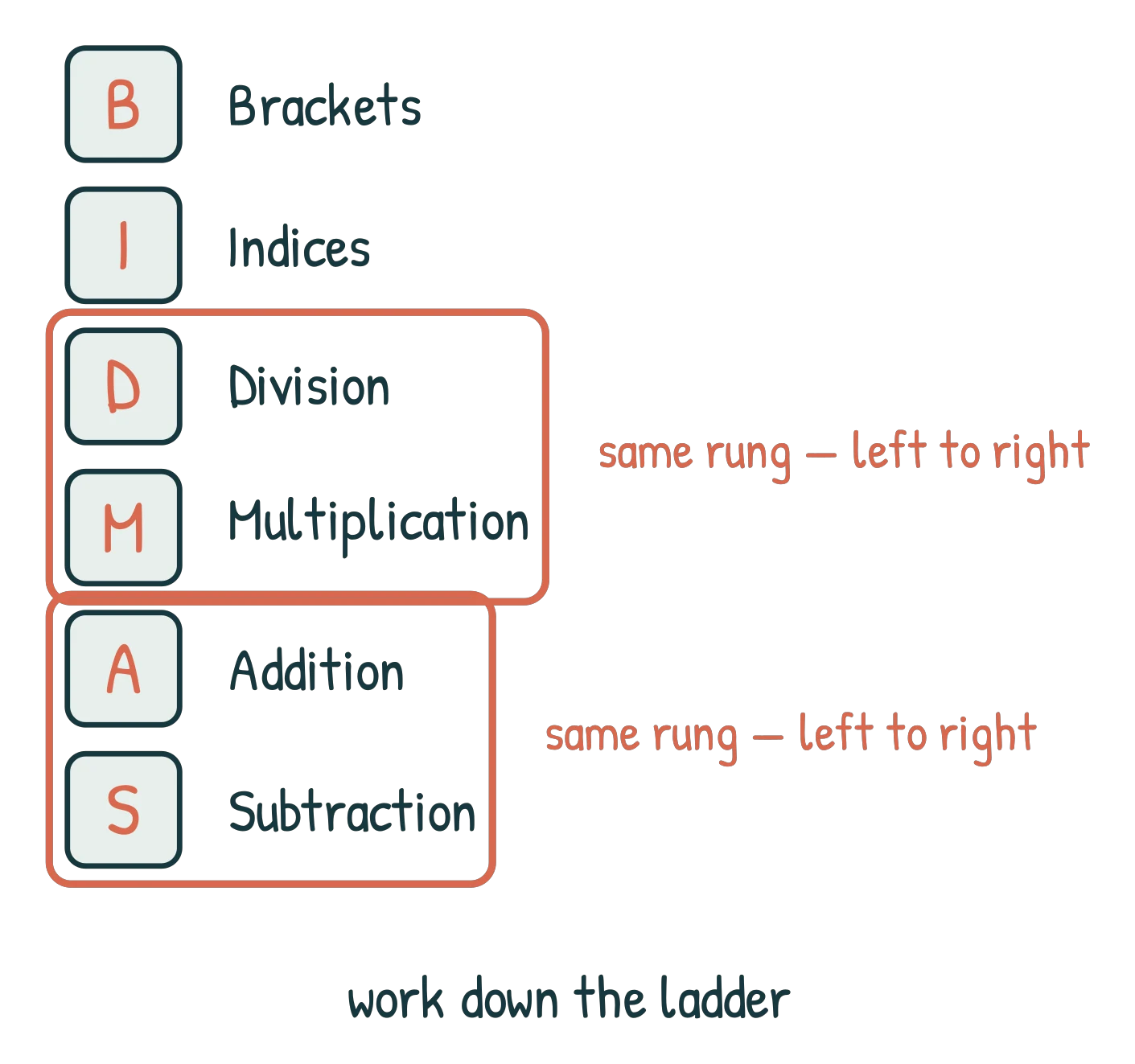
The BIDMAS ladder
Every order-of-operations question is answered by working down the ladder — the operations near the top happen before the ones lower down.
Worked example
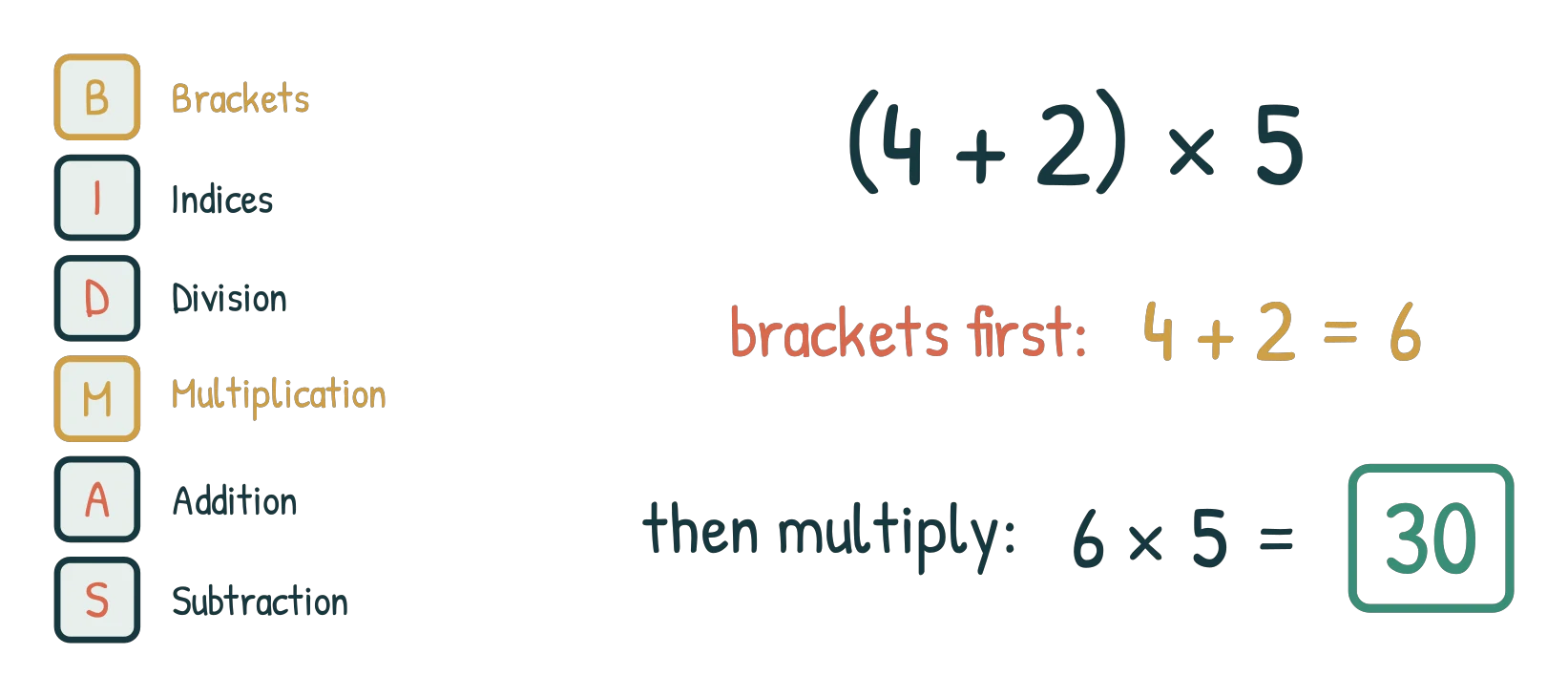
Brackets first: (4 + 2) × 5
When brackets are written for you, they go first — that's the top of the ladder. Do the inside, then multiply:
Brackets are just a way of saying "do this bit first," so there's never any doubt about what to work out before the .
Worked example
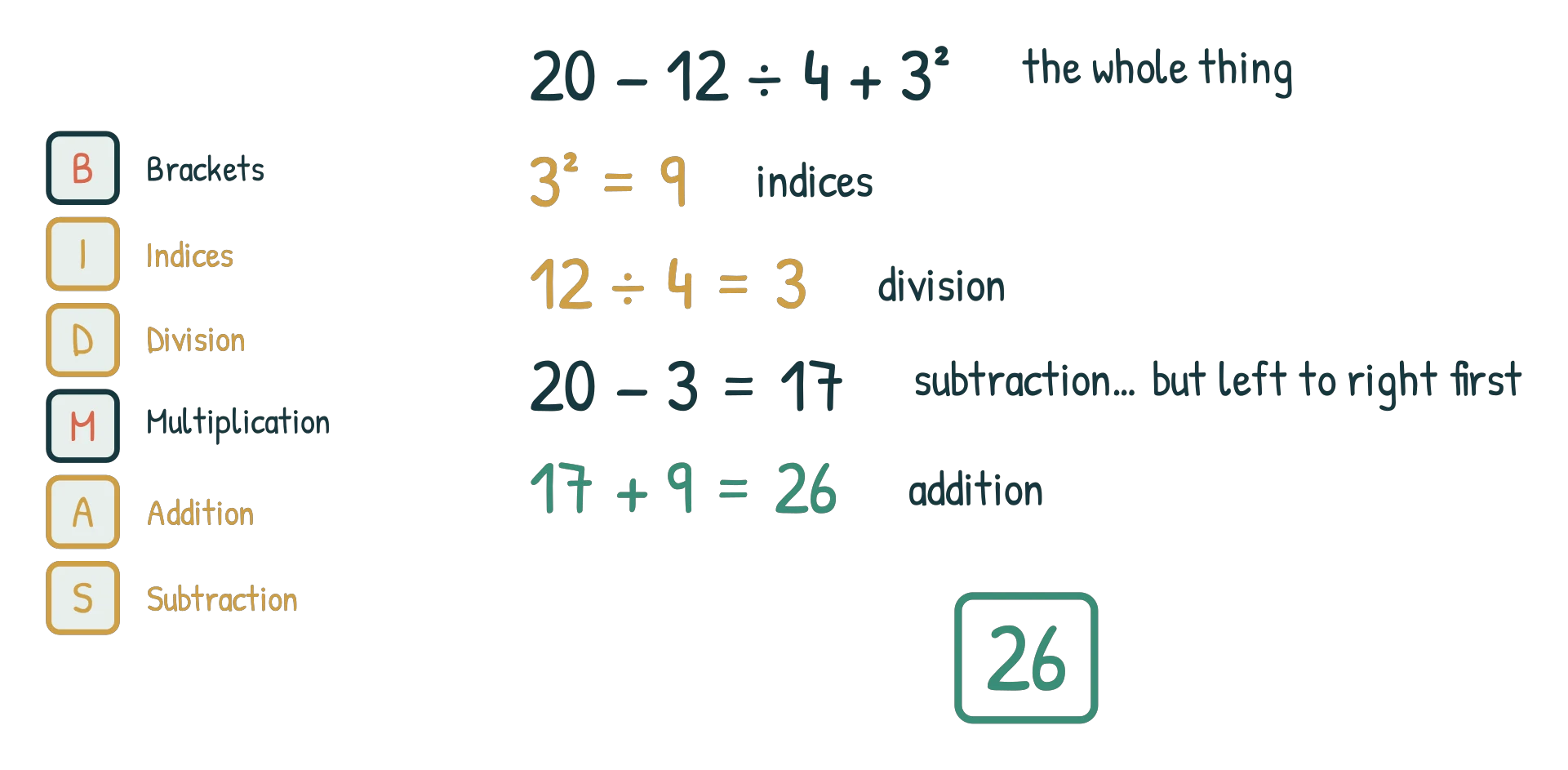
The full ladder: 20 − 12 ÷ 4 + 3²
Now every rung in one question. Work down the ladder:
- Indices: , so it becomes .
- Division: , giving .
- Addition and subtraction share the bottom rung, so work left to right: , then .
Where you'll use this next
- Every calculation with more than one operation relies on this order, so it underpins the rest of KS3.
- Square and cube numbers are the 'I' in BIDMAS — indices come before multiplying.
- Substituting into formulas in algebra needs the order applied carefully.
Practice questions
Try these yourself, then click to check each answer. Work down the ladder every time — brackets, then indices, then divide/multiply, then add/subtract — and remember that same-rung operations go left to right.
1.Work out 5 + 2 × 3Show answerHide answer
Multiplication first: , then .
2.Work out 16 − 12 ÷ 4Show answerHide answer
Division first: , then .
3.Work out 2 × 3²Show answerHide answer
Indices first: , then .
4.Work out (10 − 4) × 3Show answerHide answer
Brackets first: , then .
5.Work out 12 ÷ 4 × 3Show answerHide answer
Division and multiplication share a rung, so left to right: , then . (Not .)
6.Spot the mistake: a student writes 4 + 6 ÷ 2 = 5. What went wrong, and what's the real answer?Show answerHide answer
They added first (, then ). Division is higher on the ladder: first, then .
7.Work out 3 × (2 + 4)² Show answerHide answer
Brackets first: . Then indices: . Then multiply: .
Practise this skill
A free printable worksheet with 16 questions and a full worked answer key. No sign-up needed.
Get the Number Properties Test Paper with Mark Scheme free
Ready to test the whole topic? Your first paper is on us — exam-style questions with a full plain-English mark scheme. See what’s in it.
More number properties lessons
- How to Find Factors and Multiples | KS3 Maths
- What Is a Prime Number? | KS3 Maths
- Square and Cube Roots | KS3 Maths
- Multiplying and Dividing Negative Numbers | KS3 Maths
- Square and Cube Numbers | KS3 Maths
- Adding and Subtracting Negative Numbers | KS3 Maths
- Order of Operations (BIDMAS) — Is 8÷2(2+2) 1 or 16? | KS3 Maths