How to Find Factors and Multiples | KS3 Maths
Every rectangle you can build from a number is a factor pair. How to list all the factors of a number, find its multiples, and know when to stop.
The factors of 24 are 1, 2, 3, 4, 6, 8, 12 and 24. A factor divides into the number exactly, and factors always come in pairs — 4 × 6 and 3 × 8 both make 24.
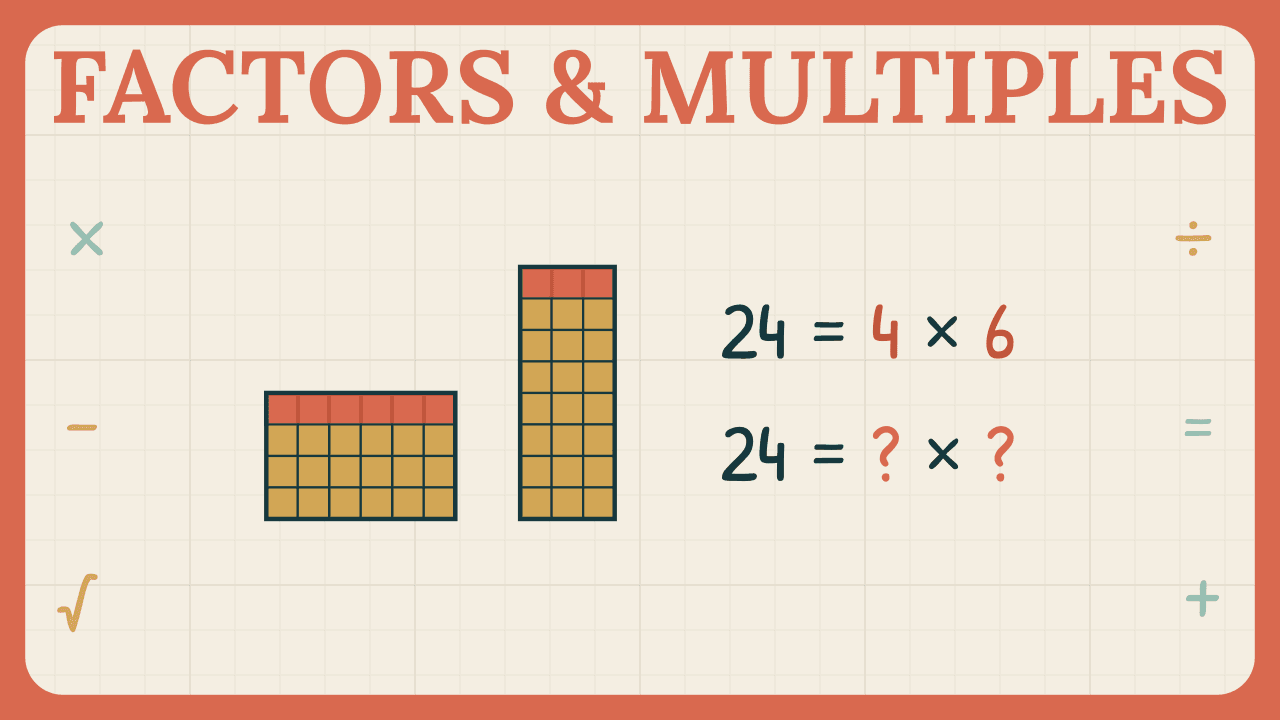
A factor of a number divides into it exactly. The quickest way to see them all is to build rectangles: take 24 tiles and every rectangle you can make from them — 4 by 6, 3 by 8, 2 by 12, 1 by 24 — hands you two factors at once. That is why factors always come in pairs, and it is how you know when your list is finished.
What is a factor?
A factor of a number is a whole number that divides into it exactly, leaving nothing over.
The picture worth holding is a rectangle of tiles. If you can arrange 24 tiles into 4 rows of 6, then , and both 4 and 6 divide into 24 exactly. Both are factors. Because a rectangle has two side lengths, every rectangle you find hands you two factors at once — which is the reason factors come in pairs, and the reason you can stop hunting once the rectangles run out.
This is the same tile picture used in square and cube numbers, where the rectangle happens to be a perfect square.
How do you find all the factors of a number?
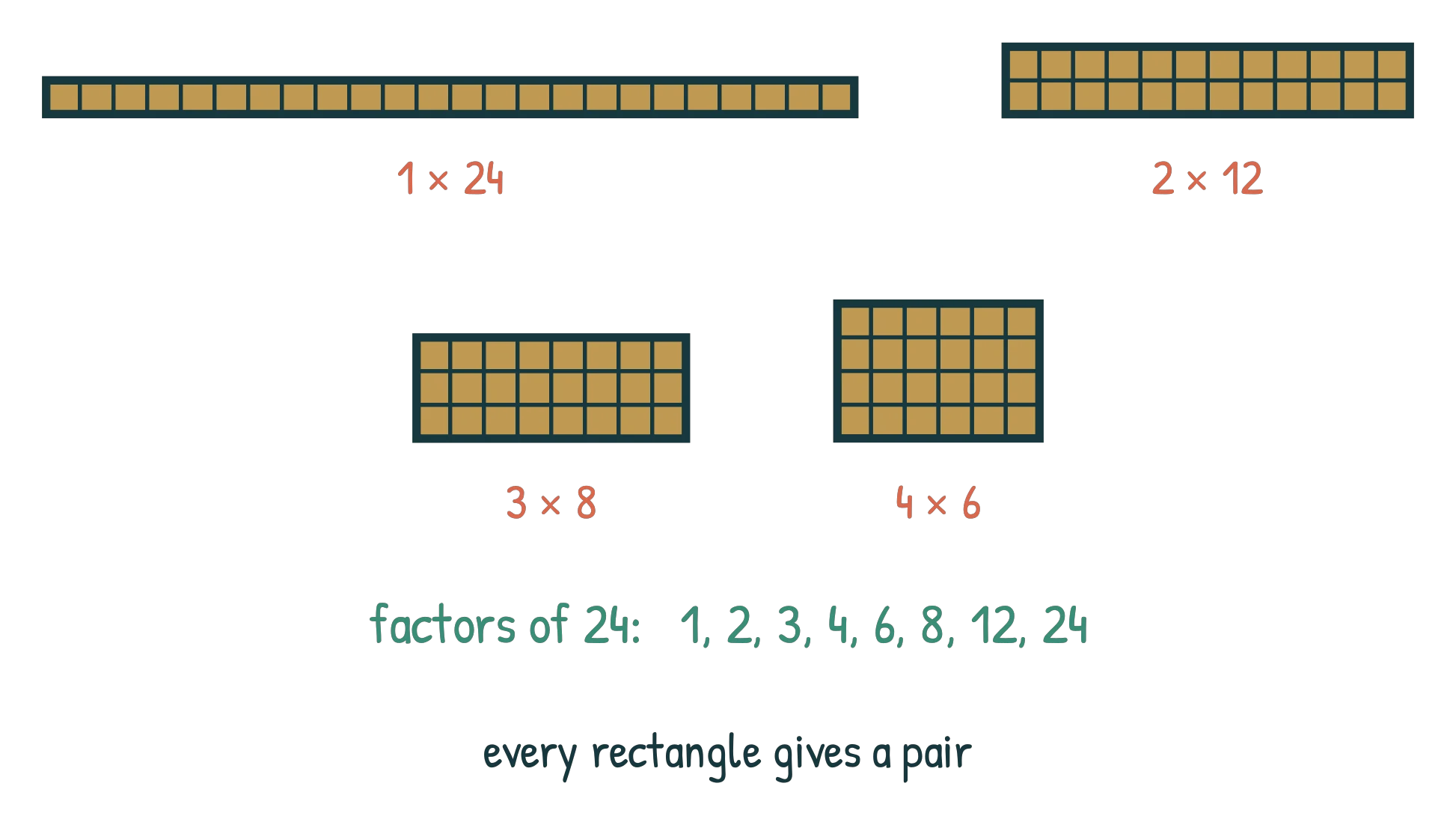
Work through the rectangles in order: 1 row, 2 rows, 3 rows, and so on. Each one that comes out even gives you a pair.
Worked example
List all the factors of 24
Start with 24 tiles and try each number of rows in turn.
1 row of 24 — . Factors: 1 and 24.
2 rows of 12 — . Factors: 2 and 12.
3 rows of 8 — . Factors: 3 and 8.
4 rows of 6 — . Factors: 4 and 6.
5 rows? 24 does not split into 5 equal rows, so 5 is not a factor.
6 rows of 4 — we have already had this pair the other way round. Once the pairs start repeating, you are done.
Eight factors, from four rectangles.
What is a multiple?
A multiple is what you land on counting up in a number. The multiples of 6 are — they carry on forever, so you are usually asked for the first few.
Worked example
Write the first five multiples of 6
Start at 6 and keep adding 6. In tiles: start with one block of six, then add another block, and another.
They are just the 6 times table, which is why a multiple of 6 is sometimes described as "a number in the 6 times table".
How are factors and multiples related?
They are the same fact read in two directions, which is exactly why they get muddled.
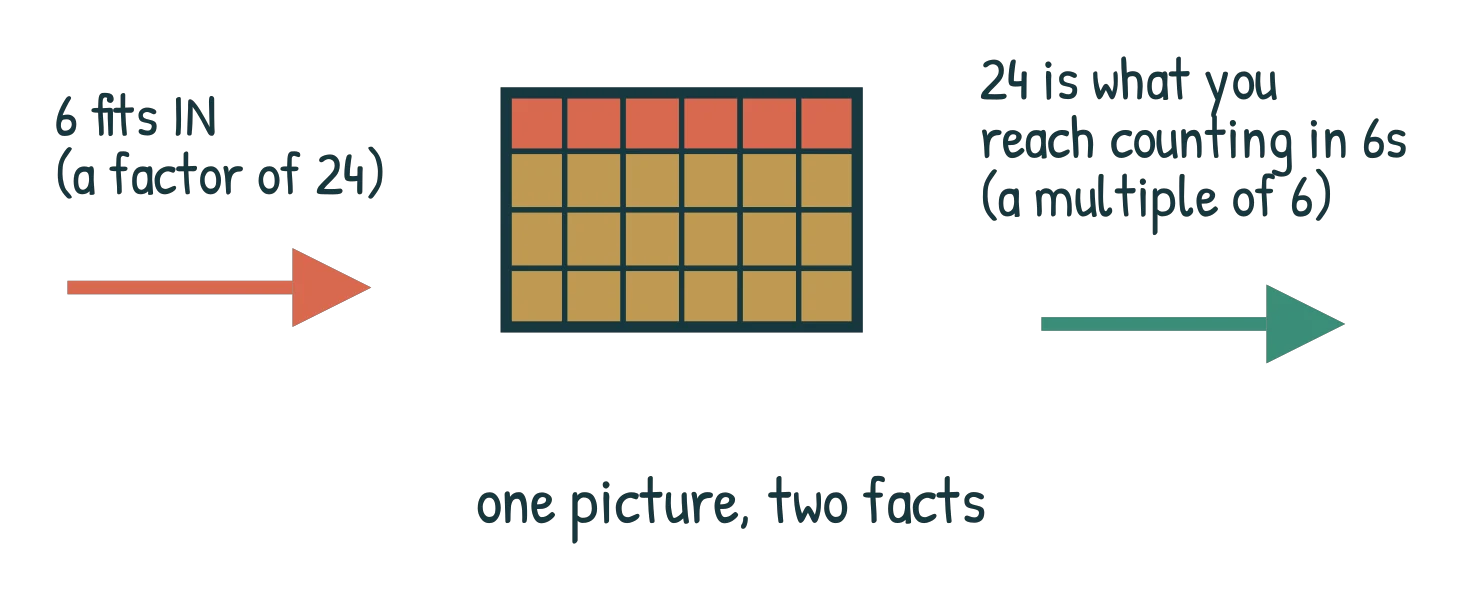
Look at the fourth multiple of 6. It is 24 — the number from the first example. So:
- 6 is a factor of 24, because 6 fits into 24 exactly.
- 24 is a multiple of 6, because 24 is what you reach counting up in sixes.
One statement, two viewpoints. A factor is smaller than the number (or equal to it); a multiple is bigger (or equal). If you can remember which way round the picture goes, you never have to remember the words.
How do you know when you have found every factor?
You stop when the pairs start repeating — and there is an exact moment when that happens.
Worked example
List all the factors of 36
Work through the rows as before.
· · ·
5 rows? 36 does not split into 5 equal rows, so 5 is not a factor.
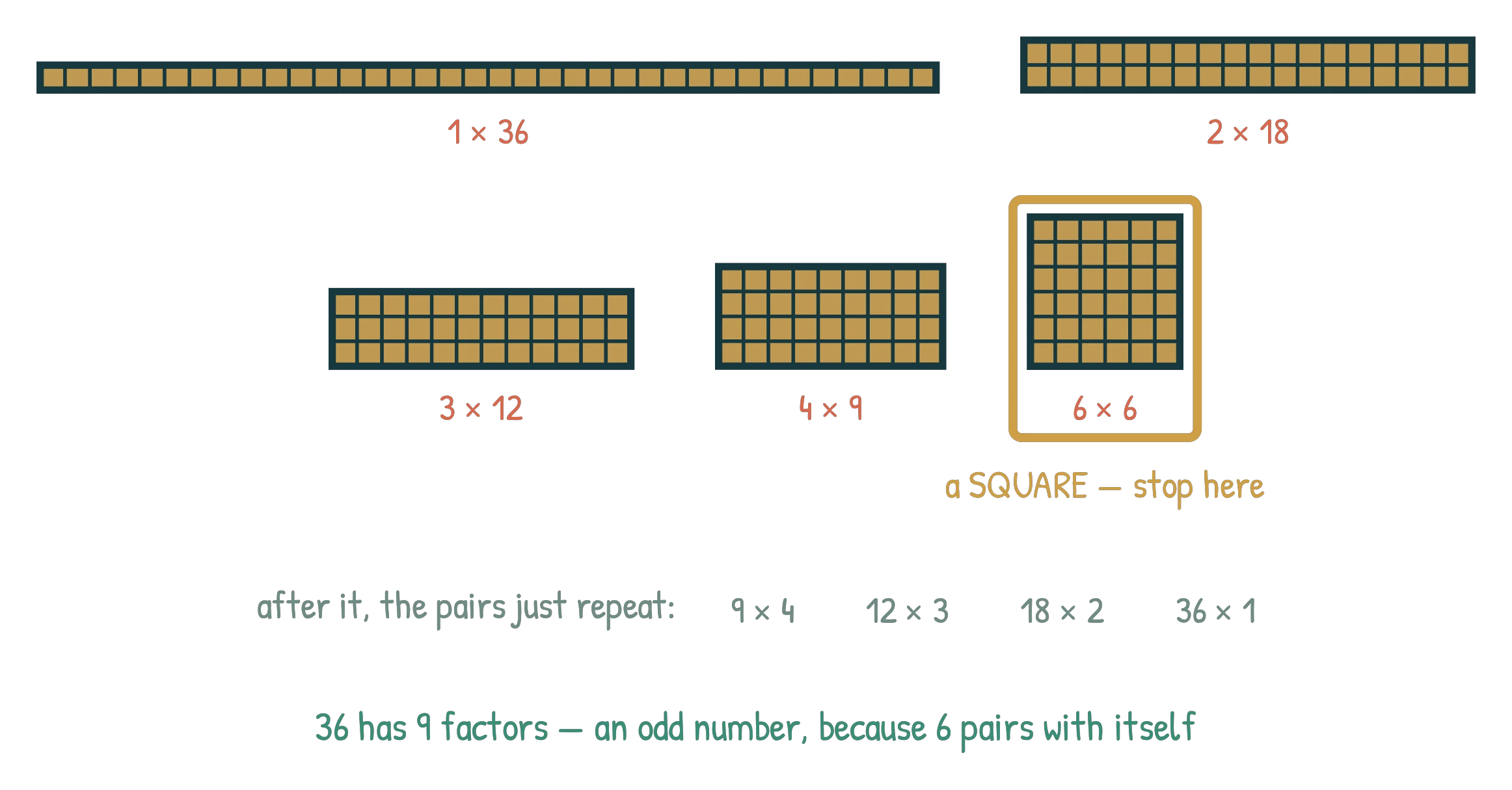
6 rows of 6 — and here is something new. This rectangle is a square: 6 pairs with itself.
That square is the stopping point. The next rectangle would be , which is turned on its side — one we have already had. So is , and , and .
Nine factors — an odd number. Every other number on this page had an even count, because the factors came in pairs. 36 has an odd count precisely because one of its "pairs" is a double. That is true of every square number and only of square numbers.
Going further
This is why you only test up to the square root. The stopping point above is not a coincidence about 36 — it happens for every number. Keep going while your test number multiplied by itself is still below the number, and stop as soon as it goes past. To check whether 97 has any factors you only need to go up to 9, because is still below 97 while is already past it — and any factor bigger than 9 would need a partner smaller than 9 that you have already tried. That shortcut is what makes testing large numbers for primes practical, and it is the heart of the prime numbers lesson.
Every number has at least two factors — except 1. Every number has and in its list. The number 1 is the exception: its two "ends" are the same number, so it has exactly one factor.
Where you'll use this next
Factors and multiples are the machinery behind a lot of what comes after. Finding the highest common factor and the lowest common multiple is exactly this skill applied to two numbers at once. Simplifying a fraction means dividing top and bottom by a common factor. Adding fractions means finding a common multiple of the denominators — which is why the adding and subtracting fractions method starts by listing multiples.
1.List all the factors of 20.Show answerHide answer
Work through the rectangles: , , . Three pairs.
1, 2, 4, 5, 10, 20
2.Write the first four multiples of 9.Show answerHide answer
Start at 9 and add 9 each time.
9, 18, 27, 36
3.Is 3 a factor or a multiple of 15?Show answerHide answer
3 fits into 15 exactly (), so it is a factor. Going the other way, 15 is a multiple of 3.
4.List all the factors of 16.Show answerHide answer
, , — and is a square, so stop.
1, 2, 4, 8, 16 — five factors, an odd number, because 4 pairs with itself.
5.Priya says the factors of 18 are 2, 3, 6 and 9. What has she missed?Show answerHide answer
She has missed 1 and 18 — the two ends. Every number has 1 and itself as factors.
The full list is 1, 2, 3, 6, 9, 18.
6.A teacher puts 36 chairs into equal rows. List every number of rows that works.Show answerHide answer
Each arrangement is a factor pair of 36: , , , , .
1, 2, 3, 4, 6, 9, 12, 18 or 36 rows.
7.Which number below 30 has the most factors?Show answerHide answer
24, with eight: 1, 2, 3, 4, 6, 8, 12, 24.
Close behind are 18 and 20 with six each, and 28 with six. A number with lots of small prime factors collects factors quickly — .
Practise this skill
A free printable worksheet with 15 questions and a full worked answer key. No sign-up needed.
Get the Number Properties Test Paper with Mark Scheme free
Ready to test the whole topic? Your first paper is on us — exam-style questions with a full plain-English mark scheme. See what’s in it.
More number properties lessons
- What Is a Prime Number? | KS3 Maths
- Square and Cube Roots | KS3 Maths
- Multiplying and Dividing Negative Numbers | KS3 Maths
- Square and Cube Numbers | KS3 Maths
- Adding and Subtracting Negative Numbers | KS3 Maths
- How to Use BIDMAS — Order of Operations | KS3 Maths
- Order of Operations (BIDMAS) — Is 8÷2(2+2) 1 or 16? | KS3 Maths