Multiplying & Dividing Decimals — KS3 Maths
Multiply and divide decimals: ignore the points and count the places, or clear the bottom to a whole number. Free KS3 lesson and worksheet.
To multiply, ignore the points, multiply as whole numbers, then put back as many decimal places as the question had. To divide, multiply both numbers until the one you're dividing by is whole.
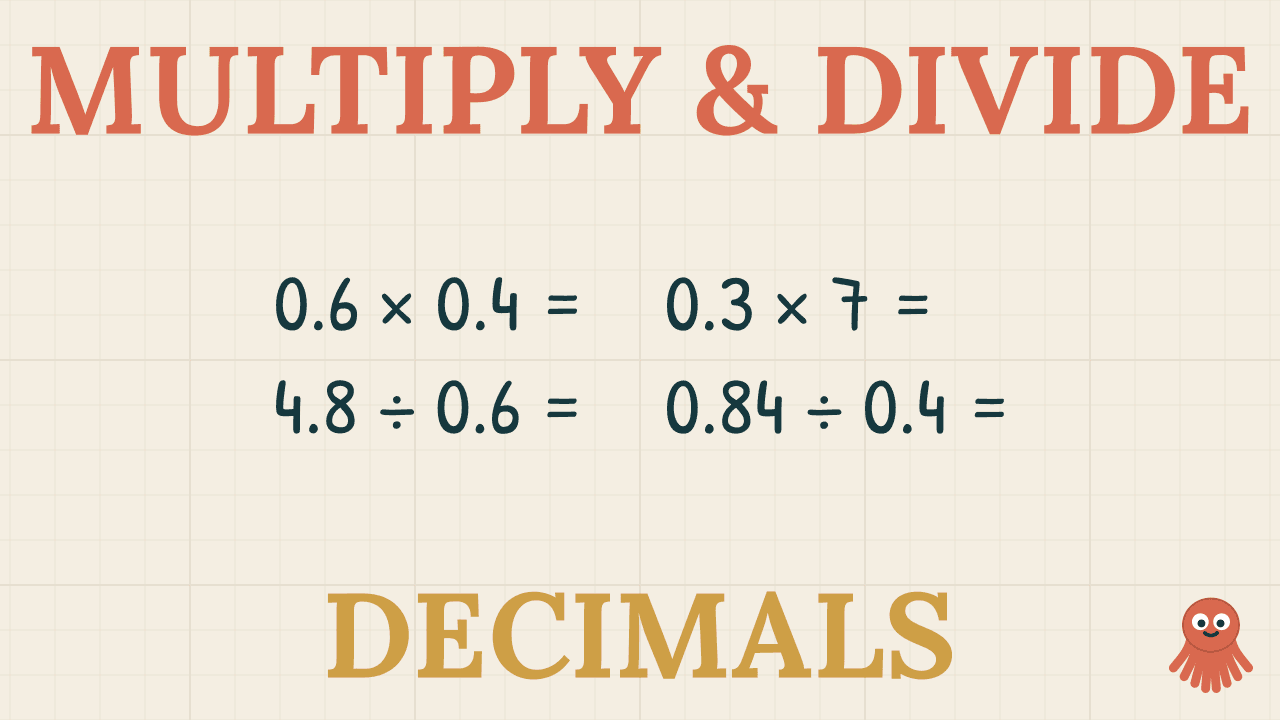
Both of these turn into whole-number arithmetic, and each has one job to do with the point. Multiplying: count the decimal places in the question and put the same number back into the answer. Dividing: clear the bottom — scale both numbers up until the one you're dividing by is a whole number.
How do you multiply decimals?
Worked example
0.6 × 0.4 (the surprising one)
Ignore the points and multiply the digits: . Now count the decimal places — one in and one in makes two. So put the point two places in:
It's , not — because you're multiplying by less than one, the answer comes out smaller than what you started with.
Worked example
0.3 × 7
Ignore the point: . There is one decimal place in the question (in ), so one in the answer:
How do you divide by a decimal?
Worked example
4.8 ÷ 0.6
Make the number you're dividing by () a whole number by multiplying both numbers by 10:
Multiplying both numbers by the same amount keeps the answer the same — but now it's an easy whole-number division.
Worked example
0.84 ÷ 0.4
Multiply both by 10 to clear the bottom, then divide:
Going further
Why does counting the places work? Because a decimal is a fraction in disguise. is , and multiplying fractions multiplies the bottoms: , which is . One place plus one place makes two places because ten times ten makes a hundred. The multiplying fractions lesson is the same rule in the other notation.
Why is scaling both numbers allowed when dividing? A division is a fraction, and multiplying top and bottom by the same amount leaves a fraction unchanged — the same fact behind equivalent fractions. So and are genuinely the same question.
Where you'll use this next
- Best value and unit pricing — cost per 100 g is a decimal division.
- Area and volume of shapes with decimal measurements.
- Scaling recipes and conversions, where you multiply by a decimal factor.
Practice questions
Use the count-the-places method to multiply, and clear the bottom to divide. Then click to check.
1.Work out 0.7 × 0.3Show answerHide answer
, two decimal places: .
2.Work out 0.5 × 8Show answerHide answer
, one decimal place: .
3.Work out 1.2 × 0.6Show answerHide answer
, two decimal places: .
4.Work out 3.5 ÷ 0.5Show answerHide answer
Clear the bottom (×10): .
5.Work out 0.96 ÷ 0.3Show answerHide answer
Clear the bottom (×10): .
6.Spot the mistake: a student says 0.8 × 0.5 = 4. What went wrong, and what's the real answer?Show answerHide answer
They forgot to put the decimal places back. , but there are two decimal places, so the answer is — smaller than 1, because you multiplied by less than one.
Practise this skill
A free printable worksheet with 16 questions and a full worked answer key. No sign-up needed.
Get the Decimals & Rounding Test Paper with Mark Scheme free
Ready to test the whole topic? Your first paper is on us — exam-style questions with a full plain-English mark scheme. See what’s in it.