How to Solve Equations | KS3 Maths
An equation is a balance. Whatever you do to one side you do to the other — how to solve one-step and two-step equations, and which move goes first.
Do the same thing to both sides until the letter is on its own. For x + 3 = 8, take 3 off both sides: x = 5. For 2x + 5 = 17, take 5 off both sides first, then share both sides by 2: x = 6.
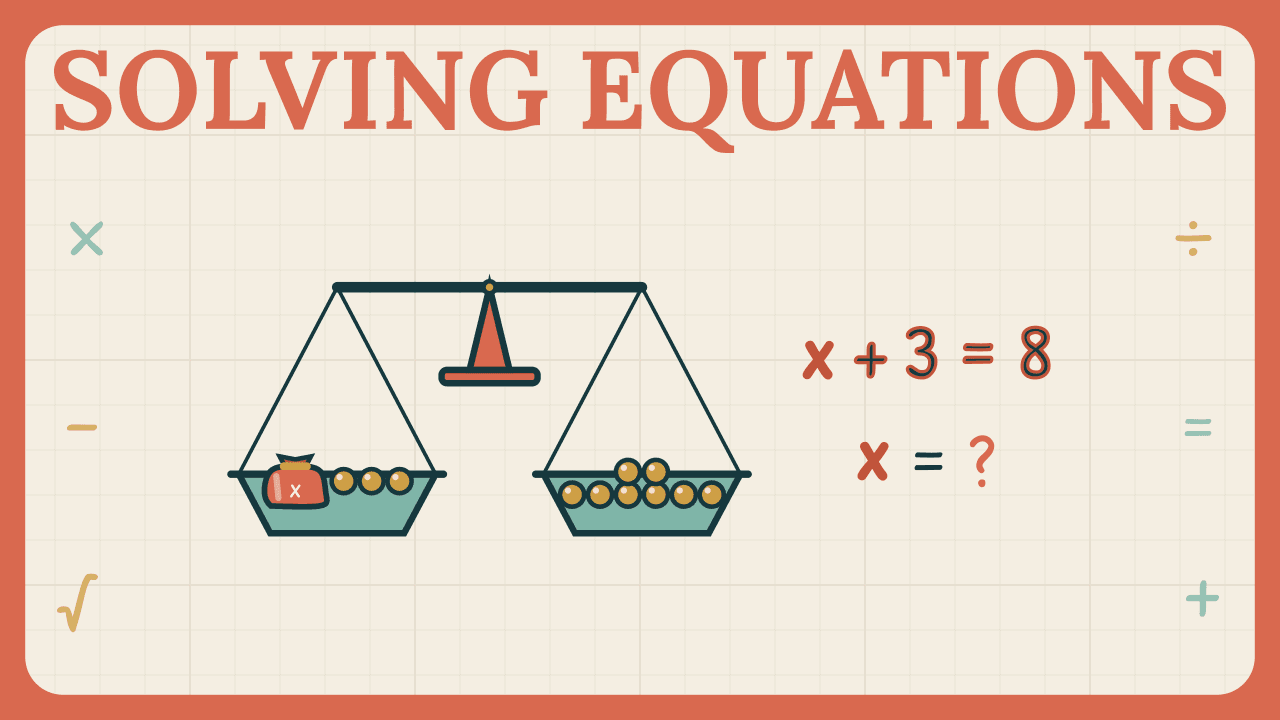
An equation is a balance. The equals sign is not an instruction to work something out — it is a statement that the two sides weigh exactly the same. That one idea gives you the whole method: whatever you do to one side, you must do to the other, because anything else tips the scales and the two sides stop being equal.
What does solving an equation mean?
Solving an equation means finding the number the letter stands for.
In , the letter is a number we do not know yet. The equation tells us that plus three comes to eight. Only one number makes that true, and finding it is what "solve" means.
The picture worth holding is a set of scales. Put a bag holding an unknown number of marbles on the left, along with three loose marbles. Put eight marbles on the right. The scales sit level, which is exactly what says.
Why can you do the same thing to both sides?
Because that is the only kind of change that keeps a balance level — and it is worth seeing it fail before you trust it.
Start with five marbles on each side. The scales are level. Now take two marbles off the left only: the right side is heavier, so it drops. The two sides are no longer equal, and any answer you get from here will be wrong.
Put the balance back to five and five, then take two off both sides. Three against three. Still level.

This is the reason the method works, and it is the reason it keeps working later, when both sides have letters on them.
How do you solve a one-step equation?
Take off whatever is sitting with the letter — from both sides.
Worked example
Solve x + 3 = 8
The balance holds a bag and three marbles on the left, and eight marbles on the right.
Take three marbles off both sides.
On the left, the three loose marbles are gone and the bag is on its own. On the right, five marbles remain.
Check it. Put five back in place of the bag: . ✓ Checking costs five seconds and catches almost every slip.
The other one-step equation looks different but uses the same rule.
Worked example
Solve 3x = 12
means three lots of — three identical bags. They balance twelve marbles.
Here nothing is being added to the bags, so there is nothing to take off. Instead, share both sides into three equal groups.
Three bags become one bag. Twelve marbles become four.
Check it. . ✓
So there are two moves, and which one you need depends on what is happening to the letter: something added to it comes off both sides, something multiplying it is shared from both sides.
How do you solve a two-step equation?
Do both moves — and the order matters.
Worked example
Solve 2x + 5 = 17
Two bags and five marbles balance seventeen marbles.
Step 1 — take five off both sides. Deal with the loose marbles first.
Two bags now balance twelve marbles.
Step 2 — share both sides by two.
Check it. . ✓

Why that order? Because taking the five off leaves whole numbers to share. Doing it the other way round means sharing the five as well, and five does not divide by two exactly — you would be dragging a fraction through the rest of the working for no reason.
A useful way to think about it: undo the operations in the reverse of the order they were applied. To build from you multiply by 2, then add 5. To take it apart you subtract 5, then divide by 2 — last on, first off.
Going further
The same rule handles subtraction and division. If the equation is , then 4 has been taken away from , so you add 4 to both sides: . If it is , then has been shared into three, so you multiply both sides by 3: . Every case is the same idea — do the opposite, to both sides.
Why "do the opposite" is not a separate rule. It is just what "same to both sides" looks like once you pick the operation that cancels. Adding 3 and subtracting 3 undo each other, so subtracting 3 from both sides is what clears a .
Letters on both sides come next. Once there are bags in both pans, the same rule still applies — you take bags off both sides instead of marbles. That is the whole of the next lesson, and it only makes sense if the balance picture is secure first.
Where you'll use this next
Solving equations is the engine under most of the algebra that follows. Rearranging a formula is the same moves applied to letters instead of numbers. Finding where two straight-line graphs cross means solving an equation. Forming an equation from a worded problem — "I think of a number, double it and add five, and get seventeen" — turns the sentence into and then finishes exactly as above.
1.Solve x + 6 = 14.Show answerHide answer
Take 6 off both sides.
x = 8 — and checking, . ✓
2.Solve 5x = 35.Show answerHide answer
Share both sides by 5.
x = 7 — and checking, . ✓
3.Solve x − 9 = 4.Show answerHide answer
Here 9 has been taken away from , so add 9 to both sides.
x = 13 — and checking, . ✓
4.Solve 3x + 4 = 19.Show answerHide answer
Take 4 off both sides first: . Then share both sides by 3.
x = 5 — and checking, . ✓
5.Solve 4x − 7 = 21.Show answerHide answer
Add 7 to both sides first: . Then share both sides by 4.
x = 7 — and checking, . ✓
6.I think of a number, multiply it by 6 and add 5. The answer is 41. What was my number?Show answerHide answer
Write it as an equation: .
Take 5 off both sides: . Share both sides by 6.
x = 6 — and checking, . ✓
7.Jo solves 2x + 8 = 20 by halving first and writes x + 8 = 10, so x = 2. What has gone wrong?Show answerHide answer
Halving has only been applied to part of the left side. Sharing both sides by 2 has to halve the 8 as well, giving .
The tidier route is to clear the 8 first: , so x = 6. Checking, . ✓
Practise this skill
A free printable worksheet with 15 questions and a full worked answer key. No sign-up needed.
Get the Solving Equations Test Paper with Mark Scheme free
Ready to test the whole topic? Your first paper is on us — exam-style questions with a full plain-English mark scheme. See what’s in it.