Navier–Stokes: What OpenAI's 10,000 Agents Actually Proved
OpenAI proved statements C and D of the official problem, which permit a smooth external push. A and B, the unforced versions mathematicians mean, are untouched. Clay still lists it open.
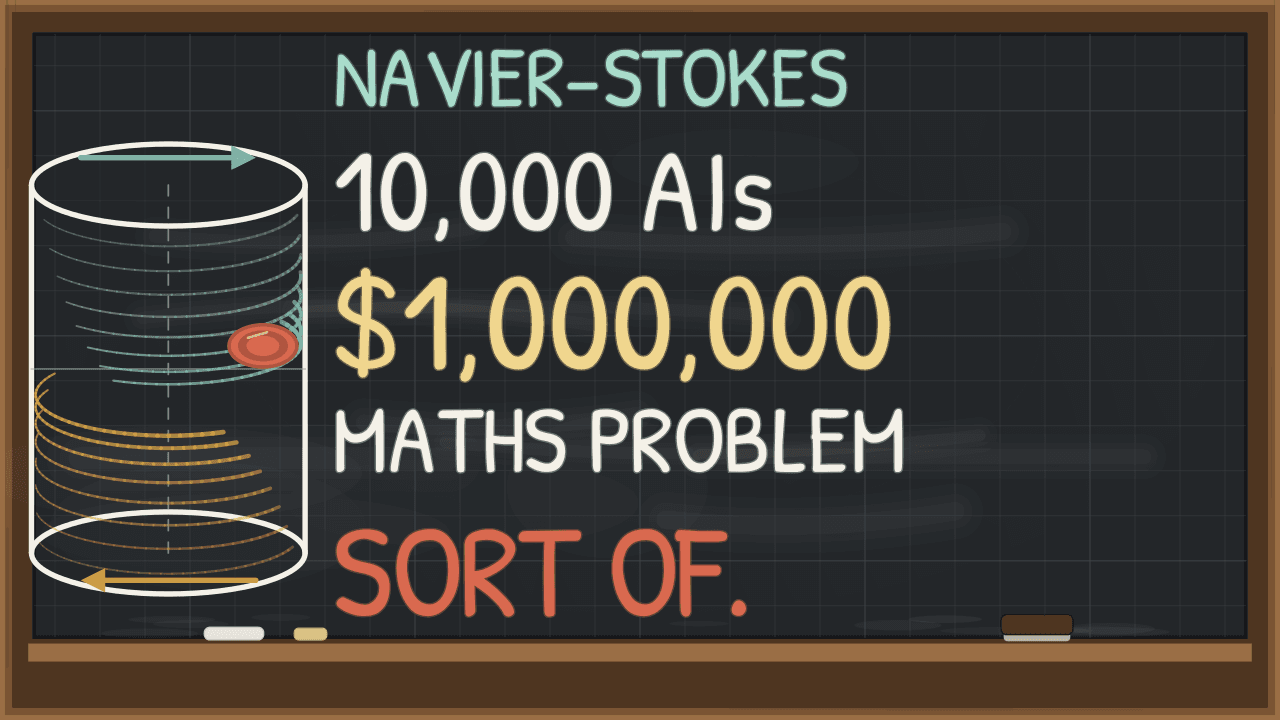
In September 2026, OpenAI ran roughly ten thousand AI agents for eighty-eight hours and published a proof about the Navier–Stokes equations, one of the seven Clay Millennium Prize Problems. The headlines said a million-dollar maths problem had fallen.
The real story is more interesting, and it turns on a distinction almost none of the coverage made.
What the Navier–Stokes equations are
They describe how a fluid moves. Not a particular fluid: any of them. Water down a pipe, air over a wing, honey off a spoon, smoke, blood, the weather.
What they say is simpler than it looks. A small parcel of fluid speeds up when something pushes it, and it is dragged back by friction against the fluid around it. That is Newton's second law, written for something that flows.
Claude-Louis Navier wrote them down in Paris in the 1820s. George Gabriel Stokes arrived at the same equations independently in Cambridge about twenty years later.
We rely on them constantly. Every weather forecast is a computer solving these equations, and so is the shape of a Formula One car and the design of an artificial heart valve.
And nobody can prove they always work.
The question nobody can answer
Start with a fluid moving smoothly. Gentle, well behaved, no sharp edges anywhere. Let the equations run forever. Does it stay smooth?
Nobody knows. The equations might, at some particular moment, produce a point where the fluid is moving infinitely fast. Not very fast: infinitely fast. At that instant the equations stop meaning anything. Mathematicians call it a blow-up, or a singularity.
How anything reaches infinite speed
The obvious objection is that infinite speed should need infinite energy. It does not, and the reason is worth understanding.
When a spinning thing is squeezed inwards it spins faster. Skaters do it by pulling their arms in: with no friction the spin is a fixed quantity, so if the circle shrinks the speed must rise. Fluids do exactly the same thing, and the energy never grows. It just gets packed into less and less space.
Now suppose a vortex could squeeze itself, handing all its energy to a smaller, faster copy, which does the same again. A faster copy finishes its handover more quickly, so every step takes less time than the one before.
Half a second, then a quarter, then an eighth. Keep halving forever and add them all up, and you get one second. Not infinity. Infinitely many squeezes can finish inside a finite time, and at that moment the speed is infinite.
The only thing standing in the way is friction. The cascade has to outrun it, and whether it can is the entire problem.
The distinction the headlines missed
The official problem statement was written by Charles Fefferman at Princeton, and it comes in four parts.
OpenAI's proof addresses C and D. That is a real theorem, it is hard, and it is the version the written problem permits. It is not the version working mathematicians mean when they talk about the Navier–Stokes problem.
And C is not the opposite of A. You can prove that the right push breaks the equations and still have no idea whether a fluid left completely alone ever breaks by itself. Both can be true at once. Statements A and B are exactly where they were.
Who did the work
The technique underneath all of this belongs to Diego Córdoba in Madrid and his student Luis Martínez-Zoroa. Beginning with Martínez-Zoroa's 2021 doctoral thesis, they built the cascade by hand, with no simulation at all: an infinite stack of layers, each one feeding the next, constructed on paper.
By 2023 they had a genuine blow-up, in the Euler equations, which are the frictionless version. It did not qualify for the prize, because the push they needed came out too rough. Each individual layer's push was perfectly smooth; it was stacking them that roughened it.
Asked who deserves the credit, Fefferman named Córdoba and Martínez-Zoroa: the heroes of the story, he called them.
Where it stands
| Agents | ~10,000 |
| Wall clock | 88 hours, 1–5 September 2026 |
| Messages between agents | 2.7 million |
| Output | ~130 billion tokens |
| Formal verification | a further 17 hours in Lean |
The Clay Mathematics Institute has not accepted the claim and still lists Navier–Stokes as an open problem. Its president, Martin Bridson, says the review will be "deliberately unhurried" and "absolutely rigorous". The rules require publication in a refereed journal followed by two years in which the world's mathematicians try to break it. OpenAI has declined to pursue the prize money.
Sources
- OpenAI — On the Navier–Stokes Millennium Prize Problem
- Quanta Magazine — AI Has Solved One of Math's $1 Million Millennium Prize Problems
- Charles Fefferman — the official problem statement (PDF)
- Clay Mathematics Institute — Millennium Prize rules
- Tristan Buckmaster — statement
- Hugo Duminil-Copin — Care for a little more AI?
Looking for curriculum lessons instead? Browse the free KS3 maths videos.